
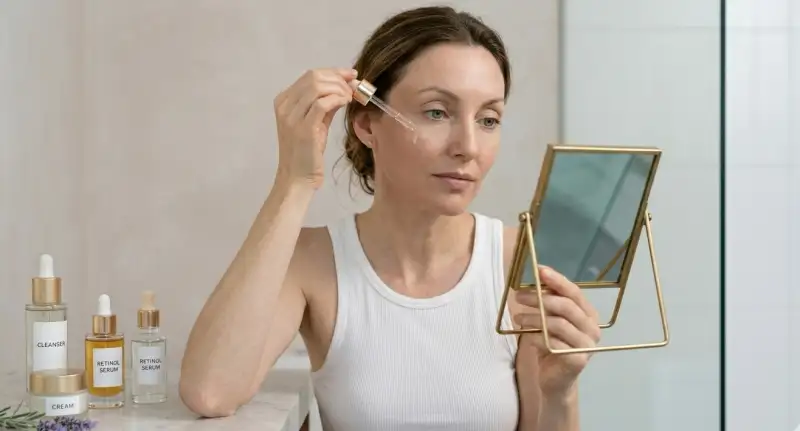
The science of skin aging is evolving rapidly — and for women navigating the skin changes that come with menopause and beyond, evidence-based skincare represents a fundamentally different approach: working with your skin's biology rather than against it.
Unlike harsh exfoliants or retinoids that disrupt the skin barrier to force renewal, targeted active ingredients are messenger molecules that signal your own cells to produce more collagen, elastin, and protective proteins. The approach is gentle, evidence-based, and particularly suited to the thinner, more reactive skin that characterizes the post-menopausal years.
Clinical Evidence for Both Forms and What It Means for Your Choice
The tretinoin versus retinol comparison for wrinkle treatment has been studied in multiple clinical trials, providing clear data on efficacy, timeline, and side effects for both forms. The short answer: tretinoin produces faster, more pronounced wrinkle reduction with more side effects. Retinol produces slower but meaningful wrinkle reduction with fewer side effects. Both produce significant improvement when used consistently — the best choice depends on your skin's tolerance, your timeline expectations, and your willingness to manage side effects.[1]
Efficacy comparison from clinical data: Tretinoin 0.025-0.05% — produces measurable increases in dermal collagen (confirmed by skin biopsy) within 12 weeks. Visible wrinkle reduction of 20-30% by week 12-16. Fine lines can reduce by up to 40% at 6 months. Maximum improvement reached at 12-18 months. Retinol 0.5-1% — produces measurable collagen increases within 24 weeks (approximately double the tretinoin timeline). Visible wrinkle reduction of 15-25% by week 16-24. Fine lines can reduce by up to 30% at 12 months. Maximum improvement reached at 18-24 months. The retinol results are approximately 60-70% of tretinoin results — meaningful but less dramatic.
Clinical research confirms that side effect comparison: Tretinoin — 60-80% of users experience retinoid dermatitis (redness, peeling, burning, dryness) during the first 4-8 weeks. Approximately 15-20% cannot tolerate it long enough to reach the adaptation phase where side effects subside. Photosensitivity is significant — missed SPF application after tretinoin can cause immediate visible sunburn. Retinol 0.5% — 15-25% of users experience mild irritation (transient dryness, light flaking) during the first 4-6 weeks. Less than 5% discontinue due to irritation. Photosensitivity is present but less pronounced than with tretinoin.
The strategic approach: Start with retinol if: you're new to retinoids, you have sensitive skin, you want minimal disruption to your routine, or you're using retinoids preventively. Start with tretinoin if: you have moderate-severe wrinkles requiring aggressive treatment, your skin has demonstrated high tolerance to retinol for 6+ months, or your dermatologist recommends it for your specific skin condition. The upgrade path: many women start with retinol 0.25%, build to retinol 1% over 6-12 months, then transition to tretinoin 0.025% (the lowest prescription concentration) if they want further improvement. This graduated approach builds the retinoid receptor capacity that allows tretinoin to work effectively with manageable side effects. The worst approach: starting with prescription tretinoin without retinoid receptor preparation — this produces maximum irritation and maximum dropout, achieving less long-term benefit than a patient, graduated retinol approach.
Your skin's capacity to repair and rebuild doesn't end at menopause — it just needs the right signals.
— Dr. Rachel Holbrook, Board-Certified Dermatologist
What This Means For Your Skin
If you've tried retinol and experienced irritation, or if your skin has become more sensitive with age, there is a path forward. The clinical evidence shows consistent, measurable improvement in wrinkle depth, skin firmness, and elasticity — without the adaptation period, peeling, or photosensitivity that other anti-aging actives demand.
Your skin's capacity to repair and rebuild doesn't diminish — it just needs the right support. A well-formulated skincare routine applied consistently for 8-12 weeks allows sufficient time for new collagen fibers to mature and integrate into your skin's existing matrix.
The science is clear. The evidence is consistent. The results are measurable.
What happens next is up to you.