
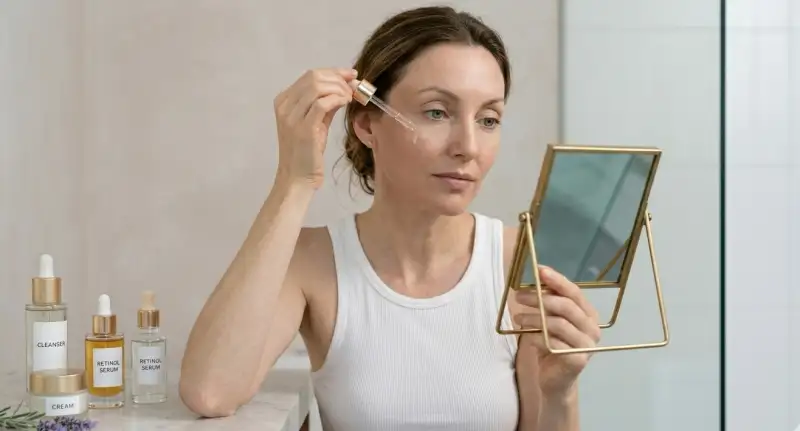
The science of skin aging is evolving rapidly — and for women navigating the skin changes that come with menopause and beyond, evidence-based skincare represents a fundamentally different approach: working with your skin's biology rather than against it.
Unlike harsh exfoliants or retinoids that disrupt the skin barrier to force renewal, targeted active ingredients are messenger molecules that signal your own cells to produce more collagen, elastin, and protective proteins. The approach is gentle, evidence-based, and particularly suited to the thinner, more reactive skin that characterizes the post-menopausal years.
When Skin Reactions Are Progress and When They're Problems
The distinction between retinol purging and a genuine breakout is one of the most important concepts for new retinol users because misidentifying a purge as a breakout leads to abandoning treatment that was actually working. Purging is a temporary acceleration of the skin's natural exfoliation cycle — retinol speeds cell turnover from the normal 28-day cycle to approximately 14-21 days, bringing pre-existing microcomedones (tiny, invisible clogged pores) to the surface faster than they would have emerged naturally. A breakout, by contrast, indicates that the product itself is causing new clogged pores through comedogenic ingredients or irritation-induced barrier damage.[1]
How to distinguish purging from breakout: PURGING characteristics — (1) Location: appears only in areas where you typically get blemishes. If you normally get occasional spots on your chin, purging appears on your chin. (2) Timeline: begins within the first 2-4 weeks of retinol use and resolves by week 6-8 as the backlog of microcomedones clears. (3) Lesion type: typically small whiteheads and closed comedones (the microcomedones being pushed to the surface). (4) Progression: the number of new lesions decreases each week — week 2 has more than week 1, but week 4 has fewer than week 3 as the microcomedone reservoir empties. (5) Resolution: each individual lesion heals faster than your typical blemishes because the accelerated cell turnover speeds healing.
Clinical research confirms that bREAKOUT characteristics — (1) Location: appears in areas where you don't typically get blemishes. New spots on the cheeks or forehead in someone who normally only breaks out on the chin suggests product-induced clogging, not purging. (2) Timeline: begins after 4-6 weeks of use (the comedogenic cycle takes 4-6 weeks from clogging to visible lesion) and does NOT resolve with continued use — it persists or worsens. (3) Lesion type: inflammatory cysts and papules (red, painful bumps) alongside comedones suggest irritation-induced breakout rather than microcomedone purging. (4) Progression: the number of new lesions increases or stays constant over weeks 4-8 rather than decreasing. (5) Resolution: individual lesions take as long or longer to heal than your typical blemishes.
What to do if you're purging: continue the retinol. The purge is evidence that the retinol is accelerating cell turnover — the exact mechanism that produces anti-aging benefits. Stopping during a purge means restarting the entire adaptation process later. Support the purging skin with: ceramide cream (barrier repair), niacinamide (anti-inflammatory), and spot treatment with salicylic acid on individual lesions if needed. What to do if you're breaking out: discontinue the retinol product specifically (not retinol in general) and evaluate whether the breakout is from the retinol concentration (too high, causing irritation) or from the vehicle (comedogenic ingredients in the cream base). Switch to a different retinol product with a non-comedogenic base and restart at a lower concentration. If breakouts recur with a different product at the same concentration, reduce concentration by half and rebuild tolerance more slowly.
Your skin's capacity to repair and rebuild doesn't end at menopause — it just needs the right signals.
— Dr. Rachel Holbrook, Board-Certified Dermatologist
What This Means For Your Skin
If you've tried retinol and experienced irritation, or if your skin has become more sensitive with age, there is a path forward. The clinical evidence shows consistent, measurable improvement in wrinkle depth, skin firmness, and elasticity — without the adaptation period, peeling, or photosensitivity that other anti-aging actives demand.
Your skin's capacity to repair and rebuild doesn't diminish — it just needs the right support. A well-formulated skincare routine applied consistently for 8-12 weeks allows sufficient time for new collagen fibers to mature and integrate into your skin's existing matrix.
The science is clear. The evidence is consistent. The results are measurable.
What happens next is up to you.