
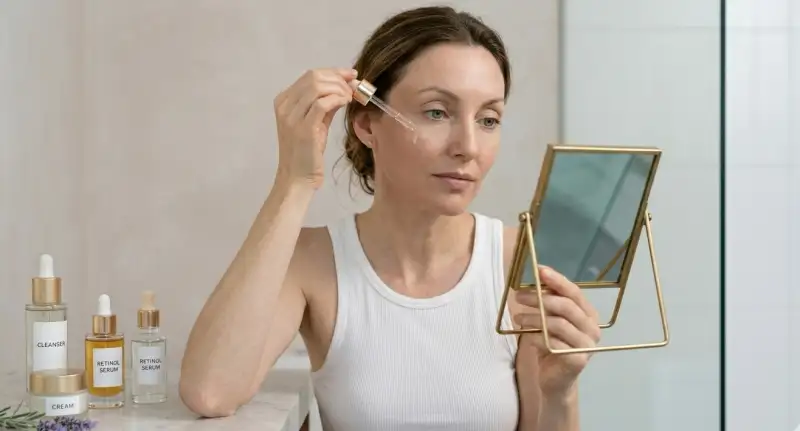
The science of skin aging is evolving rapidly — and for women navigating the skin changes that come with menopause and beyond, evidence-based skincare represents a fundamentally different approach: working with your skin's biology rather than against it.
Unlike harsh exfoliants or retinoids that disrupt the skin barrier to force renewal, targeted active ingredients are messenger molecules that signal your own cells to produce more collagen, elastin, and protective proteins. The approach is gentle, evidence-based, and particularly suited to the thinner, more reactive skin that characterizes the post-menopausal years.
Extending Retinol Treatment Below the Jawline Without Irritation
The neck and décolleté are among the most visibly aging areas of the body — yet most women apply their retinol only to the face, stopping at the jawline. This creates a visible disconnect: retinol-treated facial skin that looks younger adjacent to untreated neck and chest skin that looks its full age. Extending retinol to the neck and chest addresses this age gap — but these areas require a modified approach because their skin has different characteristics than facial skin.[1]
Why neck and chest skin requires different retinol treatment: (1) The neck skin is approximately 30% thinner than facial skin, with fewer sebaceous glands and a less robust barrier. It absorbs retinol faster and is more irritation-prone. (2) The chest (décolleté) skin is thinner still, has been chronically sun-exposed (years of V-neck necklines), and has less subcutaneous fat cushioning. Photoaging is typically more advanced on the chest than the face because the chest receives direct UV that the face partially avoids through hats, sunglasses, and instinctive shading. (3) Both areas have less natural oil production, meaning the barrier is more easily disrupted and TEWL is higher — creating a more hostile environment for retinol-induced irritation.
Clinical research confirms that the safe retinol protocol for neck and chest: Use a concentration 50% lower than your facial retinol — if you tolerate 0.5% on the face, use 0.25% on the neck and chest. Apply to the neck 2 nights per week initially (even if you use retinol nightly on the face), building to every other night over 8 weeks. Always use the sandwich method on the neck and chest — these thinner-skinned areas benefit from the buffered delivery even after your face has graduated to direct application. Apply with downward strokes on the neck (upward strokes create friction against the natural skin direction) and gentle pressing on the chest.
Common mistakes when using retinol on the neck and chest: (1) Using facial-strength retinol — the thinner skin absorbs more per unit area, creating an effective concentration higher than intended. (2) Forgetting barrier support — apply ceramide cream MORE generously on the neck and chest than on the face. (3) Skipping SPF on the chest — many women apply facial SPF but forget the décolleté, allowing UV-induced MMP activation to undermine the retinol's collagen-building work. (4) Starting neck and chest retinol simultaneously with facial retinol — always establish facial tolerance first (at least 3 months), then extend to the neck, then to the chest. Treating all three zones simultaneously multiplies the irritation surface area. Results timeline for neck and chest: expect slower visible improvement than the face because the starting point is typically more damaged (more severe photoaging) and the skin has fewer fibroblasts per unit area. Visible improvement in neck texture by month 3-4, chest texture by month 4-6, measurable wrinkle softening by month 6-12.
Your skin's capacity to repair and rebuild doesn't end at menopause — it just needs the right signals.
— Dr. Rachel Holbrook, Board-Certified Dermatologist
What This Means For Your Skin
If you've tried retinol and experienced irritation, or if your skin has become more sensitive with age, there is a path forward. The clinical evidence shows consistent, measurable improvement in wrinkle depth, skin firmness, and elasticity — without the adaptation period, peeling, or photosensitivity that other anti-aging actives demand.
Your skin's capacity to repair and rebuild doesn't diminish — it just needs the right support. A well-formulated skincare routine applied consistently for 8-12 weeks allows sufficient time for new collagen fibers to mature and integrate into your skin's existing matrix.
The science is clear. The evidence is consistent. The results are measurable.
What happens next is up to you.