
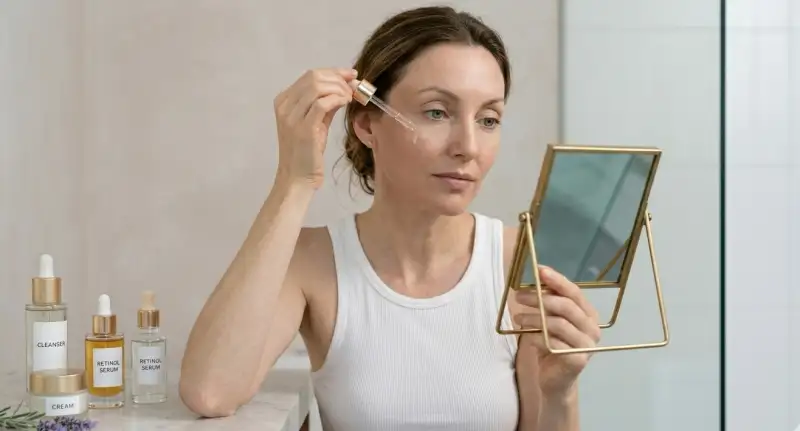
The science of skin aging is evolving rapidly — and for women navigating the skin changes that come with menopause and beyond, evidence-based skincare represents a fundamentally different approach: working with your skin's biology rather than against it.
Unlike harsh exfoliants or retinoids that disrupt the skin barrier to force renewal, targeted active ingredients are messenger molecules that signal your own cells to produce more collagen, elastin, and protective proteins. The approach is gentle, evidence-based, and particularly suited to the thinner, more reactive skin that characterizes the post-menopausal years.
The Exact Application Sequence for Maximum Results
The step-by-step sequence of a retinol night routine matters more than most users realize — the wrong order can either reduce retinol penetration (applying it over thick moisturizer) or increase irritation (applying it to damp, freshly exfoliated skin). The optimal sequence balances three competing needs: maximize retinol delivery to the dermis, minimize irritation risk, and maintain overnight hydration that supports the collagen-building process.[1]
The complete retinol night routine: Step 1 — Cleanse gently (60 seconds). Use a cream or oil cleanser, never a foaming or gel cleanser on retinol nights. Foaming cleansers strip barrier lipids that protect against retinol irritation. Rinse with lukewarm water — hot water increases skin permeability and can amplify retinol irritation. Step 2 — Dry completely (2-3 minutes). Pat the face dry with a clean towel, then wait 2-3 additional minutes. Retinol applied to damp skin absorbs 40-60% faster than on dry skin — this sounds beneficial but actually overwhelms the retinoid receptor system, causing the concentrated burst of retinoic acid conversion that triggers irritation. Dry skin provides controlled, even absorption.
Clinical research confirms that step 3 — Apply retinol (for beginners, use the sandwich method: thin ceramide cream first, wait 1 minute, then retinol, then ceramide cream. For experienced users: retinol directly on dry skin). Use a pea-sized amount for the full face. Apply in dots — one on each cheek, one on the forehead, one on the chin — then blend outward with gentle pressing motions. Avoid the eye corners, nostrils, and lip corners where the skin is thinnest and most irritation-prone. Step 4 — Wait 5-10 minutes. Allow the retinol to absorb before applying the next layer. This absorption window ensures the retinol makes direct contact with the skin surface without being diluted by the next product.
Step 5 — Apply HA serum (if using). Press HA serum over the absorbed retinol. The HA now serves as a moisture-locking layer over the retinol, not a barrier to it — the retinol has already been absorbed during the waiting period. Step 6 — Apply ceramide night cream generously. This is your overnight seal — it prevents TEWL, delivers barrier-repairing ceramides, and maintains the hydrated environment that supports retinol's collagen-stimulating activity throughout the night. Apply more thickly on retinol nights than non-retinol nights. Step 7 — Eye cream (separate, retinol-free for beginners). The periorbital area is 3-4x more absorbent than the cheeks — dedicated eye cream with peptides and ceramides provides appropriate treatment without the irritation risk of facial retinol migrating to the eye area. Step 8 — Lip balm with ceramides on the lip border. Total routine time: 8-12 minutes including wait times. The morning after: cleanse gently, apply vitamin C serum, apply SPF 50. The morning-after SPF is non-negotiable — retinol-treated skin is photosensitive for 24-48 hours.
Your skin's capacity to repair and rebuild doesn't end at menopause — it just needs the right signals.
— Dr. Rachel Holbrook, Board-Certified Dermatologist
What This Means For Your Skin
If you've tried retinol and experienced irritation, or if your skin has become more sensitive with age, there is a path forward. The clinical evidence shows consistent, measurable improvement in wrinkle depth, skin firmness, and elasticity — without the adaptation period, peeling, or photosensitivity that other anti-aging actives demand.
Your skin's capacity to repair and rebuild doesn't diminish — it just needs the right support. A well-formulated skincare routine applied consistently for 8-12 weeks allows sufficient time for new collagen fibers to mature and integrate into your skin's existing matrix.
The science is clear. The evidence is consistent. The results are measurable.
What happens next is up to you.