
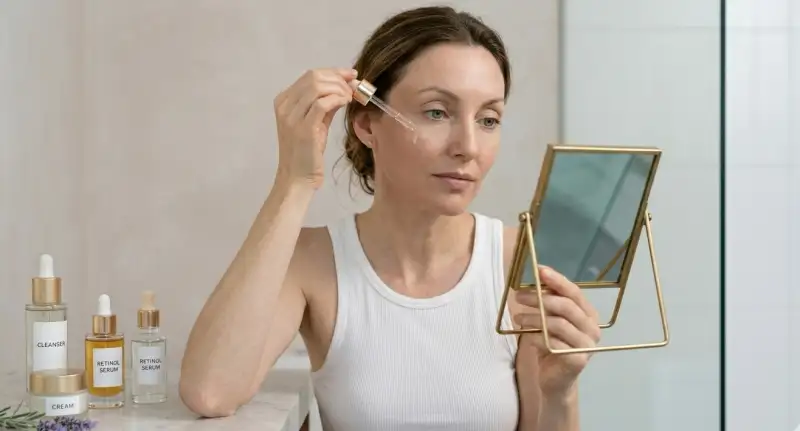
The science of skin aging is evolving rapidly — and for women navigating the skin changes that come with menopause and beyond, evidence-based skincare represents a fundamentally different approach: working with your skin's biology rather than against it.
Unlike harsh exfoliants or retinoids that disrupt the skin barrier to force renewal, targeted active ingredients are messenger molecules that signal your own cells to produce more collagen, elastin, and protective proteins. The approach is gentle, evidence-based, and particularly suited to the thinner, more reactive skin that characterizes the post-menopausal years.
Why Sequence Matters for Both Efficacy and Tolerance
The layering order of retinol and hyaluronic acid is not merely a cosmetic preference — it directly affects both the penetration rate of retinol (determining efficacy and irritation risk) and the hydration delivery of HA (determining how effectively it plumps fine lines). The correct order depends on your retinol tolerance level, because the same sequence that optimizes efficacy for experienced users can cause irritation in beginners.[1]
For retinol beginners and sensitive skin (using retinol < 6 months): Layer 1 — HA serum on damp skin. Layer 2 — Wait 2-3 minutes for HA absorption. Layer 3 — Retinol over the HA layer. Layer 4 — Ceramide cream as seal. Rationale: the HA layer creates a hydrated buffer between the skin surface and the retinol, slowing retinol penetration and reducing the concentration that reaches the dermis per unit time. This buffering effect reduces irritation while still allowing retinol to penetrate — it's the mechanism behind the popular 'retinol sandwich' technique. The HA simultaneously provides the hydrated environment that supports the retinol's collagen-stimulating activity once it reaches the dermis.
Clinical research confirms that for experienced retinol users (tolerating retinol nightly for 6+ months): Layer 1 — Retinol on clean, dry skin. Layer 2 — Wait 5-10 minutes for retinol absorption. Layer 3 — HA serum over the retinol. Layer 4 — Ceramide cream as seal. Rationale: applying retinol directly to clean, dry skin maximizes penetration rate and dermal concentration — experienced users' upregulated retinoid receptors can handle this higher delivery rate without irritation. The HA applied afterward serves a different purpose: it locks moisture into the stratum corneum OVER the absorbed retinol, preventing the overnight TEWL that dehydrates the dermis and reduces retinol efficacy.
The common mistake: applying HA and retinol simultaneously (mixed in the palm). This creates an inconsistent dilution that delivers retinol unevenly — some areas receive concentrated retinol (potential irritation spots) while others receive heavily diluted retinol (reduced efficacy). Always apply sequentially with a waiting period between layers. The HA molecular weight matters: low molecular weight HA (< 50 kDa) penetrates deeper and provides dermal hydration that supports retinol activity. High molecular weight HA (> 1,000 kDa) stays on the surface and provides occlusive moisture retention. Multi-weight HA formulations provide both benefits. For retinol users, a multi-weight HA serum is optimal because it simultaneously supports the retinol working environment in the dermis (low MW) and prevents surface dehydration (high MW) that makes retinol-treated skin feel dry and tight.
Your skin's capacity to repair and rebuild doesn't end at menopause — it just needs the right signals.
— Dr. Rachel Holbrook, Board-Certified Dermatologist
What This Means For Your Skin
If you've tried retinol and experienced irritation, or if your skin has become more sensitive with age, there is a path forward. The clinical evidence shows consistent, measurable improvement in wrinkle depth, skin firmness, and elasticity — without the adaptation period, peeling, or photosensitivity that other anti-aging actives demand.
Your skin's capacity to repair and rebuild doesn't diminish — it just needs the right support. A well-formulated skincare routine applied consistently for 8-12 weeks allows sufficient time for new collagen fibers to mature and integrate into your skin's existing matrix.
The science is clear. The evidence is consistent. The results are measurable.
What happens next is up to you.