
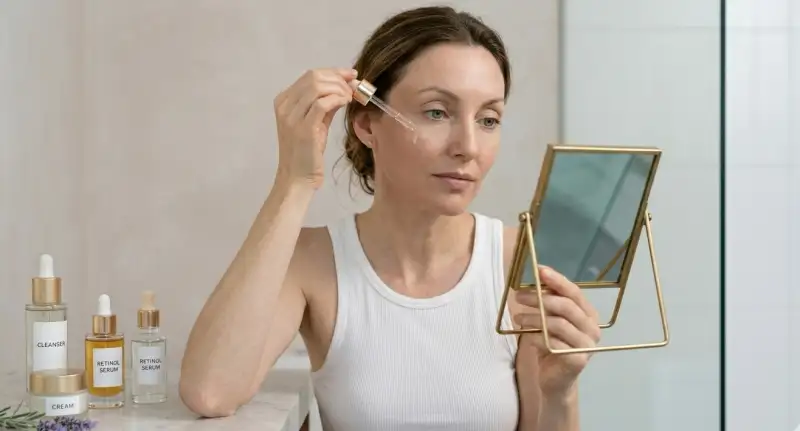
The science of skin aging is evolving rapidly — and for women navigating the skin changes that come with menopause and beyond, evidence-based skincare represents a fundamentally different approach: working with your skin's biology rather than against it.
Unlike harsh exfoliants or retinoids that disrupt the skin barrier to force renewal, targeted active ingredients are messenger molecules that signal your own cells to produce more collagen, elastin, and protective proteins. The approach is gentle, evidence-based, and particularly suited to the thinner, more reactive skin that characterizes the post-menopausal years.
The Evidence Behind the Most Debated Ingredient Combination
The advice to never use retinol and vitamin C together originated from a legitimate but now outdated concern: L-ascorbic acid (vitamin C) requires a pH of 2.5-3.5 for stability and penetration, while retinol is most stable at pH 5.5-6.0. In theory, combining them creates a pH conflict where neither ingredient operates optimally. However, modern formulations and application strategies have resolved this conflict. The current dermatological consensus: retinol and vitamin C can be used together effectively — but the method of combination matters.[1]
Strategy 1 — Time separation (most conservative): Apply vitamin C serum in the morning (provides antioxidant UV defense + collagen cofactor) and retinol at night (provides retinoid receptor activation during peak repair). This approach completely eliminates the pH conflict because the ingredients never occupy the same application window. Each ingredient operates at its optimal pH in its optimal biological window. This is the simplest and most widely recommended approach. Strategy 2 — Sequential evening application (moderate): Apply vitamin C serum first, wait 20-30 minutes for full absorption and pH normalization, then apply retinol. By the time retinol is applied, the vitamin C has been absorbed and the skin surface pH has returned toward neutral, eliminating the direct pH conflict.
Clinical research confirms that strategy 3 — Combined formulation (advanced): Some modern formulations encapsulate retinol in pH-buffered delivery systems that protect it from the acidic environment of L-ascorbic acid. These combined serums are formulated to release each ingredient at different depths and timepoints, avoiding the pH conflict at the molecular level. These products are generally more expensive but provide the convenience of single-application delivery. The biological case for using both: vitamin C and retinol stimulate collagen through completely different pathways. Retinol activates retinoid receptors (RAR/RXR) that upregulate collagen gene transcription. Vitamin C provides the ascorbic acid cofactor that prolyl hydroxylase requires to stabilize newly formed collagen triple helices. Without vitamin C, the collagen that retinol stimulates cannot assemble into stable fibers.
The practical recommendation for aging skin: use both ingredients, but start with Strategy 1 (morning vitamin C, evening retinol) for simplicity and proven efficacy. This approach provides: morning — antioxidant defense (vitamin C neutralizes UV-generated free radicals) + collagen cofactor supply + brightening. Evening — retinoid receptor activation (retinol stimulates collagen gene transcription) + accelerated cell turnover + wrinkle reduction. The combined 24-hour protocol delivers more collagen-building benefit than either ingredient alone because it activates two independent production pathways and provides both the stimulus (retinol) and the cofactor (vitamin C) that the collagen assembly process requires. Women who use both ingredients consistently for 6+ months see significantly better results than those using either one alone.
Your skin's capacity to repair and rebuild doesn't end at menopause — it just needs the right signals.
— Dr. Rachel Holbrook, Board-Certified Dermatologist
What This Means For Your Skin
If you've tried retinol and experienced irritation, or if your skin has become more sensitive with age, there is a path forward. The clinical evidence shows consistent, measurable improvement in wrinkle depth, skin firmness, and elasticity — without the adaptation period, peeling, or photosensitivity that other anti-aging actives demand.
Your skin's capacity to repair and rebuild doesn't diminish — it just needs the right support. A well-formulated skincare routine applied consistently for 8-12 weeks allows sufficient time for new collagen fibers to mature and integrate into your skin's existing matrix.
The science is clear. The evidence is consistent. The results are measurable.
What happens next is up to you.