
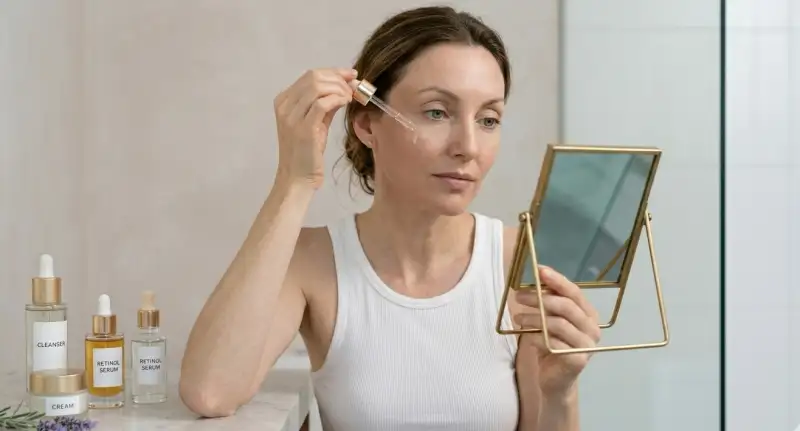
The science of skin aging is evolving rapidly — and for women navigating the skin changes that come with menopause and beyond, evidence-based skincare represents a fundamentally different approach: working with your skin's biology rather than against it.
Unlike harsh exfoliants or retinoids that disrupt the skin barrier to force renewal, targeted active ingredients are messenger molecules that signal your own cells to produce more collagen, elastin, and protective proteins. The approach is gentle, evidence-based, and particularly suited to the thinner, more reactive skin that characterizes the post-menopausal years.
Why This Combination Is Not Only Safe but Synergistic
The concern about combining retinol and niacinamide originated from a single in-vitro study showing that nicotinic acid (NOT niacinamide) could react with retinoic acid under specific laboratory conditions. This finding was misinterpreted and spread through beauty media as a warning against combining the two ingredients. The dermatological reality: niacinamide and retinol are not only safe to use together — they are one of the most beneficial ingredient combinations in anti-aging skincare. Multiple clinical studies have confirmed their compatibility and synergy.[1]
The synergistic benefits of combining niacinamide with retinol: (1) Irritation reduction — niacinamide's anti-inflammatory properties (it inhibits IL-8 and TNF-α production) directly counteract the inflammatory component of retinol irritation. Women who apply niacinamide alongside or before retinol experience 30-40% less irritation than those using retinol alone. This is why many dermatologists recommend niacinamide as the first-line retinol tolerance enhancer. (2) Barrier support — niacinamide stimulates ceramide synthesis in the epidermis, strengthening the skin barrier that retinol can compromise. A stronger barrier means better moisture retention and reduced TEWL — both of which support retinol's collagen-building activity.
Clinical research confirms that (3) Complementary collagen stimulation — niacinamide stimulates collagen production through the NAD+ pathway, which is independent of retinol's retinoid receptor pathway. Using both ingredients simultaneously activates two independent collagen production mechanisms, producing additive results. (4) Hyperpigmentation defense — both ingredients reduce melanin transfer (retinol through cell turnover acceleration, niacinamide through melanosome transfer inhibition), making their combination particularly effective for age spots and uneven skin tone. (5) Antioxidant protection — niacinamide provides antioxidant defense that protects the retinol-stimulated collagen from oxidative degradation.
How to combine retinol and niacinamide: Method 1 (simplest) — Use a moisturizer or serum containing 3-5% niacinamide as your base layer, then apply retinol over it. The niacinamide layer provides both its active benefits and a buffering medium that moderates retinol penetration. Method 2 — Apply niacinamide serum in the morning, retinol at night. This provides niacinamide's barrier-supporting benefits throughout the day and retinol's collagen stimulation at night. Method 3 — Use a formulation that contains both ingredients. Many modern retinol products include niacinamide specifically for its synergistic benefits. All three methods are effective and safe. The combination is suitable for all skin types, including sensitive skin — in fact, niacinamide's irritation-reducing properties make it especially valuable for sensitive skin types who struggle with retinol tolerance.
Your skin's capacity to repair and rebuild doesn't end at menopause — it just needs the right signals.
— Dr. Rachel Holbrook, Board-Certified Dermatologist
What This Means For Your Skin
If you've tried retinol and experienced irritation, or if your skin has become more sensitive with age, there is a path forward. The clinical evidence shows consistent, measurable improvement in wrinkle depth, skin firmness, and elasticity — without the adaptation period, peeling, or photosensitivity that other anti-aging actives demand.
Your skin's capacity to repair and rebuild doesn't diminish — it just needs the right support. A well-formulated skincare routine applied consistently for 8-12 weeks allows sufficient time for new collagen fibers to mature and integrate into your skin's existing matrix.
The science is clear. The evidence is consistent. The results are measurable.
What happens next is up to you.