
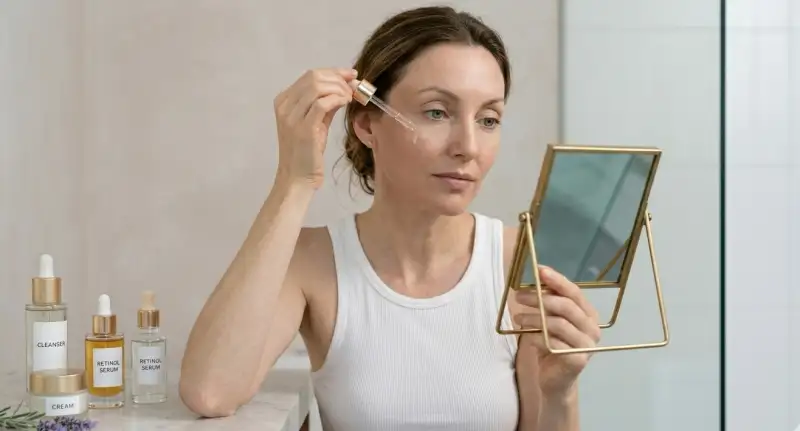
The science of skin aging is evolving rapidly — and for women navigating the skin changes that come with menopause and beyond, evidence-based skincare represents a fundamentally different approach: working with your skin's biology rather than against it.
Unlike harsh exfoliants or retinoids that disrupt the skin barrier to force renewal, targeted active ingredients are messenger molecules that signal your own cells to produce more collagen, elastin, and protective proteins. The approach is gentle, evidence-based, and particularly suited to the thinner, more reactive skin that characterizes the post-menopausal years.
Dual-Pathway Collagen Stimulation for Maximum Anti-Aging Results
Retinol and peptides are the two most effective topical collagen stimulators available — and they work through completely independent biological pathways, making their combination additive rather than redundant. Retinol activates collagen production through retinoid acid receptors (RAR/RXR) on fibroblasts, directly upregulating collagen gene transcription. Peptides (Matrixyl 3000) stimulate collagen production through TGF-β growth factor signaling, a pathway that operates independently of retinoid receptors. Using both means two separate cellular 'instructions' are telling fibroblasts to produce collagen simultaneously — and fibroblasts respond to both signals, producing more total collagen than either signal alone.[1]
The optimal combination strategy: use peptides in the morning AND evening, and retinol in the evening only. Morning routine — vitamin C serum (collagen cofactor) → peptide cream (TGF-β pathway activation) → SPF. The morning peptide application provides daytime collagen stimulation through the growth factor pathway. Evening routine — retinol (retinoid receptor pathway activation) → peptide cream (growth factor pathway activation) → ceramide night cream. The evening peptide application layered over retinol means both pathways are activated simultaneously during the nocturnal repair window when fibroblast activity peaks.
Clinical research confirms that the layering order matters: apply retinol FIRST (it needs direct skin contact for optimal absorption through the stratum corneum), wait 5-10 minutes for absorption, then apply peptide cream OVER the retinol. The peptide cream serves a dual purpose: it delivers its own active signaling AND it creates a moisture-retaining layer over the absorbed retinol that supports overnight hydration. Some formulations combine retinol and peptides in a single product — these are convenient but may contain lower concentrations of each ingredient compared to separate, dedicated products.
The clinical advantage of the combination: a study comparing retinol alone, peptides alone, and the retinol+peptide combination found that the combination group showed approximately 30% greater improvement in wrinkle depth and skin firmness at 12 weeks compared to either ingredient used alone. The mechanism is straightforward: two independent production signals activate two independent cellular response pathways, and the total output is the sum of both responses minus any diminishing returns from fibroblast production capacity limits. For women over 40 who want the maximum topical anti-aging benefit, the retinol+peptide combination represents the most effective evidence-based approach available without prescription. Adding vitamin C as a morning cofactor creates a three-pathway protocol (retinoid + growth factor + enzymatic cofactor) that approaches the ceiling of what topical products can achieve for collagen stimulation.
Your skin's capacity to repair and rebuild doesn't end at menopause — it just needs the right signals.
— Dr. Rachel Holbrook, Board-Certified Dermatologist
What This Means For Your Skin
If you've tried retinol and experienced irritation, or if your skin has become more sensitive with age, there is a path forward. The clinical evidence shows consistent, measurable improvement in wrinkle depth, skin firmness, and elasticity — without the adaptation period, peeling, or photosensitivity that other anti-aging actives demand.
Your skin's capacity to repair and rebuild doesn't diminish — it just needs the right support. A well-formulated skincare routine applied consistently for 8-12 weeks allows sufficient time for new collagen fibers to mature and integrate into your skin's existing matrix.
The science is clear. The evidence is consistent. The results are measurable.
What happens next is up to you.