
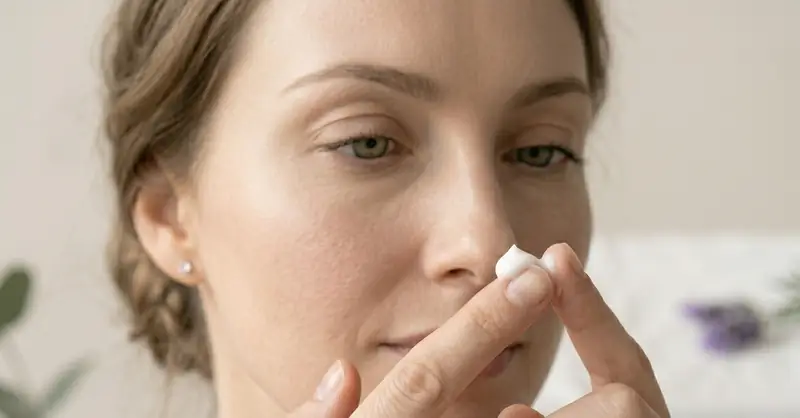
The science of skin aging is evolving rapidly — and for women navigating the skin changes that come with menopause and beyond, evidence-based skincare represents a fundamentally different approach: working with your skin's biology rather than against it.
Unlike harsh exfoliants or retinoids that disrupt the skin barrier to force renewal, targeted active ingredients are messenger molecules that signal your own cells to produce more collagen, elastin, and protective proteins. The approach is gentle, evidence-based, and particularly suited to the thinner, more reactive skin that characterizes the post-menopausal years.
Gentle Formulations That Deliver Results Without Reactions
Sensitive skin and retinol have a complicated relationship — but it's not the impossibility that many women believe. Sensitive skin reacts to retinol more intensely because its barrier is already compromised: fewer ceramides, higher transepidermal water loss, and elevated baseline inflammation mean that the additional stress of retinoid-induced cell turnover acceleration pushes an already-stressed system past its tolerance threshold. The solution isn't to avoid retinol entirely (forfeiting its unmatched anti-aging benefits) but to choose formulations specifically engineered to deliver retinol below the irritation threshold of sensitive skin.[1]
The three formulation features that make a retinol cream suitable for sensitive skin: (1) Encapsulated retinol — the retinol molecules are enclosed in a lipid or polymer shell that breaks down slowly on the skin surface, creating time-released delivery that avoids the concentration spike that triggers irritation. Encapsulated retinol produces significantly less irritation than free retinol at equivalent total doses. (2) Built-in barrier support — the cream base contains ceramides, niacinamide, and/or centella asiatica (cica) that actively strengthen the barrier while the retinol accelerates cell turnover. These counter-balancing ingredients offset retinol's temporary barrier-disrupting effect. (3) Cream vehicle (not serum) — cream formulations contain lipids that moderate retinol penetration rate, similar to the sandwich method. Retinol serums in water-based or alcohol-containing vehicles penetrate faster and cause more irritation.
Clinical research confirms that the retinol alternatives for extremely sensitive skin that cannot tolerate any retinol concentration: retinyl palmitate (the gentlest retinoid, 2-step conversion, minimal irritation potential — use as a starting point before attempting retinol), bakuchiol (a plant-derived retinol alternative that activates some retinoid receptor pathways without the irritation cascade — studies show anti-aging effects at 0.5% concentration, though weaker than retinol), and retinaldehyde at very low concentration (0.01-0.05% — paradoxically, retinaldehyde can be better tolerated than retinol on sensitive skin because it requires only one conversion step, producing a more predictable and controlled retinoic acid release).
The sensitive skin retinol introduction protocol: use the sandwich method from day one (non-negotiable for sensitive skin). Start at 0.1% retinol (lower than the standard 0.25% beginner recommendation). Apply once per week for the first two weeks — yes, once per week. Increase to twice per week for weeks 3-4. Then every third night for weeks 5-8. This ultra-gradual escalation gives sensitive skin 4x more adaptation time than standard protocols. If any phase produces more than mild, transient pinkness, remain at that frequency for an additional 3 weeks before attempting to increase. Many sensitive-skin women plateau at every-third-night application — and at this frequency, retinol still produces meaningful anti-aging results over 6-12 months. Frequency matters less than consistency.
Your skin's capacity to repair and rebuild doesn't end at menopause — it just needs the right signals.
— Dr. Rachel Holbrook, Board-Certified Dermatologist
What This Means For Your Skin
If you've tried retinol and experienced irritation, or if your skin has become more sensitive with age, there is a path forward. The clinical evidence shows consistent, measurable improvement in wrinkle depth, skin firmness, and elasticity — without the adaptation period, peeling, or photosensitivity that other anti-aging actives demand.
Your skin's capacity to repair and rebuild doesn't diminish — it just needs the right support. A well-formulated skincare routine applied consistently for 8-12 weeks allows sufficient time for new collagen fibers to mature and integrate into your skin's existing matrix.
The science is clear. The evidence is consistent. The results are measurable.
What happens next is up to you.