
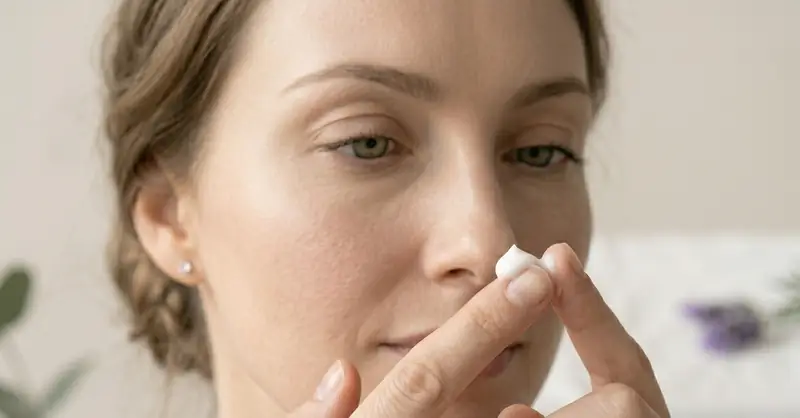
The science of skin aging is evolving rapidly — and for women navigating the skin changes that come with menopause and beyond, evidence-based skincare represents a fundamentally different approach: working with your skin's biology rather than against it.
Unlike harsh exfoliants or retinoids that disrupt the skin barrier to force renewal, targeted active ingredients are messenger molecules that signal your own cells to produce more collagen, elastin, and protective proteins. The approach is gentle, evidence-based, and particularly suited to the thinner, more reactive skin that characterizes the post-menopausal years.
The AM/PM Split That Makes Both Ingredients Work Better
The retinol-vitamin C combination question has generated more confusion than almost any other skincare topic — partly because the answer has evolved as formulation chemistry advanced. The traditional advice ('never mix them') was based on valid chemistry: vitamin C (L-ascorbic acid) requires a low pH (2.5-3.5) for stability and penetration, while retinol works optimally at a slightly higher pH (5.5-6.5). Applying both at the same pH compromises one or both ingredients. However, this doesn't mean they can't be used in the same routine — it means they shouldn't be applied in the same step.[1]
The AM/PM split is the dermatologist-recommended approach that maximizes both ingredients: Vitamin C in the morning — L-ascorbic acid provides UV defense (neutralizes free radicals generated by sun exposure), brightens skin tone, and inhibits tyrosinase (reducing dark spot formation). All of these functions are most valuable during daytime UV exposure. Retinol in the evening — retinol increases UV sensitivity (making daytime application counterproductive) and works optimally during the skin's nighttime repair cycle when cell turnover and collagen synthesis are naturally elevated. The AM/PM split isn't a compromise — it's actually the optimal scheduling for both ingredients.
Clinical research confirms that the synergy between vitamin C and retinol when used in an AM/PM split: vitamin C's morning application creates a reservoir of antioxidant protection that lasts approximately 72 hours in the skin, providing ongoing UV defense even during retinol-induced photosensitivity. Meanwhile, retinol's collagen-stimulating effect requires vitamin C as a cofactor — the prolyl hydroxylase and lysyl hydroxylase enzymes that stabilize newly formed collagen fibers are vitamin C-dependent. By maintaining consistent vitamin C levels in the skin (morning application), you ensure that the collagen stimulated by retinol (evening application) is properly assembled and functional. They're not just compatible — they're complementary.
The exception to the separation rule: newer formulations using retinol derivatives (retinyl palmitate, retinol encapsulated in cyclodextrins) and stabilized vitamin C derivatives (ascorbyl glucoside, sodium ascorbyl phosphate) are pH-compatible and can theoretically be combined in the same application. Several products now contain both ingredients in a single formula. However, for beginners — especially those over 40 with sensitive or barrier-compromised skin — the AM/PM split remains the safest approach. Combining both active ingredients in one application doubles the irritation potential at a stage when the skin is still building retinol tolerance. Once tolerance is established (after 3+ months of consistent retinol use), a combined product can be considered if desired for routine simplification.
Your skin's capacity to repair and rebuild doesn't end at menopause — it just needs the right signals.
— Dr. Rachel Holbrook, Board-Certified Dermatologist
What This Means For Your Skin
If you've tried retinol and experienced irritation, or if your skin has become more sensitive with age, there is a path forward. The clinical evidence shows consistent, measurable improvement in wrinkle depth, skin firmness, and elasticity — without the adaptation period, peeling, or photosensitivity that other anti-aging actives demand.
Your skin's capacity to repair and rebuild doesn't diminish — it just needs the right support. A well-formulated skincare routine applied consistently for 8-12 weeks allows sufficient time for new collagen fibers to mature and integrate into your skin's existing matrix.
The science is clear. The evidence is consistent. The results are measurable.
What happens next is up to you.