
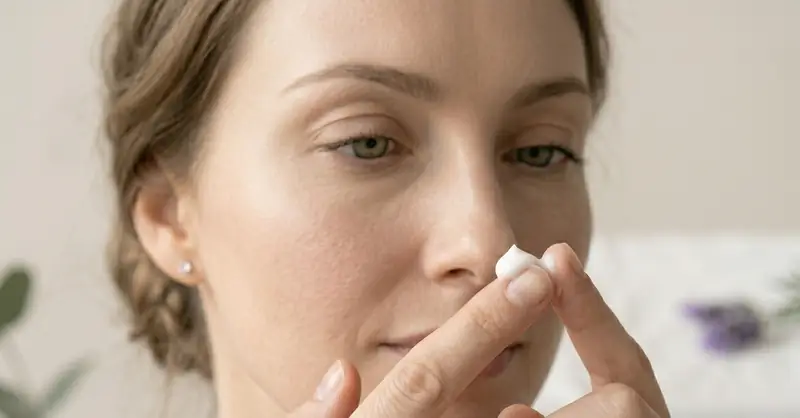
The science of skin aging is evolving rapidly — and for women navigating the skin changes that come with menopause and beyond, evidence-based skincare represents a fundamentally different approach: working with your skin's biology rather than against it.
Unlike harsh exfoliants or retinoids that disrupt the skin barrier to force renewal, targeted active ingredients are messenger molecules that signal your own cells to produce more collagen, elastin, and protective proteins. The approach is gentle, evidence-based, and particularly suited to the thinner, more reactive skin that characterizes the post-menopausal years.
Application Sequence That Maximizes Efficacy and Comfort
The layering order of retinol and moisturizer is not a matter of preference — it's a functional decision that significantly affects both the efficacy and tolerance of your retinol treatment. The two viable approaches (retinol first vs. moisturizer first) produce measurably different outcomes in terms of retinol penetration depth, retinoic acid concentration at the dermal level, and irritation severity. Understanding the physics of each approach allows you to choose the sequence that matches your skin's current tolerance level.[1]
Approach 1 — Retinol on bare skin, then moisturizer (experienced users): applying retinol directly to clean, dry skin provides maximum penetration. Without any barrier between the retinol and the stratum corneum, the active ingredient moves efficiently through the lipid bilayers to reach the dermis where it activates fibroblast receptors. Moisturizer applied afterward serves as an occlusive seal that enhances the retinol's contact time and prevents it from evaporating or transferring to the pillowcase. This approach delivers approximately 100% of the retinol's potential efficacy — but also 100% of its irritation potential. Recommended only for women who have completed the 6-8 week tolerance-building phase without significant irritation.
Clinical research confirms that approach 2 — Moisturizer first, then retinol, then moisturizer (beginners / sandwich method): applying ceramide moisturizer before retinol creates a buffering layer that slows retinol penetration. The retinol must diffuse through the moisturizer to reach the skin, which extends the absorption timeline from 15 minutes to 2-4 hours. This time-released delivery reduces peak retinoic acid concentration at the epidermis by approximately 30-40%, significantly reducing irritation. The second moisturizer layer on top completes the sandwich, providing additional buffering and occlusion. Total retinol reaching the dermis is reduced by only 15% compared to bare-skin application — a minimal sacrifice for dramatically improved comfort.
The universal rules regardless of layering approach: (1) Wait 5-10 minutes after cleansing before applying anything — freshly cleansed skin has elevated permeability that increases irritation risk with all application orders. (2) Apply retinol to fully dry skin — residual water on the skin surface increases retinol penetration unpredictably and can cause localized concentration spikes that produce uneven irritation. (3) Use a pea-sized amount for the entire face — more product does not mean more results but does mean more irritation. (4) Avoid the eye area, lip borders, nose creases, and neck unless using an eye-specific retinol product — these areas have thinner skin and absorb more retinol than the cheeks and forehead. (5) Apply SPF 30+ the next morning — non-negotiable regardless of layering order.
Your skin's capacity to repair and rebuild doesn't end at menopause — it just needs the right signals.
— Dr. Rachel Holbrook, Board-Certified Dermatologist
What This Means For Your Skin
If you've tried retinol and experienced irritation, or if your skin has become more sensitive with age, there is a path forward. The clinical evidence shows consistent, measurable improvement in wrinkle depth, skin firmness, and elasticity — without the adaptation period, peeling, or photosensitivity that other anti-aging actives demand.
Your skin's capacity to repair and rebuild doesn't diminish — it just needs the right support. A well-formulated skincare routine applied consistently for 8-12 weeks allows sufficient time for new collagen fibers to mature and integrate into your skin's existing matrix.
The science is clear. The evidence is consistent. The results are measurable.
What happens next is up to you.