
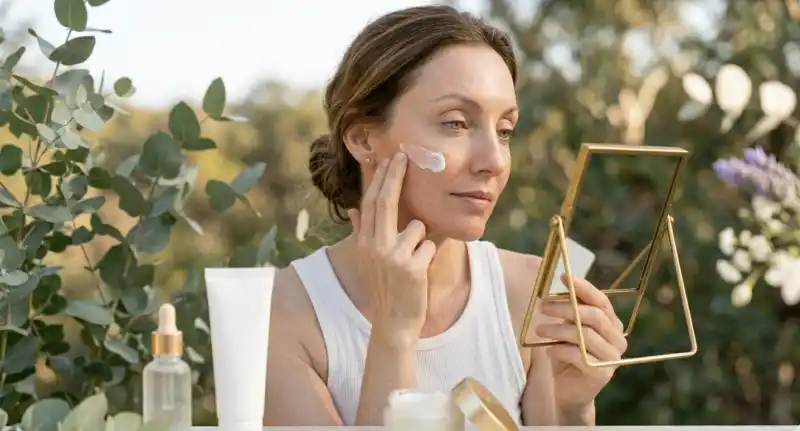
The science of skin aging is evolving rapidly — and for women navigating the skin changes that come with menopause and beyond, evidence-based skincare represents a fundamentally different approach: working with your skin's biology rather than against it.
Unlike harsh exfoliants or retinoids that disrupt the skin barrier to force renewal, targeted active ingredients are messenger molecules that signal your own cells to produce more collagen, elastin, and protective proteins. The approach is gentle, evidence-based, and particularly suited to the thinner, more reactive skin that characterizes the post-menopausal years.
Treating the Areas Where Photoaging Is Often Most Severe
The chest (décolleté) and neck frequently show more severe sun damage than the face for two interconnected reasons: (1) decades of V-neck necklines, open collars, and bathing suits have exposed these areas to direct UV while the face received partial protection from hats, sunglasses, and instinctive shading, and (2) women historically applied sunscreen to the face but rarely to the chest and neck, creating a protection gap that compounded over years. The result: many women in their 50s and 60s have a face that looks 10 years younger than their chest — a visible age disconnect that draws attention to the more damaged areas.[1]
Why chest and neck skin is harder to repair than facial skin: (1) Thinner dermis — the neck skin is approximately 30% thinner than facial skin, and the chest skin is thinner still. Thinner dermis means a smaller collagen reserve, making the proportional loss from UV damage more severe. (2) Fewer sebaceous glands — less natural oil production means a weaker barrier, greater TEWL, and slower recovery from active ingredient irritation. (3) More chronic UV exposure — the cumulative dose on the chest and neck often exceeds the face by decades of unprotected exposure. (4) Greater motion — the neck flexes constantly during daily movement, creating mechanical stress on already-weakened collagen.
Clinical research confirms that the repair protocol for chest and neck sun damage: Step 1 (Foundation) — Daily SPF 50 applied to the entire chest, neck, and face. Extend sunscreen application to every area that will be exposed. This is the non-negotiable first step that enables all subsequent repair. Step 2 (Retinol) — Use a concentration 50% lower than your facial retinol (if face = 0.5%, chest/neck = 0.25%). Apply with the sandwich method (ceramide cream → retinol → ceramide cream) because the thinner skin is more irritation-prone. Start at 1-2 nights per week, building slowly. Step 3 (Vitamin C) — Morning application of 10-15% L-ascorbic acid to the chest and neck. The antioxidant protection and collagen cofactor support are even more critical in these chronically UV-assaulted areas.
Step 4 (Peptide cream) — Apply generously to the chest and neck morning and evening. Peptides provide collagen stimulation without the irritation risk that makes retinol challenging on thin chest/neck skin. For women who cannot tolerate retinol on the chest, peptide cream becomes the primary collagen stimulator. Step 5 (Ceramide cream) — Evening application as an occlusive seal, particularly important for the sebum-deficient chest and neck skin. The overnight hydration support is critical for maintaining the dermal environment that collagen assembly requires. Results timeline: chest and neck repair takes longer than facial repair because the starting point is typically more damaged and the skin has less regenerative capacity. Expect visible texture improvement by month 3-4, pigmentation fading by month 4-6, and measurable wrinkle softening by month 6-12. The age disconnect between face and chest gradually narrows over 12-24 months of consistent treatment.
Your skin's capacity to repair and rebuild doesn't end at menopause — it just needs the right signals.
— Dr. Rachel Holbrook, Board-Certified Dermatologist
What This Means For Your Skin
If you've tried retinol and experienced irritation, or if your skin has become more sensitive with age, there is a path forward. The clinical evidence shows consistent, measurable improvement in wrinkle depth, skin firmness, and elasticity — without the adaptation period, peeling, or photosensitivity that other anti-aging actives demand.
Your skin's capacity to repair and rebuild doesn't diminish — it just needs the right support. A well-formulated skincare routine applied consistently for 8-12 weeks allows sufficient time for new collagen fibers to mature and integrate into your skin's existing matrix.
The science is clear. The evidence is consistent. The results are measurable.
What happens next is up to you.