
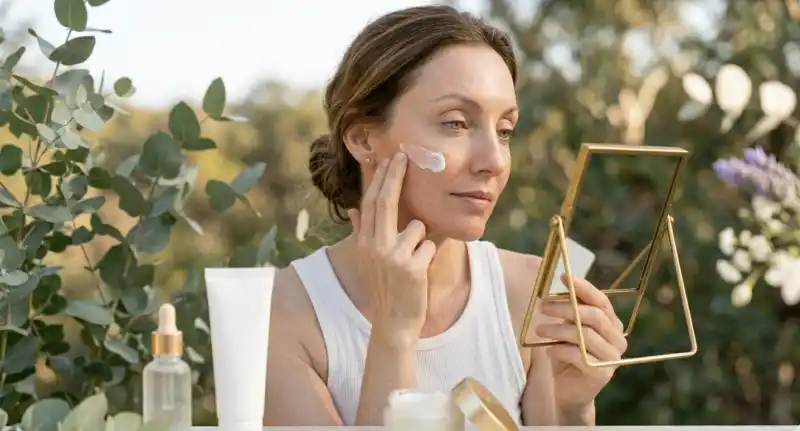
The science of skin aging is evolving rapidly — and for women navigating the skin changes that come with menopause and beyond, evidence-based skincare represents a fundamentally different approach: working with your skin's biology rather than against it.
Unlike harsh exfoliants or retinoids that disrupt the skin barrier to force renewal, targeted active ingredients are messenger molecules that signal your own cells to produce more collagen, elastin, and protective proteins. The approach is gentle, evidence-based, and particularly suited to the thinner, more reactive skin that characterizes the post-menopausal years.
What Topical Treatment Can and Cannot Achieve Over 12 Months
Setting realistic expectations for sun damage repair is essential because the gap between marketing promises ('reverse years of sun damage in 2 weeks') and biological reality ('measurable improvement over 6-12 months') causes many women to abandon effective treatments prematurely. The truth is encouraging but measured: consistent topical treatment with proven ingredients produces genuine, visible improvement in photoaged skin — but the timeline is months, not weeks, and the degree of improvement has biological limits that no cream can exceed.[1]
What 12 months of consistent SPF + retinol + vitamin C + peptide treatment realistically achieves: Fine wrinkles — 30-40% reduction in depth. The shallow dermal creases caused by early collagen loss respond well to collagen rebuilding. Many fine lines, particularly those accentuated by dehydration, can become nearly invisible. Moderate wrinkles — 15-25% reduction in depth. Deeper wrinkles require more collagen to fill their larger dermal deficit, and the improvement is proportionally less dramatic but still meaningful and visible. Deep wrinkles (nasolabial folds, deep forehead lines) — 5-15% improvement. These structural folds involve not just collagen loss but fat pad descent and bone resorption — factors that topical treatment cannot address. The improvement is subtle but present.
Clinical research confirms that skin texture — significant improvement. Rough, leathery, photoaged texture responds dramatically to retinol-accelerated cell turnover and collagen rebuilding. This is often the most noticeable improvement. Pigmentation — moderate improvement. Superficial solar lentigines fade 40-60% with consistent vitamin C + niacinamide + retinol treatment. Deep, long-established spots may fade only 20-30% and may require professional treatment for full resolution. Skin firmness — measurable improvement. Skin elasticity increases as new collagen accumulates, though the improvement is more detectable by touch (better bounce-back) than by appearance. Overall appearance — most women report looking '5-8 years younger' after 12 months of consistent comprehensive treatment. This is not a marketing claim — it reflects the cumulative improvement across texture, tone, hydration, fine lines, and firmness.
What topical treatment CANNOT achieve: (1) Cannot reverse bone resorption that changes facial structure. (2) Cannot reposition descended fat pads that create deep nasolabial folds. (3) Cannot eliminate deeply established wrinkles entirely — only reduce their depth. (4) Cannot remove all solar lentigines — some deep spots require professional intervention. (5) Cannot produce results faster than the biological timeline of collagen rebuilding — patience is not optional. The women who are most satisfied with sun damage treatment results are those who (a) understand the realistic timeline and degree of improvement, (b) commit to consistent daily application for 12+ months, and (c) appreciate the cumulative improvement rather than expecting a transformative single moment. The improvement is real and meaningful — but it's a gradual brightening, not a sudden before-and-after transformation.
Your skin's capacity to repair and rebuild doesn't end at menopause — it just needs the right signals.
— Dr. Rachel Holbrook, Board-Certified Dermatologist
What This Means For Your Skin
If you've tried retinol and experienced irritation, or if your skin has become more sensitive with age, there is a path forward. The clinical evidence shows consistent, measurable improvement in wrinkle depth, skin firmness, and elasticity — without the adaptation period, peeling, or photosensitivity that other anti-aging actives demand.
Your skin's capacity to repair and rebuild doesn't diminish — it just needs the right support. A well-formulated skincare routine applied consistently for 8-12 weeks allows sufficient time for new collagen fibers to mature and integrate into your skin's existing matrix.
The science is clear. The evidence is consistent. The results are measurable.
What happens next is up to you.