
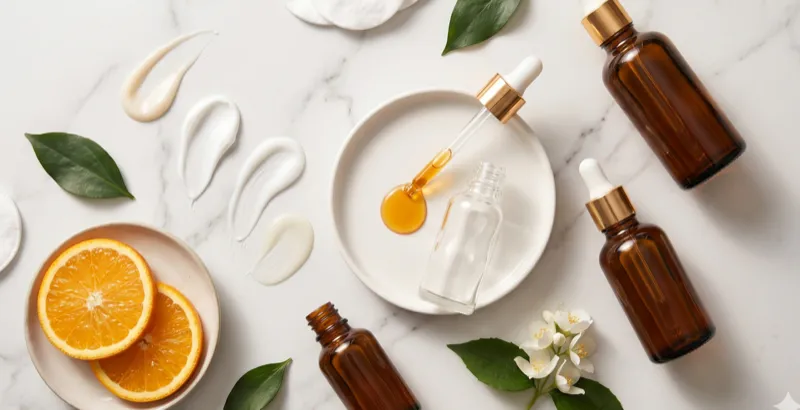
The science of skin aging is evolving rapidly — and for women navigating the skin changes that come with menopause and beyond, evidence-based skincare represents a fundamentally different approach: working with your skin's biology rather than against it.
Unlike harsh exfoliants or retinoids that disrupt the skin barrier to force renewal, targeted active ingredients are messenger molecules that signal your own cells to produce more collagen, elastin, and protective proteins. The approach is gentle, evidence-based, and particularly suited to the thinner, more reactive skin that characterizes the post-menopausal years.
Chemical Exfoliation as a Support Strategy for Structural Rebuilding
Glycolic acid — the smallest alpha-hydroxy acid (AHA), with a molecular weight of 76 Daltons — has a well-established role in anti-aging skincare, but that role is frequently misunderstood. Glycolic acid is not a structural rebuilder like retinol or peptides — it does not directly stimulate collagen production through receptor-mediated signaling. Its anti-aging value lies in three support mechanisms: (1) chemical exfoliation that removes accumulated dead corneocytes, revealing smoother, more radiant skin beneath; (2) stimulation of glycosaminoglycan (GAG) production in the dermis, which improves hydration and plumpness; and (3) enhanced penetration of subsequently applied active ingredients through the thinned stratum corneum. These are genuine benefits, but they position glycolic acid as a support player in the anti-aging routine rather than the lead active.[1]
How glycolic acid supports anti-aging: Mechanism 1 — Exfoliation. Glycolic acid dissolves the desmosomes (protein bridges) that hold dead corneocytes together in the outer stratum corneum. This accelerates the shedding of the dull, rough surface layer, revealing the newer, more uniform cells beneath. The visible result is immediate improvement in skin radiance, smoothness, and luminosity. This is a cosmetic benefit — it makes the skin look better without changing the underlying dermal structure. Mechanism 2 — GAG stimulation. At concentrations above 8-10%, glycolic acid stimulates fibroblast production of glycosaminoglycans (primarily hyaluronic acid) in the dermis. This increased dermal GAG content improves tissue hydration and plumpness, providing a modest but measurable wrinkle-reducing effect through hydration rather than collagen stimulation. Mechanism 3 — Penetration enhancement. By thinning the stratum corneum barrier, glycolic acid allows subsequently applied actives (retinol, peptides, vitamin C) to penetrate more efficiently, potentially increasing their efficacy.
Clinical research confirms that how to use glycolic acid safely in an anti-aging routine: (1) Concentration — 5-10% for daily-use products (toners, serums); 20-30% for weekly at-home peels (with caution). Higher concentrations provide more dramatic exfoliation but proportionally greater barrier compromise. For anti-aging support, 5-8% daily use provides optimal benefit-to-risk ratio. (2) Frequency — daily to every other day for 5-8% products; weekly or bi-weekly for higher-concentration peels. (3) pH — glycolic acid is most effective at pH 3-4, where it is partially un-ionized and can penetrate the stratum corneum. Products at pH above 4.5 provide minimal exfoliation. (4) Timing — evening use preferred, as exfoliated skin is more photosensitive. Always follow with SPF 50 the next morning. (5) Critical caution with retinol — glycolic acid and retinol both thin the stratum corneum and increase photosensitivity. Using both on the same evening can overwhelm the barrier, particularly on thin or sensitive skin. The recommended approach: alternate nights — glycolic acid one evening, retinol the next — rather than layering both in the same routine.
Where glycolic acid fits in the ingredient hierarchy: glycolic acid is a valuable support ingredient when the primary actives (retinol, peptides, vitamin C) are already in place. Adding glycolic acid to a routine that lacks these structural rebuilders is like polishing a table without fixing the wobbly legs — the surface looks better, but the underlying structural deficit remains. The optimal integration: use glycolic acid 2-3 evenings per week on non-retinol nights as a toner or serum step. Follow with peptide cream and ceramide seal. This provides exfoliation and GAG stimulation benefits on the nights when retinoid receptor stimulation is not occurring, creating a complementary alternating protocol. For women who already use retinol 3-4 nights per week, glycolic acid is optional — retinol provides its own turnover acceleration that partially overlaps with glycolic acid's exfoliation benefit. Adding glycolic acid in this scenario provides modest incremental benefit with measurable irritation risk — a trade-off that is worthwhile for thick, tolerant skin but counterproductive for thin or sensitive skin.
Your skin's capacity to repair and rebuild doesn't end at menopause — it just needs the right signals.
— Dr. Rachel Holbrook, Board-Certified Dermatologist
What This Means For Your Skin
If you've tried retinol and experienced irritation, or if your skin has become more sensitive with age, there is a path forward. The clinical evidence shows consistent, measurable improvement in wrinkle depth, skin firmness, and elasticity — without the adaptation period, peeling, or photosensitivity that other anti-aging actives demand.
Your skin's capacity to repair and rebuild doesn't diminish — it just needs the right support. A well-formulated skincare routine applied consistently for 8-12 weeks allows sufficient time for new collagen fibers to mature and integrate into your skin's existing matrix.
The science is clear. The evidence is consistent. The results are measurable.
What happens next is up to you.