
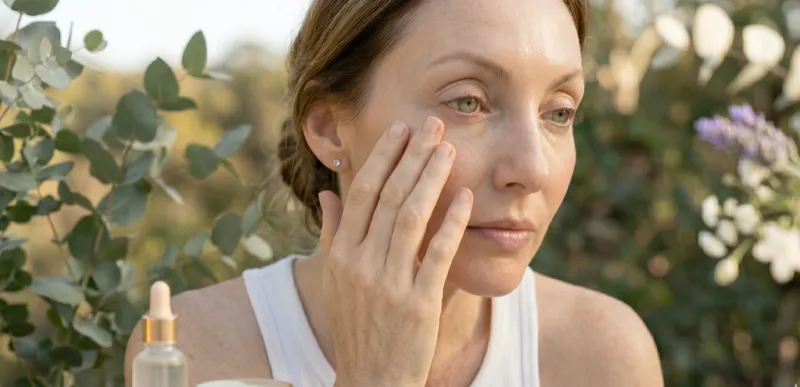
The science of skin aging is evolving rapidly — and for women navigating the skin changes that come with menopause and beyond, evidence-based skincare represents a fundamentally different approach: working with your skin's biology rather than against it.
Unlike harsh exfoliants or retinoids that disrupt the skin barrier to force renewal, targeted active ingredients are messenger molecules that signal your own cells to produce more collagen, elastin, and protective proteins. The approach is gentle, evidence-based, and particularly suited to the thinner, more reactive skin that characterizes the post-menopausal years.
Why Overnight Fluid Shifts Cause Morning Puffiness and How to Reverse Them
Morning eye puffiness is primarily a gravitational and vascular phenomenon — not a sign of poor health or premature aging, though chronic puffiness can accelerate the appearance of both. During sleep, the body lies horizontal for 7-8 hours, eliminating the gravitational drainage that keeps fluid moving downward through the lymphatic system during the day. Without gravity pulling fluid toward the extremities, interstitial fluid redistributes evenly throughout the body, and the periorbital region — the area surrounding the eyes — is uniquely vulnerable to fluid accumulation because of its anatomical characteristics. The periorbital skin is the thinnest on the entire body at approximately 0.5mm (compared to 2mm on most facial areas), it contains virtually no subcutaneous fat to provide structural resistance against swelling, and the underlying connective tissue (orbital septum) is loose and distensible, allowing fluid to pool in the space between the skin and the orbital bone. This combination means that even a small increase in interstitial fluid volume produces visible swelling that is immediately noticeable because the thin, translucent skin cannot conceal the underlying edema. The fluid that accumulates overnight is primarily water and dissolved proteins that have leaked from the periorbital capillaries through a process called transudation — the hydrostatic pressure in the capillaries during the horizontal sleeping position exceeds the oncotic pressure retaining fluid within the vessels, causing plasma to seep into the surrounding tissue. This is a normal physiological process that occurs throughout the body during sleep, but only becomes visible in the periorbital region because of the tissue's unique thinness and laxity.[1]
Several factors amplify morning eye puffiness beyond the baseline gravitational effect. Dietary sodium is the most common amplifier — a high-sodium meal the evening before increases plasma osmolarity, which triggers the body to retain water to maintain electrolyte balance. This retained water distributes into the interstitial spaces during horizontal sleep, and the periorbital tissue, being the least resistant to fluid accumulation, swells disproportionately. Alcohol consumption amplifies puffiness through a different mechanism: alcohol is a vasodilator that increases capillary permeability, allowing more plasma to leak into the periorbital tissue, and it simultaneously suppresses antidiuretic hormone (ADH), causing dehydration that the body compensates for by retaining fluid in the tissues. Crying before sleep causes morning puffiness through direct mechanical and chemical irritation — tears contain salt and cytokines that cause localized inflammation of the thin periorbital skin, and the rubbing associated with crying further damages the delicate tissue. Allergic reactions — whether from dust mites in bedding, pet dander, or seasonal allergens — trigger histamine release that increases capillary permeability specifically in the periorbital region, where the tissue's high mast cell density produces a disproportionate inflammatory response. Sleep position is another significant factor: side sleepers and stomach sleepers experience asymmetric puffiness because the gravitational fluid accumulation concentrates on the dependent (downward) side of the face, producing visibly more swelling in the eye closest to the pillow.
Clinical research confirms that the morning de-puffing protocol addresses the fluid accumulation at multiple levels. Immediate mechanical interventions: (1) Gravity reset — sit upright or stand as soon as you wake. The simple act of assuming an upright position restarts gravitational lymphatic drainage, and the periorbital fluid begins to redistribute within minutes. (2) Cold application — apply a cold compress, chilled spoons, or refrigerated eye cream to the periorbital area for 3-5 minutes. Cold causes vasoconstriction of the dilated periorbital capillaries, reducing the hydrostatic pressure that drives fluid leakage, and simultaneously stimulates lymphatic contraction that accelerates fluid drainage. The temperature should be cool (refrigerator temperature, approximately 4-8 degrees Celsius), not ice-cold — extreme cold can damage the delicate periorbital skin. (3) Gentle lymphatic massage — using the ring finger (which applies the least pressure), tap gently from the inner corner of the eye outward along the orbital bone, then down the side of the nose toward the nasolabial fold. This follows the lymphatic drainage pathway and physically encourages fluid movement out of the periorbital tissue and into the deeper lymphatic channels. Perform 10-15 taps along each pathway, taking approximately 30 seconds per eye. The combination of gravity, cold, and massage typically reduces visible morning puffiness by 50-70% within 10-15 minutes.
Topical interventions that complement the mechanical de-puffing: (1) Caffeine eye cream applied after the cold compress. Caffeine is a xanthine derivative that constricts the periorbital blood vessels through phosphodiesterase inhibition, reducing the vascular engorgement that contributes to visible puffiness. Applied topically at concentrations of 1-5%, caffeine produces measurable reduction in periorbital circumference within 15-30 minutes. The effect is temporary (lasting 4-6 hours) but provides meaningful cosmetic improvement for the morning hours when puffiness is most visible. (2) Peptide eye cream for long-term structural support — while peptides do not directly address the fluid accumulation, they strengthen the periorbital skin and connective tissue over time, making the thin skin more resistant to visible swelling. A stronger orbital septum and thicker periorbital dermis mean that the same amount of fluid accumulation produces less visible external puffiness. Prevention protocol for chronic morning puffiness: limit sodium intake after 4pm, sleep with the head slightly elevated (an extra pillow or 15-degree bed elevation reduces overnight periorbital fluid accumulation by decreasing venous pressure in the head), maintain consistent hydration throughout the day (paradoxically, adequate hydration reduces fluid retention because the body is not triggered to conserve water), address allergies with antihistamines or allergen-proof bedding if allergic shiners are contributing, and sleep on the back when possible to distribute fluid symmetrically across both eyes rather than creating asymmetric puffiness.
Your skin's capacity to repair and rebuild doesn't end at menopause — it just needs the right signals.
— Dr. Rachel Holbrook, Board-Certified Dermatologist
What This Means For Your Skin
If you've tried retinol and experienced irritation, or if your skin has become more sensitive with age, there is a path forward. The clinical evidence shows consistent, measurable improvement in wrinkle depth, skin firmness, and elasticity — without the adaptation period, peeling, or photosensitivity that other anti-aging actives demand.
Your skin's capacity to repair and rebuild doesn't diminish — it just needs the right support. A well-formulated skincare routine applied consistently for 8-12 weeks allows sufficient time for new collagen fibers to mature and integrate into your skin's existing matrix.
The science is clear. The evidence is consistent. The results are measurable.
What happens next is up to you.