
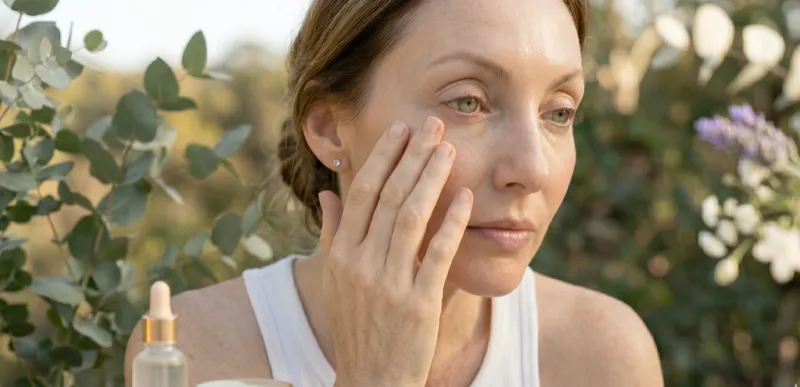
The science of skin aging is evolving rapidly — and for women navigating the skin changes that come with menopause and beyond, evidence-based skincare represents a fundamentally different approach: working with your skin's biology rather than against it.
Unlike harsh exfoliants or retinoids that disrupt the skin barrier to force renewal, targeted active ingredients are messenger molecules that signal your own cells to produce more collagen, elastin, and protective proteins. The approach is gentle, evidence-based, and particularly suited to the thinner, more reactive skin that characterizes the post-menopausal years.
The Pharmacology Behind Caffeine's Effect on Periorbital Puffiness
Caffeine in eye cream works through a well-understood pharmacological mechanism — but the scope of what it actually does is narrower than marketing suggests. Caffeine (1,3,7-trimethylxanthine) is a non-selective phosphodiesterase inhibitor that, when applied topically to the periorbital skin, produces localized vasoconstriction by preventing the degradation of cyclic AMP (cAMP) in vascular smooth muscle cells. The elevated cAMP levels increase smooth muscle contraction in the periorbital arterioles, reducing blood flow to the superficial capillary beds. This vasoconstriction has two visible effects: (1) it reduces the vascular engorgement that contributes to periorbital puffiness, and (2) it decreases the dark coloration visible through the thin under-eye skin that comes from dilated, blood-filled capillaries. The caffeine molecule is small enough (molecular weight 194 Da) to penetrate the thin periorbital epidermis effectively, reaching the superficial vasculature within 15-30 minutes of application. Clinical studies measuring periorbital skin thickness via ultrasound have demonstrated measurable reduction in edema volume following topical caffeine application at concentrations of 3-5%.[1]
What caffeine eye cream DOES effectively: (1) Temporarily reduces morning puffiness — the vasoconstriction reduces the fluid-filled, swollen appearance by decreasing the hydrostatic pressure that drives fluid leakage from capillaries into the periorbital interstitial space. Duration: approximately 4-6 hours before the vasoconstrictive effect wears off and the vessels re-dilate. (2) Temporarily reduces the appearance of dark circles caused by vascular congestion — when dark circles are primarily caused by dilated blood vessels visible through the thin under-eye skin (as opposed to hyperpigmentation or hollow tear troughs), caffeine's vasoconstriction reduces the visible dark coloration. Again, this is temporary. (3) Provides a mildly firming sensation — the dehydrating effect of caffeine on the superficial skin cells creates a temporary tightening sensation that many users interpret as 'firming.' This is a cosmetic surface effect, not structural improvement. (4) Enhances the penetration of other actives — caffeine's vasodilation of lymphatic vessels (distinct from its vasoconstriction of blood vessels) may enhance drainage and delivery of co-formulated ingredients.
Clinical research confirms that what caffeine eye cream DOES NOT do: (1) It does not build collagen — caffeine has no collagen-stimulating mechanism. The 'firming' sensation is surface dehydration, not structural reinforcement. For periorbital collagen building, peptides (Matrixyl 3000, palmitoyl tripeptide-1) are the appropriate actives. (2) It does not reduce wrinkles — fine lines under the eyes result from collagen and elastin loss in the thin periorbital dermis. Caffeine does not address either. (3) It does not treat genetic dark circles — dark circles caused by periorbital hyperpigmentation (melanin deposits in the thin under-eye skin) do not respond to caffeine because the discoloration is pigmentary, not vascular. Vitamin C, arbutin, or tranexamic acid target pigmentary dark circles. (4) It does not address hollow tear troughs — the shadowing caused by volume loss beneath the eye is structural, requiring either filler or fat transfer. Caffeine cannot restore lost volume. (5) The effects are entirely temporary — caffeine must be reapplied daily because it does not modify any underlying structure. Once the caffeine is metabolized and cleared (4-6 hours), the periorbital vasculature returns to its baseline state.
The practical verdict on caffeine eye cream: it is a genuinely effective SHORT-TERM treatment for periorbital puffiness and vascular dark circles. As a morning de-puffing agent, caffeine works — the pharmacology is sound and the clinical evidence supports its vasoconstrictor effect on the thin periorbital skin. However, caffeine should not be the ONLY active in your eye cream if you have concerns beyond morning puffiness. The ideal eye cream for comprehensive periorbital care combines caffeine (for immediate de-puffing and vascular dark circle reduction) with peptides (for long-term collagen rebuilding in the thin periorbital dermis), hyaluronic acid (for hydration-based plumping that reduces fine line visibility), and niacinamide (for barrier support and mild brightening). This combination addresses both the immediate cosmetic concern (puffiness) and the underlying structural aging (collagen loss, dehydration, barrier compromise) that makes the periorbital area look increasingly aged over time. If you are using a caffeine-only eye cream and seeing only temporary improvement that resets every morning, adding peptide support is the logical next step for lasting improvement.
Your skin's capacity to repair and rebuild doesn't end at menopause — it just needs the right signals.
— Dr. Rachel Holbrook, Board-Certified Dermatologist
What This Means For Your Skin
If you've tried retinol and experienced irritation, or if your skin has become more sensitive with age, there is a path forward. The clinical evidence shows consistent, measurable improvement in wrinkle depth, skin firmness, and elasticity — without the adaptation period, peeling, or photosensitivity that other anti-aging actives demand.
Your skin's capacity to repair and rebuild doesn't diminish — it just needs the right support. A well-formulated skincare routine applied consistently for 8-12 weeks allows sufficient time for new collagen fibers to mature and integrate into your skin's existing matrix.
The science is clear. The evidence is consistent. The results are measurable.
What happens next is up to you.