
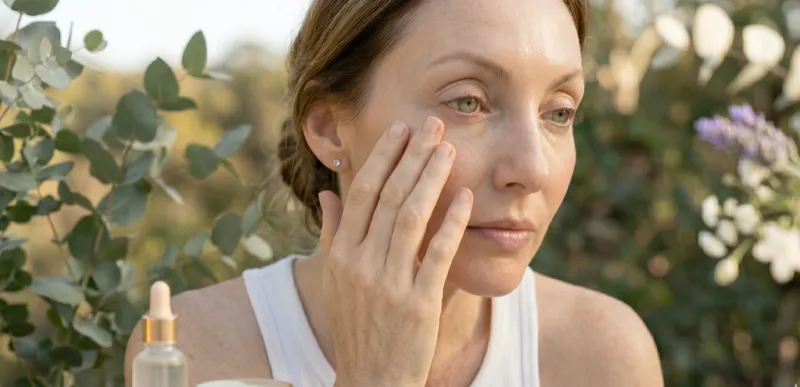
The science of skin aging is evolving rapidly — and for women navigating the skin changes that come with menopause and beyond, evidence-based skincare represents a fundamentally different approach: working with your skin's biology rather than against it.
Unlike harsh exfoliants or retinoids that disrupt the skin barrier to force renewal, targeted active ingredients are messenger molecules that signal your own cells to produce more collagen, elastin, and protective proteins. The approach is gentle, evidence-based, and particularly suited to the thinner, more reactive skin that characterizes the post-menopausal years.
How to Address Two Different Eye Concerns With One Product
Puffiness and wrinkles around the eyes are the two most common periorbital concerns, but they arise from fundamentally different mechanisms — which is why many eye creams that effectively address one fail to address the other. Puffiness is a fluid dynamics problem: excess interstitial fluid accumulates in the loose periorbital connective tissue, creating visible swelling that is typically worst in the morning and fluctuates with diet, sleep, allergies, and hormones. Wrinkles are a structural degradation problem: the periorbital dermis — already the thinnest on the body at approximately 0.5mm — loses collagen and elastin progressively from UV exposure, intrinsic aging, and the constant mechanical stress of blinking (approximately 15,000-20,000 blinks per day). An eye cream that only contains caffeine addresses puffiness but does nothing for the structural collagen loss creating wrinkles. An eye cream that only contains retinol addresses wrinkles but may actually worsen puffiness through irritation-induced inflammation. The ideal formulation must contain complementary actives that address both mechanisms without conflicting.[1]
The ingredient architecture of an effective dual-purpose eye cream: Layer 1 — Anti-puffiness actives: Caffeine (1-5%) provides immediate vasoconstriction that reduces periorbital fluid engorgement within 15-30 minutes. It is the most pharmacologically validated topical de-puffing ingredient available. Hesperidin (a citrus bioflavonoid) strengthens the periorbital capillary walls, reducing the vascular leakage that allows fluid to accumulate in the first place — it addresses the cause rather than the symptom. Peptides such as acetyl tetrapeptide-5 (Eyeseryl) specifically target periorbital fluid accumulation by reducing capillary permeability and improving lymphatic drainage. Layer 2 — Anti-wrinkle actives: Palmitoyl tripeptide-1 and palmitoyl tetrapeptide-7 (Matrixyl 3000) stimulate fibroblast collagen I and III production through TGF-beta signaling. Peptides are preferred over retinol for the periorbital area because they provide collagen stimulation without the irritation, dryness, and barrier disruption that retinol frequently causes on the ultra-thin periorbital skin. Retinol CAN be used around the eyes but must be at very low concentration (0.025-0.05% — approximately one-tenth of typical facial concentration) and buffered within a ceramide-rich formulation. Hyaluronic acid (low molecular weight) penetrates the thin periorbital dermis effectively, providing hydration-based plumping that immediately reduces the visibility of fine lines while structural treatments work over months.
Clinical research confirms that layer 3 — Structural support actives: Ceramides (NP, AP, EOP) restore the barrier function of the periorbital skin, which has minimal sebaceous gland density and cannot maintain its moisture barrier independently. Without ceramide support, the thin skin dehydrates rapidly, making both puffiness and wrinkles appear worse — dehydrated skin shows lines more prominently and loses the turgor pressure that resists fluid-induced swelling. Niacinamide (2-4%) strengthens the periorbital barrier while providing mild anti-inflammatory activity that reduces the chronic low-grade inflammation contributing to both fluid retention and collagen degradation. Vitamin E (tocopherol) provides antioxidant protection for the thin skin that has minimal intrinsic defense against oxidative stress from UV exposure and environmental pollutants.
Application protocol for maximum dual benefit: Morning application — apply a small amount (pea-sized for both eyes) to the orbital bone area using the ring finger, which applies the least pressure. Start at the inner corner of the lower orbital bone and tap gently outward, then continue along the upper orbital bone from the outer corner inward. The tapping motion (rather than rubbing) prevents mechanical stretching of the thin skin while stimulating lymphatic drainage that assists de-puffing. The caffeine component begins working within 15 minutes, providing immediate puffiness reduction for the morning hours. Follow with SPF — the periorbital skin is highly vulnerable to UV-driven collagen destruction. Evening application — repeat the tapping application. The evening application provides the longest uninterrupted contact time (7-8 hours during sleep), maximizing peptide absorption and collagen stimulation. The ceramide and HA components maintain overnight hydration that prevents the morning dehydration exacerbation of both puffiness and fine lines. For women over 40 experiencing both significant puffiness and moderate wrinkles, the peptide + caffeine + ceramide combination applied twice daily for 12+ weeks typically produces measurable improvement in both concerns — reducing morning puffiness duration by approximately 40-60% and improving fine line depth by 15-25% through cumulative collagen rebuilding.
Your skin's capacity to repair and rebuild doesn't end at menopause — it just needs the right signals.
— Dr. Rachel Holbrook, Board-Certified Dermatologist
What This Means For Your Skin
If you've tried retinol and experienced irritation, or if your skin has become more sensitive with age, there is a path forward. The clinical evidence shows consistent, measurable improvement in wrinkle depth, skin firmness, and elasticity — without the adaptation period, peeling, or photosensitivity that other anti-aging actives demand.
Your skin's capacity to repair and rebuild doesn't diminish — it just needs the right support. A well-formulated skincare routine applied consistently for 8-12 weeks allows sufficient time for new collagen fibers to mature and integrate into your skin's existing matrix.
The science is clear. The evidence is consistent. The results are measurable.
What happens next is up to you.