
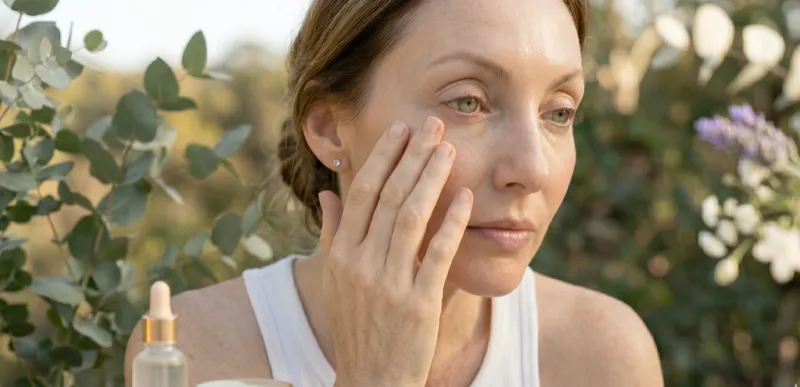
The science of skin aging is evolving rapidly — and for women navigating the skin changes that come with menopause and beyond, evidence-based skincare represents a fundamentally different approach: working with your skin's biology rather than against it.
Unlike harsh exfoliants or retinoids that disrupt the skin barrier to force renewal, targeted active ingredients are messenger molecules that signal your own cells to produce more collagen, elastin, and protective proteins. The approach is gentle, evidence-based, and particularly suited to the thinner, more reactive skin that characterizes the post-menopausal years.
What to Realistically Expect From Consistent Peptide Use Around the Eyes
Peptide eye cream results follow a predictable timeline that most women abandon before reaching — the dropout rate for eye cream use is estimated at 60-70% within the first 6 weeks, which is tragically before the most meaningful structural improvements become visible. Understanding the realistic before-and-after timeline prevents the premature abandonment of a genuinely effective treatment and sets expectations that match the biology of collagen rebuilding in the thin periorbital dermis. The periorbital skin responds to peptide treatment in three distinct phases, each producing different types of improvement that build upon each other. Phase 1 — Hydration and barrier improvement (weeks 1-4): the first visible changes are NOT collagen-related — they come from the ceramide, HA, and emollient components of the peptide cream restoring hydration and barrier function to the chronically dry periorbital skin. Within the first week, the under-eye area appears more hydrated, smoother, and less crepey. Fine dehydration lines (the shallow, web-like lines visible when the skin is dry) diminish or disappear as dermal water content increases. The skin tone appears more even and the periorbital area looks generally healthier. These changes are real and visible but they are NOT yet from the peptides' collagen-building activity — they are from the cream's moisturizing base. This distinction matters because if you stop the cream, these hydration benefits reverse within 3-5 days.[1]
Phase 2 — Early structural improvement (weeks 4-12): this is when the peptide activity begins to produce visible results. Matrixyl 3000 and related peptides stimulate fibroblast production of procollagen through TGF-beta signaling — a process that takes 4-6 weeks from signal initiation to the deposition of mature, cross-linked collagen fibers in the dermis. At weeks 4-8, the newly deposited collagen begins to increase dermal density in the thin periorbital skin. The visible changes: fine lines that were previously always visible (static lines) begin to soften — they do not disappear, but their depth decreases as the dermis beneath them thickens slightly. The overall texture of the periorbital skin improves — the surface becomes smoother and more uniform as the increased dermal support reduces the surface irregularities. Skin firmness improves — the thin skin feels slightly less tissue-paper-like and more resilient to gentle pinching. Dark circles may improve modestly if they are partly caused by skin thinness (the thicker dermis reduces translucency, concealing the underlying vasculature slightly better). At weeks 8-12, these structural improvements become clearly visible in before-and-after comparison — though they may be too gradual to notice day-to-day without photographic documentation.
Clinical research confirms that phase 3 — Cumulative collagen maturation (weeks 12-24+): collagen remodeling is a slow process — newly deposited collagen fibers continue to cross-link, organize, and strengthen for months after deposition. The periorbital improvement from peptide treatment continues to build beyond the initial 12 weeks as the collagen network matures and densifies. At 3-6 months of consistent use, the typical results visible in before-and-after comparison include: 15-25% reduction in fine line depth around the eyes (measurable via silicone replica or high-resolution photography), noticeable improvement in periorbital skin texture (smoother, less crepey, more uniform), modest improvement in skin firmness and resilience (the thin skin shows better turgor when gently displaced), gradual reduction in the translucency that allows dark circles to show through, and improved overall periorbital appearance that may prompt comments from others who notice the eyes look 'more rested' or 'brighter' without identifying the specific changes. These results require CONSISTENT twice-daily application throughout the entire period — gaps of more than 2-3 days interrupt the collagen-building signaling cycle and delay the timeline proportionally.
Factors that influence the magnitude of before-and-after results: Age — women who begin peptide treatment in their 30s-40s typically see more dramatic improvement than those starting in their 60s-70s, because the fibroblasts' collagen production capacity declines with age. However, improvement is measurable at any age. Starting condition — women with more significant baseline aging (deeper lines, more pronounced thinning) have more room for visible improvement, even though their absolute skin quality may remain below that of someone with milder baseline aging. UV protection — results are dramatically better in women who simultaneously use daily SPF, because the collagen being built by the peptides is not being simultaneously degraded by UV-activated matrix metalloproteinases. Without SPF, peptide treatment is a self-defeating exercise. Combined treatments — adding low-concentration retinol (0.025-0.05%) 2-3 nights per week alongside the peptide cream activates a second collagen production pathway, producing approximately 30-40% greater improvement than peptides alone over the same timeframe. Realistic summary: peptide eye cream will not make a 55-year-old's eye area look 30. It will make a 55-year-old's eye area look like a well-maintained 48-50 — softer lines, better texture, less translucency, healthier appearance. For most women, this 5-7 year visual improvement is meaningful and satisfying, particularly when combined with the knowledge that consistent use is slowing further aging.
Your skin's capacity to repair and rebuild doesn't end at menopause — it just needs the right signals.
— Dr. Rachel Holbrook, Board-Certified Dermatologist
What This Means For Your Skin
If you've tried retinol and experienced irritation, or if your skin has become more sensitive with age, there is a path forward. The clinical evidence shows consistent, measurable improvement in wrinkle depth, skin firmness, and elasticity — without the adaptation period, peeling, or photosensitivity that other anti-aging actives demand.
Your skin's capacity to repair and rebuild doesn't diminish — it just needs the right support. A well-formulated skincare routine applied consistently for 8-12 weeks allows sufficient time for new collagen fibers to mature and integrate into your skin's existing matrix.
The science is clear. The evidence is consistent. The results are measurable.
What happens next is up to you.