
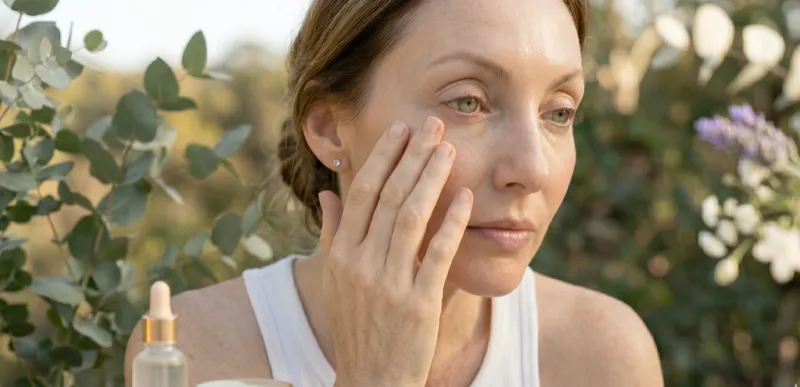
The science of skin aging is evolving rapidly — and for women navigating the skin changes that come with menopause and beyond, evidence-based skincare represents a fundamentally different approach: working with your skin's biology rather than against it.
Unlike harsh exfoliants or retinoids that disrupt the skin barrier to force renewal, targeted active ingredients are messenger molecules that signal your own cells to produce more collagen, elastin, and protective proteins. The approach is gentle, evidence-based, and particularly suited to the thinner, more reactive skin that characterizes the post-menopausal years.
How to Use Retinol on the Thinnest Skin Without Irritation
Retinol is the most clinically validated topical anti-aging ingredient — but using it around the eyes requires specific concentration and protocol modifications because the periorbital skin is fundamentally different from the rest of the face. The periorbital dermis is approximately 0.5mm thick (compared to 1.5-2mm on the cheeks and forehead), has virtually no sebaceous glands (meaning no lipid buffer to slow retinol penetration), sits over a minimal subcutaneous fat layer (no cushioning against irritation), and is in constant motion from blinking (15,000-20,000 times daily, creating micro-abrasions that increase permeability). These characteristics mean that the periorbital skin absorbs retinol faster and more completely than facial skin, and the inflammatory response to retinol irritation is disproportionately visible because the thin, translucent skin cannot conceal the underlying redness and swelling. The practical consequence: a retinol concentration that produces smooth, renewed facial skin may produce irritation, dryness, peeling, and reactive swelling on the periorbital skin — creating the paradoxical result of eyes that look MORE aged and tired from the treatment meant to improve them.[1]
The safe concentration range for periorbital retinol: the evidence and clinical experience converge on 0.025-0.05% retinol for the periorbital area — approximately one-fifth to one-tenth of the 0.25-0.5% concentrations commonly used on the face. At this concentration range, retinol provides sufficient retinoid receptor activation to stimulate fibroblast collagen production and keratinocyte turnover without overwhelming the thin periorbital skin's tolerance threshold. The collagen stimulation at 0.025-0.05% is meaningful — studies demonstrate measurable dermal thickening and fine line improvement at these concentrations when applied consistently over 12-24 weeks. The improvement is slower than at higher concentrations, but the periorbital skin's tolerance allows consistent use without the irritation breaks that higher concentrations necessitate, producing equal or better cumulative results through uninterrupted treatment. Encapsulated retinol formulations (retinol enclosed in lipid or polymer microspheres that release gradually) are particularly well-suited for periorbital use because the slow-release mechanism further reduces peak-concentration irritation while maintaining therapeutic exposure over hours.
Clinical research confirms that the safe periorbital retinol protocol: Frequency — begin at once per week for weeks 1-4, increase to twice per week for weeks 5-8, then three times per week if tolerated. Never use periorbital retinol nightly unless specifically directed by a dermatologist. The 3-times-per-week maximum allows adequate recovery time between applications for the thin skin. Application method — the 'ceramide sandwich' is essential for periorbital retinol: apply a thin layer of ceramide-rich eye cream first, wait 2-3 minutes, apply a rice-grain amount of the retinol product to the entire orbital bone area (lower and upper), wait 5 minutes, then apply another layer of ceramide-rich eye cream over the retinol. The ceramide layers slow the retinol penetration rate, reduce peak concentration at the dermal level, and maintain barrier hydration that prevents the irritation cascade. Placement — apply to the orbital bone rim, not directly under the lashes or on the eyelid margin. The retinol migrates slightly from its application point, reaching the periocular skin without the direct-contact irritation risk to the most sensitive areas.
Combining retinol with peptides for superior periorbital results: the most effective periorbital anti-aging protocol uses both retinol and peptides because they stimulate collagen through independent pathways — retinol activates the retinoid receptor pathway (RAR/RXR), while peptides activate the TGF-beta pathway. Using both provides additive collagen stimulation that exceeds either ingredient alone. The protocol: use peptide eye cream on all nights (both retinol nights and non-retinol nights), and add retinol 2-3 nights per week ON TOP of the peptide application. On retinol nights: ceramide cream → peptide serum → retinol → ceramide cream. On non-retinol nights: peptide serum → ceramide cream. This protocol provides continuous peptide-driven collagen stimulation 7 days a week, supplemented by retinol-driven stimulation 2-3 days a week — the maximum collagen-building combination the thin periorbital skin can sustain without irritation. Signs that your periorbital retinol concentration or frequency is too high: persistent dryness or flaking around the eyes, redness that lasts more than 24 hours after application, increased sensitivity to other eye products, reactive puffiness (inflammation-driven swelling), or stinging upon application of previously tolerated products. If any of these occur, reduce frequency by 50% and ensure the ceramide sandwich is thick enough. The goal is consistent, gentle stimulation — not maximum-strength treatment that creates irritation cycles.
Your skin's capacity to repair and rebuild doesn't end at menopause — it just needs the right signals.
— Dr. Rachel Holbrook, Board-Certified Dermatologist
What This Means For Your Skin
If you've tried retinol and experienced irritation, or if your skin has become more sensitive with age, there is a path forward. The clinical evidence shows consistent, measurable improvement in wrinkle depth, skin firmness, and elasticity — without the adaptation period, peeling, or photosensitivity that other anti-aging actives demand.
Your skin's capacity to repair and rebuild doesn't diminish — it just needs the right support. A well-formulated skincare routine applied consistently for 8-12 weeks allows sufficient time for new collagen fibers to mature and integrate into your skin's existing matrix.
The science is clear. The evidence is consistent. The results are measurable.
What happens next is up to you.