
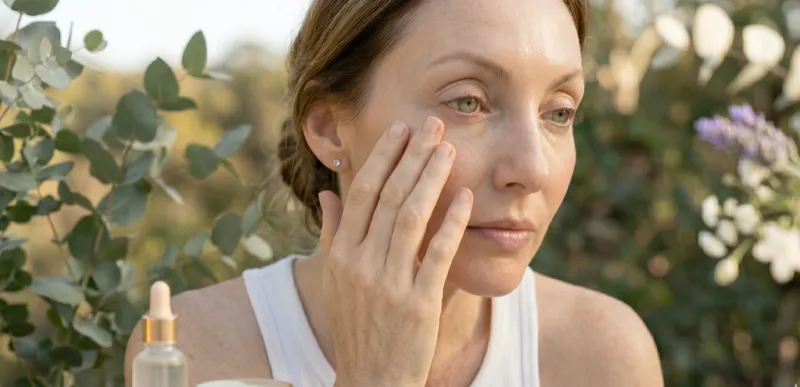
The science of skin aging is evolving rapidly — and for women navigating the skin changes that come with menopause and beyond, evidence-based skincare represents a fundamentally different approach: working with your skin's biology rather than against it.
Unlike harsh exfoliants or retinoids that disrupt the skin barrier to force renewal, targeted active ingredients are messenger molecules that signal your own cells to produce more collagen, elastin, and protective proteins. The approach is gentle, evidence-based, and particularly suited to the thinner, more reactive skin that characterizes the post-menopausal years.
A Decade-by-Decade Guide to Periorbital Changes and Interventions
The periorbital area ages in a predictable, sequential pattern — but the timeline varies significantly between individuals based on genetics, sun exposure history, and skincare habits. Understanding the typical progression allows women to anticipate changes, start preventive treatment before changes become entrenched, and select the most appropriate interventions for their current stage rather than under-treating or over-treating. The periorbital aging sequence follows four distinct phases, each with characteristic changes and optimal treatment approaches. Phase 1 — Late 20s to early 30s: the earliest periorbital aging signs appear. Fine dehydration lines become visible beneath the eyes, particularly when the skin is dry or when smiling. These are not true wrinkles — they are superficial creases in the thin periorbital epidermis caused by chronic dehydration (the periorbital skin has minimal sebaceous glands) and the beginning of collagen thinning. Crow's feet begin to appear as dynamic lines — visible only during expression (smiling, squinting) and disappearing at rest. Morning puffiness may become more noticeable and take longer to resolve as lymphatic drainage efficiency begins to decline. Dark circles may appear or worsen if previously mild, particularly the vascular type (thin skin increasingly reveals the underlying capillary bed).[1]
Phase 1 treatment: This is the prevention phase — interventions started now produce the greatest long-term benefit with the least effort. (1) SPF 30-50 applied daily around the eyes — this single habit prevents 80% of the UV-driven collagen destruction that accelerates all subsequent periorbital aging. (2) Hydrating eye cream with hyaluronic acid and ceramides — addresses the dehydration lines that are the earliest visible sign. At this stage, proper hydration alone can make fine lines invisible. (3) Peptide eye cream — beginning peptide treatment in the early 30s maintains collagen production at the rate needed to resist the structural thinning that creates wrinkles in the next decade. Phase 2 — Mid 30s to early 40s: dynamic crow's feet begin transitioning to static lines — they remain faintly visible even at rest. Under-eye fine lines deepen from dehydration creases to true wrinkles as dermal collagen loss reduces the structural support for the thin skin. The tear trough begins to show — a subtle hollow between the lower eyelid and the cheek where the suborbicularis fat pad is starting to atrophy. Dark circles may darken as the periorbital skin continues to thin, increasing vascular visibility. The upper eyelid skin may begin to show mild textural changes — fine lines and reduced elasticity.
Clinical research confirms that phase 2 treatment: This is the active treatment phase — the structural changes are progressing and require targeted intervention. (1) Peptide eye cream becomes essential — the collagen loss accelerating in this phase needs active stimulation to slow. Apply twice daily. (2) Low-concentration retinol (0.025-0.05%) can be introduced 2-3 nights per week, buffered within a ceramide-rich formulation. This provides a second collagen-building pathway alongside peptides. (3) Caffeine eye cream for morning application — addresses the increasingly persistent morning puffiness. (4) Vitamin C serum — applied before eye cream in the morning, provides both antioxidant protection and collagen cofactor support. (5) Continued diligent SPF use. Phase 3 — Mid 40s to 50s: significant structural changes become apparent. Crow's feet are deeply etched static lines. Under-eye bags may appear as the orbital septum weakens and retro-orbital fat herniates forward. The tear trough deepens noticeably as fat pad atrophy progresses. Upper lid hooding begins — the eyelid skin loses elasticity and drapes over the lid crease, making the eyes appear smaller and heavier. Periorbital skin texture becomes visibly crepey — the thin skin develops the micro-wrinkled, papery texture characteristic of advanced collagen and elastin loss. Dark circles intensify from the combination of increased skin translucency, deeper hollowing, and any pigmentary changes accumulated over decades.
Phase 3 treatment: This is the intensive management phase — multiple concurrent treatments are needed to address the several simultaneous changes. (1) Peptide eye cream remains the cornerstone — applied generously twice daily to the entire periorbital area including the upper lid. (2) Retinol can be increased to 0.05-0.1% if tolerated, still with the ceramide sandwich method. (3) Rich ceramide eye cream or balm becomes critical — the severely oil-deficient periorbital skin in this phase requires aggressive barrier support to maintain the hydration that makes every other treatment more effective. (4) Caffeine for ongoing puffiness management. (5) Consider professional treatments as adjuncts: hyaluronic acid filler for significant tear trough hollowing, and professional assessment for upper lid hooding if it affects vision or is cosmetically distressing. Phase 4 — 50s and beyond: the accumulated changes from all previous phases create the composite periorbital aging appearance. At this stage, the treatment focus shifts to: maintenance of skin quality through consistent peptide, ceramide, and SPF use; acceptance that topical treatments produce incremental rather than transformative improvement at this stage; and judicious consideration of professional interventions for specific concerns (filler for volume loss, laser for texture, surgical assessment for functional upper lid hooding). The most important principle across all phases: consistency beats intensity. A moderate peptide eye cream used faithfully twice daily for years produces dramatically better results than an aggressive anti-aging eye treatment used inconsistently. The periorbital skin rewards steady, gentle care — and punishes harsh or sporadic treatment.
Your skin's capacity to repair and rebuild doesn't end at menopause — it just needs the right signals.
— Dr. Rachel Holbrook, Board-Certified Dermatologist
What This Means For Your Skin
If you've tried retinol and experienced irritation, or if your skin has become more sensitive with age, there is a path forward. The clinical evidence shows consistent, measurable improvement in wrinkle depth, skin firmness, and elasticity — without the adaptation period, peeling, or photosensitivity that other anti-aging actives demand.
Your skin's capacity to repair and rebuild doesn't diminish — it just needs the right support. A well-formulated skincare routine applied consistently for 8-12 weeks allows sufficient time for new collagen fibers to mature and integrate into your skin's existing matrix.
The science is clear. The evidence is consistent. The results are measurable.
What happens next is up to you.