
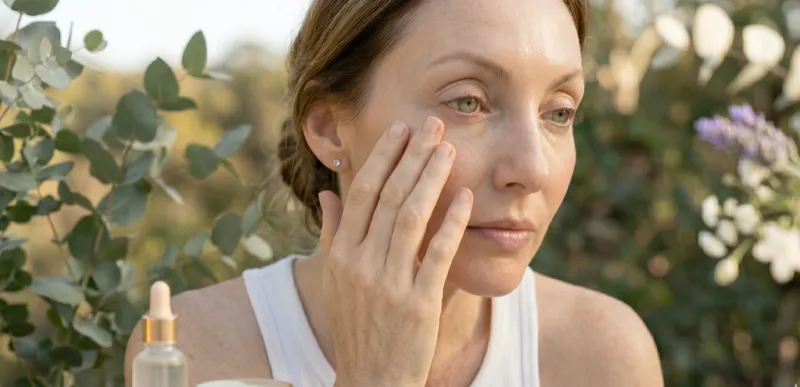
The science of skin aging is evolving rapidly — and for women navigating the skin changes that come with menopause and beyond, evidence-based skincare represents a fundamentally different approach: working with your skin's biology rather than against it.
Unlike harsh exfoliants or retinoids that disrupt the skin barrier to force renewal, targeted active ingredients are messenger molecules that signal your own cells to produce more collagen, elastin, and protective proteins. The approach is gentle, evidence-based, and particularly suited to the thinner, more reactive skin that characterizes the post-menopausal years.
The Five Anatomical Changes That Create an Aged, Fatigued Appearance
When your eyes look tired and old despite adequate sleep and good health, the cause is anatomical rather than behavioral — five specific structural changes in the periorbital region create the visual impression of fatigue and aging, and understanding which changes are affecting you determines the most effective treatment approach. The periorbital area ages faster than any other facial zone because of its unique anatomical vulnerability: the thinnest skin on the body (0.5mm vs 2mm elsewhere on the face), minimal subcutaneous fat, constant mechanical stress from 15,000-20,000 blinks per day, virtually no sebaceous glands for moisture protection, and the highest ratio of blood vessel density to skin thickness on the body — meaning every vascular change is immediately visible through the translucent surface. Change 1 — Periorbital skin thinning: starting in the late 20s, the already-thin periorbital dermis loses approximately 1% of its collagen per year from intrinsic aging, with UV exposure accelerating this by 3-5x. As the dermis thins further, it becomes increasingly translucent, revealing the underlying vascular bed (creating dark circles), allowing fine lines to etch more deeply (crow's feet), and losing the smooth surface tension that gives youthful eyes their rested appearance. The thinning is progressive and cumulative — each year makes the translucency and wrinkling incrementally worse.[1]
Change 2 — Suborbicularis fat pad atrophy: beneath the orbicularis oculi muscle lies a fat pad that provides volume and smoothness to the under-eye area. This fat pad begins to atrophy in the mid-30s to 40s, creating the hollow tear trough that casts a shadow interpreted as a dark circle and makes the lower lid appear sunken and gaunt. The fat pad atrophy also weakens the structural support holding the orbital contents in position, contributing to under-eye bags when the remaining fat herniates forward through the weakened orbital septum. Change 3 — Orbital septum weakening: the orbital septum is a thin fibrous membrane that holds the orbital fat pads behind the orbital rim. With age, this membrane stretches and weakens, allowing the retro-orbital fat to bulge forward, creating the puffy bags that are among the most age-revealing periorbital features. Unlike morning puffiness (which is fluid-based and temporary), fat pad herniation is structural and permanent — the bags are present at all times and worsen with gravity throughout the day. Change 4 — Lateral canthal lines (crow's feet): the repetitive contraction of the orbicularis oculi muscle during squinting, smiling, and blinking creates dynamic lines at the outer corners of the eyes that eventually become static (permanently etched) as the periorbital collagen thins. Crow's feet are one of the earliest visible signs of facial aging because the thin periorbital skin creases under far less mechanical force than thicker facial skin.
Clinical research confirms that change 5 — Upper eyelid hooding: the skin of the upper eyelid loses elasticity and begins to drape over the lid crease, creating a heavy, hooded appearance that makes the eyes look smaller, sleepier, and older. Upper lid hooding is partly genetic (some people have naturally heavier upper lids) and partly age-related (the forehead and brow area loses collagen, allowing the brow to descend and push the upper lid skin downward). Hooding can also partially obstruct the superior visual field, causing subconscious brow elevation that creates forehead lines. Together, these five changes create the composite appearance that reads as 'tired and old' — hollow under-eyes with visible dark circles, puffy bags, wrinkled crow's feet, thinned translucent skin, and hooded upper lids. The eyes carry disproportionate visual weight in facial perception — studies show that observers judge age and fatigue primarily from the periorbital area, making it the single most impactful zone for anti-aging treatment.
The targeted treatment approach for each change: For periorbital skin thinning — peptide eye cream (Matrixyl 3000) applied twice daily gradually rebuilds dermal collagen, thickening the thin periorbital skin to reduce translucency and improve fine line resilience. Retinol at very low concentration (0.025-0.05%) can supplement peptide therapy for accelerated collagen production, but must be introduced cautiously on the ultra-thin periorbital skin. SPF applied daily around the eyes prevents the UV-driven collagen destruction that is the primary accelerator of periorbital thinning. For fat pad atrophy and orbital septum weakening — topical treatments have limited ability to restore lost orbital volume or tighten the orbital septum. However, peptides can strengthen the surrounding skin, and HA provides temporary plumping that softens the tear trough appearance. For significant volume loss, hyaluronic acid filler professionally injected into the tear trough remains the most effective non-surgical option. For crow's feet — peptide cream applied to the lateral canthal area morning and evening, combined with diligent SPF use, slows the progression and gradually improves existing lines through collagen rebuilding. For upper lid hooding — peptide cream applied to the upper lid can improve skin quality, though significant hooding typically requires professional evaluation. The comprehensive periorbital anti-aging protocol: peptide eye cream (collagen rebuilding) + caffeine (de-puffing) + ceramides (barrier support) + SPF (UV protection) applied consistently for 6-12 months produces meaningful improvement in the overall 'tired and old' appearance by addressing the skin quality component of all five changes simultaneously.
Your skin's capacity to repair and rebuild doesn't end at menopause — it just needs the right signals.
— Dr. Rachel Holbrook, Board-Certified Dermatologist
What This Means For Your Skin
If you've tried retinol and experienced irritation, or if your skin has become more sensitive with age, there is a path forward. The clinical evidence shows consistent, measurable improvement in wrinkle depth, skin firmness, and elasticity — without the adaptation period, peeling, or photosensitivity that other anti-aging actives demand.
Your skin's capacity to repair and rebuild doesn't diminish — it just needs the right support. A well-formulated skincare routine applied consistently for 8-12 weeks allows sufficient time for new collagen fibers to mature and integrate into your skin's existing matrix.
The science is clear. The evidence is consistent. The results are measurable.
What happens next is up to you.