
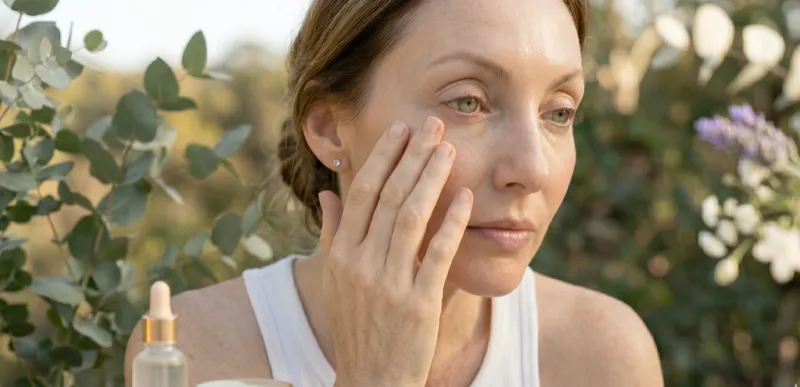
The science of skin aging is evolving rapidly — and for women navigating the skin changes that come with menopause and beyond, evidence-based skincare represents a fundamentally different approach: working with your skin's biology rather than against it.
Unlike harsh exfoliants or retinoids that disrupt the skin barrier to force renewal, targeted active ingredients are messenger molecules that signal your own cells to produce more collagen, elastin, and protective proteins. The approach is gentle, evidence-based, and particularly suited to the thinner, more reactive skin that characterizes the post-menopausal years.
Understanding the Three Types of Dark Circles and What Actually Helps
Dark circles under the eyes are among the most common cosmetic complaints, yet treatment frequently fails because the term 'dark circles' actually describes three completely different conditions with different causes, different appearances, and different treatment requirements. Treating all dark circles identically — as most eye creams attempt to do — produces disappointing results because the product addresses one mechanism while the patient's dark circles are caused by another. Accurate self-diagnosis of your dark circle type is the first and most important step toward effective treatment. Type 1: Vascular dark circles — these appear as a blue-purple or reddish discoloration concentrated in the tear trough and medial (inner) under-eye area. The color comes from dilated, congested blood vessels visible through the extremely thin periorbital skin (0.5mm thick, compared to 2mm elsewhere on the face). The thin, translucent epidermis cannot conceal the underlying vascular bed, so engorgement of the periorbital capillaries creates visible dark coloration from the outside. Vascular dark circles are typically worse in the morning (from horizontal sleeping position), during allergy season (histamine-mediated vasodilation), and during periods of fatigue (reduced vascular tone). They often have a hereditary component — people with naturally thinner periorbital skin or more prominent periorbital vasculature develop vascular dark circles regardless of lifestyle factors.[1]
Type 2: Pigmentary dark circles (periorbital hyperpigmentation) — these appear as brown or dark brown discoloration that is uniform across the under-eye area and often extends to the upper eyelid. The color comes from excess melanin deposited in the thin periorbital epidermis and superficial dermis. Pigmentary dark circles are more common in Fitzpatrick skin types III-VI and have a strong genetic component. They are worsened by UV exposure (which stimulates melanocyte activity in the periorbital skin), post-inflammatory hyperpigmentation from eczema or allergic dermatitis, and chronic rubbing or friction that triggers melanocyte activation through mechanical stimulation. Unlike vascular dark circles, pigmentary dark circles do not change significantly with time of day, sleep quality, or head position — they are consistent because the melanin deposits are structural, not dynamic. Type 3: Structural dark circles (tear trough hollowing) — these appear as a shadow cast by the concavity beneath the eye where the thin periorbital skin meets the thicker cheek skin. The 'dark circle' is actually an optical illusion created by light falling into the hollow and creating shadow. Structural dark circles worsen with age as the suborbicularis oculi fat pad atrophies, the orbital septum weakens, and the malar fat pad descends, deepening the groove between the lower eyelid and the cheek. Many people have a combination of two or all three types, which is why a single treatment approach rarely resolves the complete dark circle appearance.
Clinical research confirms that natural treatment matched to dark circle type. For vascular dark circles: (1) Cold therapy — morning application of chilled spoons, refrigerated eye masks, or cold-steeped green tea bags (the caffeine provides additional vasoconstriction). Apply for 5-10 minutes. The cold constricts the dilated periorbital capillaries, immediately reducing the visible blue-purple coloration. (2) Topical caffeine — 3-5% caffeine applied morning and as needed provides sustained vasoconstriction that keeps the periorbital vasculature less congested. (3) Vitamin K cream — vitamin K is a cofactor in the coagulation cascade and, when applied topically, may reduce the appearance of blood pooling in the periorbital capillaries by supporting the vascular wall integrity that prevents microhemorrhages. Evidence is modest but the mechanism is plausible. (4) Allergy management — if allergic rhinitis is contributing to periorbital vascular congestion (allergic shiners), treating the underlying allergy with antihistamines, nasal corticosteroids, or allergen avoidance produces significant improvement in the dark circles as a secondary benefit. (5) Sleep elevation — sleeping with the head slightly elevated (15-degree incline) reduces the overnight venous congestion that makes vascular dark circles worst in the morning.
For pigmentary dark circles: (1) Vitamin C serum — L-ascorbic acid at 10-15% inhibits tyrosinase activity, reducing melanin production in the hyperactive periorbital melanocytes. Applied daily for 8-12 weeks, vitamin C produces gradual brightening of the pigmented area. Use a formulation specifically designed for the periorbital area (lower concentration, gentler pH) to avoid irritating the thin skin. (2) Niacinamide — at 4-5%, niacinamide inhibits melanosome transfer from melanocytes to keratinocytes, reducing the visible pigmentation without irritation. Niacinamide is particularly well-suited for the sensitive periorbital skin because it causes virtually no irritation. (3) Strict SPF protection — UV exposure directly stimulates the melanocytes causing periorbital hyperpigmentation. Daily application of mineral SPF 30-50 around the eyes (using a formula designed for the eye area to avoid stinging) prevents UV-triggered melanin production that would undo the brightening treatment. (4) Arbutin — a natural hydroquinone derivative from bearberry that inhibits tyrosinase more gently than prescription hydroquinone, making it appropriate for the sensitive periorbital skin. For structural dark circles (hollowing): topical treatments have limited effectiveness because the issue is volume loss, not skin quality. However, peptide cream applied to the periorbital skin can gradually thicken the thin dermis, reducing the translucency that accentuates the shadow effect. Hyaluronic acid serum provides temporary plumping that softens the tear trough concavity. For significant structural dark circles, dermal filler injected by a trained professional into the tear trough remains the most effective non-surgical intervention.
Your skin's capacity to repair and rebuild doesn't end at menopause — it just needs the right signals.
— Dr. Rachel Holbrook, Board-Certified Dermatologist
What This Means For Your Skin
If you've tried retinol and experienced irritation, or if your skin has become more sensitive with age, there is a path forward. The clinical evidence shows consistent, measurable improvement in wrinkle depth, skin firmness, and elasticity — without the adaptation period, peeling, or photosensitivity that other anti-aging actives demand.
Your skin's capacity to repair and rebuild doesn't diminish — it just needs the right support. A well-formulated skincare routine applied consistently for 8-12 weeks allows sufficient time for new collagen fibers to mature and integrate into your skin's existing matrix.
The science is clear. The evidence is consistent. The results are measurable.
What happens next is up to you.