
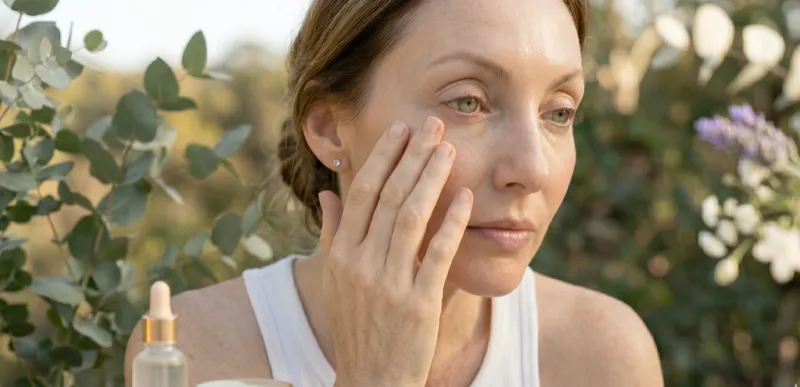
The science of skin aging is evolving rapidly — and for women navigating the skin changes that come with menopause and beyond, evidence-based skincare represents a fundamentally different approach: working with your skin's biology rather than against it.
Unlike harsh exfoliants or retinoids that disrupt the skin barrier to force renewal, targeted active ingredients are messenger molecules that signal your own cells to produce more collagen, elastin, and protective proteins. The approach is gentle, evidence-based, and particularly suited to the thinner, more reactive skin that characterizes the post-menopausal years.
Restoring Luminosity to the Periorbital Area Through Targeted Ingredients
Dull, lackluster under-eye skin is one of the most common periorbital complaints — and one of the most treatable because its primary causes are functional rather than structural. Unlike deep wrinkles or fat herniation (which involve irreversible tissue changes), dullness is primarily caused by three reversible conditions: chronic dehydration of the thin periorbital epidermis, accumulated dead cell buildup from sluggish keratinocyte turnover, and impaired micro-circulation that reduces the healthy glow produced by adequate blood flow to the superficial dermis. Addressing all three produces visible brightening within days for the hydration component and weeks for the cellular turnover and circulatory components. The periorbital skin is particularly prone to dullness because its unique anatomy amplifies all three causes. Dehydration: the periorbital skin has minimal sebaceous glands — the oil-producing glands that maintain the lipid barrier everywhere else on the face are virtually absent around the eyes. Without this natural lipid barrier, transepidermal water loss (TEWL) from the periorbital skin is 2-3x higher than from the sebum-protected cheeks and forehead, creating chronic dehydration that makes the skin appear flat, grey, and lifeless. Dead cell accumulation: the thin periorbital epidermis turns over slightly more slowly than thicker facial skin, and the absence of sebum (which assists in natural desquamation) means that dead corneocytes accumulate on the surface, creating a dull, opaque film that blocks light reflection.[1]
Micro-circulation impairment: the periorbital blood supply runs through small, superficial vessels that are prone to sluggish flow — particularly in the morning, during sedentary periods, and in smokers. When micro-circulation is impaired, the thin, translucent periorbital skin loses the warm, healthy coloration that comes from well-oxygenated blood flowing through the superficial capillary bed, and instead takes on the grey-blue cast of poorly oxygenated stagnant blood. The comprehensive brightening protocol: Step 1 — Intensive hydration (immediate effect, days 1-3). The fastest route to visibly brighter under-eye skin is aggressive hydration that restores the dermal water content. Apply hyaluronic acid serum to damp periorbital skin — low molecular weight HA penetrates the thin epidermis readily, drawing and binding water in the superficial dermis that produces immediate plumping and light-reflecting smoothness. Seal with ceramide eye cream to prevent the rapid TEWL that would drain the HA-bound water within hours. The hydration effect is visible within a single application — properly hydrated periorbital skin appears immediately brighter, smoother, and more luminous compared to the flat, grey appearance of dehydrated skin.
Clinical research confirms that step 2 — Gentle cellular renewal (progressive effect, weeks 2-6). Accelerating the removal of accumulated dead cells reveals the fresher, more light-reflective skin beneath. For the sensitive periorbital area, use gentle renewal agents only: (1) Peptide eye cream — peptides stimulate keratinocyte proliferation, gradually increasing turnover rate without the mechanical or chemical irritation of traditional exfoliants. (2) Niacinamide (3-5%) — stimulates cellular energy production (NAD+ precursor) that supports faster keratinocyte turnover, while simultaneously strengthening the barrier. (3) Low-concentration retinol (0.025%) used 1-2 nights per week — normalizes keratinocyte differentiation and turnover, addressing the dead cell accumulation at its regulatory source. NEVER use AHA/BHA chemical exfoliants or physical scrubs on the periorbital skin — the tissue is too thin and fragile for these approaches, and the irritation they cause creates inflammatory redness and swelling that makes the area look worse, not better.
Step 3 — Micro-circulation enhancement (progressive effect, weeks 2-8). Improving blood flow to the periorbital area restores the warm, healthy coloration that dull skin lacks. (1) Vitamin C serum (sodium ascorbyl phosphate 5-10%, a stabilized form suitable for the periorbital area) — vitamin C improves endothelial function in small vessels, enhancing micro-circulation while providing antioxidant protection and collagen cofactor support. Apply in the morning under eye cream. (2) Caffeine — in addition to its de-puffing vasoconstrictor effect, caffeine's phosphodiesterase inhibition improves the contractile function of small blood vessels, supporting healthier circulatory dynamics in the periorbital tissue. (3) Gentle periorbital massage — 30 seconds of light tapping along the orbital bone after product application stimulates local blood flow. The mechanical stimulation activates endothelial nitric oxide production, promoting vasodilation in the deeper circulatory bed while the superficial vasoconstriction from caffeine manages puffiness — a complementary dual effect. (4) Cold-to-warm alternation — briefly alternating cold (refrigerated spoon, 10 seconds) and warm (finger warmth, 10 seconds) application, repeated 3-4 times, creates a vascular pump effect that flushes stagnant blood and brings fresh, oxygenated blood to the periorbital area. Brightness-specific ingredients to look for: vitamin C (brightening + collagen support), niacinamide (tone evening + barrier strengthening), licorice root extract (glabridin — gentle tyrosinase inhibition that reduces any pigmentary contribution to dullness), and light-diffusing minerals (mica, silica — provide immediate optical brightening while active ingredients work on the biological causes).
Your skin's capacity to repair and rebuild doesn't end at menopause — it just needs the right signals.
— Dr. Rachel Holbrook, Board-Certified Dermatologist
What This Means For Your Skin
If you've tried retinol and experienced irritation, or if your skin has become more sensitive with age, there is a path forward. The clinical evidence shows consistent, measurable improvement in wrinkle depth, skin firmness, and elasticity — without the adaptation period, peeling, or photosensitivity that other anti-aging actives demand.
Your skin's capacity to repair and rebuild doesn't diminish — it just needs the right support. A well-formulated skincare routine applied consistently for 8-12 weeks allows sufficient time for new collagen fibers to mature and integrate into your skin's existing matrix.
The science is clear. The evidence is consistent. The results are measurable.
What happens next is up to you.