
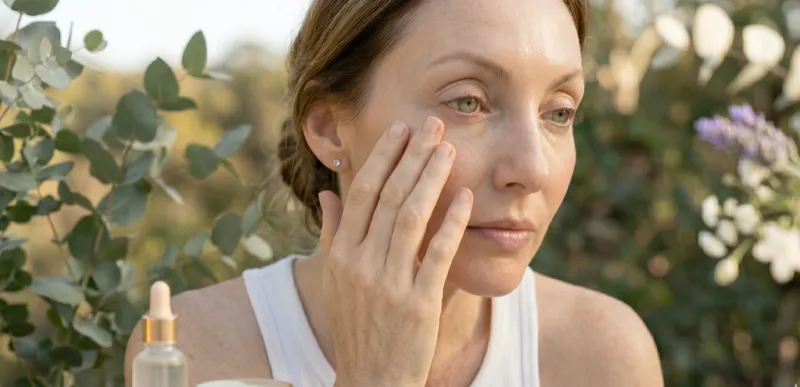
The science of skin aging is evolving rapidly — and for women navigating the skin changes that come with menopause and beyond, evidence-based skincare represents a fundamentally different approach: working with your skin's biology rather than against it.
Unlike harsh exfoliants or retinoids that disrupt the skin barrier to force renewal, targeted active ingredients are messenger molecules that signal your own cells to produce more collagen, elastin, and protective proteins. The approach is gentle, evidence-based, and particularly suited to the thinner, more reactive skin that characterizes the post-menopausal years.
The Complete Periorbital Protocol for Mature Skin
The periorbital area after 50 presents a constellation of concurrent changes that require a comprehensive, twice-daily treatment approach: the periorbital dermis has lost an estimated 30-40% of its collagen from intrinsic aging and cumulative UV exposure; the orbital septum has weakened, allowing fat pad herniation that creates persistent under-eye bags; the suborbicularis fat pad has atrophied, deepening the tear trough; the periorbital skin's already-minimal sebaceous gland function has further declined (particularly post-menopause), creating chronic barrier compromise; and the elastin network has degraded, reducing the elastic recoil that maintained smooth periorbital skin surface tension. These changes are not reversible to their youthful state through topical treatment — but consistent, targeted care can improve skin quality, reduce the severity of visible aging, and slow further progression meaningfully. The women over 50 who look years younger than their age around the eyes are invariably those with a disciplined, daily periorbital routine rather than those who rely on occasional intensive treatments.[1]
The morning routine (focus: protection, de-puffing, hydration): Step 1 — Cold compress or chilled eye cream application (2-3 minutes). Morning puffiness after 50 is more persistent because weakened lymphatic drainage clears overnight fluid accumulation more slowly. A brief cold application jump-starts the drainage. Step 2 — Eye serum with caffeine and peptides. Apply with the ring finger using gentle tapping along the orbital bone. The caffeine sustains the cold-initiated vasoconstriction for 4-6 hours, managing the puffiness through the morning and early afternoon. The peptides begin their daily collagen-stimulation work. Step 3 — Eye cream with ceramides and HA layered over the serum. After 50, the serum alone cannot provide adequate hydration for the severely oil-depleted periorbital skin — the cream provides the lipid barrier seal that keeps the serum's actives in contact with the skin and prevents the rapid TEWL that dehydrates the thin periorbital dermis within hours. Step 4 — SPF 30-50 applied over the eye cream. Even after decades of UV exposure, daily SPF prevents further UV-driven collagen destruction. The periorbital collagen that remains must be protected aggressively.
Clinical research confirms that the evening routine (focus: repair, collagen stimulation, intensive hydration): Step 1 — Gentle cleansing of the periorbital area. Use a micellar water or cleansing balm to remove makeup and SPF without rubbing the fragile skin. The orbicularis oculi muscle has thinned with age, providing less structural support beneath the skin — aggressive rubbing during cleansing can stretch the already-lax tissue. Step 2 — Peptide eye serum applied to damp periorbital skin. Evening application is the most important for collagen stimulation because the 7-8 hour overnight contact period provides the longest uninterrupted active ingredient exposure. The skin's circadian repair cycle peaks during sleep, making the evening application synergistic with the body's natural repair timing. Step 3 — Low-concentration retinol (0.025-0.05%) applied 2-3 nights per week, layered over the peptide serum. After 50, the periorbital skin is more reactive to retinol, so the ultra-low concentration and ceramide buffering are essential. On retinol nights, the peptide serum provides the moisture buffer beneath the retinol, reducing irritation while maintaining peptide contact. On non-retinol nights, skip this step. Step 4 — Rich ceramide eye balm or cream as the final seal. This is the most critical evening step after 50 — without an aggressive lipid barrier, the overnight TEWL from the oil-depleted periorbital skin can reach levels that completely negate the hydrating benefit of the underlying products.
Additional weekly and as-needed treatments: (1) Intensive overnight eye mask — once weekly, apply a generous layer of ceramide-rich eye balm or petroleum jelly over the entire periorbital area as an overnight occlusive treatment. The intensive occlusion provides deep hydration that reduces the crepey texture for 2-3 days. (2) Gentle periorbital massage — 2-3 times weekly, after applying evening products, perform 30 seconds of gentle tapping along the orbital bone to stimulate circulation and lymphatic drainage. This is particularly important after 50 when lymphatic efficiency has declined. (3) Hydrating eye patches — as needed before events or when the periorbital area looks particularly dry or fatigued. Hydrogel patches infused with HA and peptides provide 20-30 minutes of intensive contact that produces immediate visible improvement. Important principles for the over-50 periorbital routine: Pressure — always minimal. Use the ring finger exclusively. Never rub, pull, or stretch the periorbital skin. Products — choose ophthalmologist-tested formulations to avoid the irritation that can cause inflammatory swelling and barrier disruption. Consistency — twice daily, every day. The cumulative collagen-building benefit from peptides requires uninterrupted daily stimulation; missed days reset the signaling cycle. Expectations — topical treatment produces meaningful, visible improvement in skin quality, hydration, fine line depth, and puffiness severity — but cannot fully reverse decades of structural aging. The goal is the best possible version of your periorbital area, which consistent care can make look 5-10 years younger than neglected periorbital skin of the same age.
Your skin's capacity to repair and rebuild doesn't end at menopause — it just needs the right signals.
— Dr. Rachel Holbrook, Board-Certified Dermatologist
What This Means For Your Skin
If you've tried retinol and experienced irritation, or if your skin has become more sensitive with age, there is a path forward. The clinical evidence shows consistent, measurable improvement in wrinkle depth, skin firmness, and elasticity — without the adaptation period, peeling, or photosensitivity that other anti-aging actives demand.
Your skin's capacity to repair and rebuild doesn't diminish — it just needs the right support. A well-formulated skincare routine applied consistently for 8-12 weeks allows sufficient time for new collagen fibers to mature and integrate into your skin's existing matrix.
The science is clear. The evidence is consistent. The results are measurable.
What happens next is up to you.