
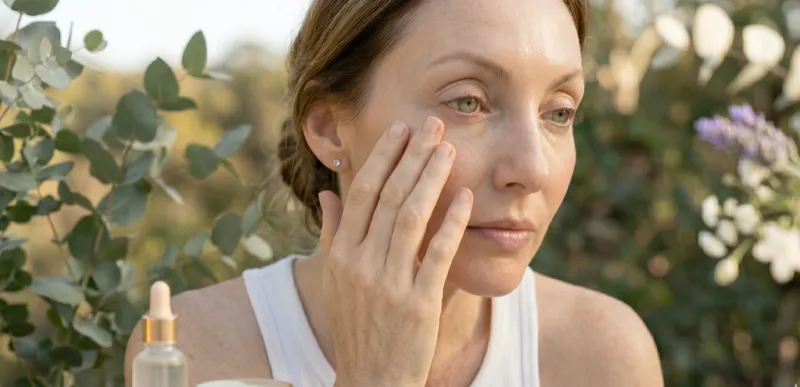
The science of skin aging is evolving rapidly — and for women navigating the skin changes that come with menopause and beyond, evidence-based skincare represents a fundamentally different approach: working with your skin's biology rather than against it.
Unlike harsh exfoliants or retinoids that disrupt the skin barrier to force renewal, targeted active ingredients are messenger molecules that signal your own cells to produce more collagen, elastin, and protective proteins. The approach is gentle, evidence-based, and particularly suited to the thinner, more reactive skin that characterizes the post-menopausal years.
Comparing Immediate Physical and Topical Approaches to Periorbital Swelling
The cold compress vs eye cream comparison for periorbital puffiness is not actually an either/or decision — the two approaches work through completely different mechanisms, produce different timelines of benefit, and are most effective when used together. However, understanding the distinct mechanism of each helps set realistic expectations and optimize the combined protocol. Cold compresses work through direct physical vasoconstriction: when cold (4-8 degrees Celsius) is applied to the periorbital skin, the thermal receptors in the skin trigger a sympathetic nervous system response that constricts the superficial arterioles and capillaries. This vasoconstriction reduces the hydrostatic pressure that drives plasma transudation from the periorbital capillaries into the surrounding tissue, immediately slowing the rate of fluid accumulation. Simultaneously, the cold stimulates contraction of the smooth muscle walls of the lymphatic vessels, accelerating the drainage of fluid that has already accumulated in the periorbital interstitial space. The result is a measurable reduction in periorbital edema volume within 5-10 minutes of cold application.[1]
Cold compress characteristics: Speed of onset — 3-5 minutes for visible puffiness reduction. Duration of effect — 30-60 minutes after the cold is removed, before the vessels re-dilate. Cumulative benefit — none. Cold compresses provide the same temporary benefit each time with no long-term improvement. Mechanism — pure physics (vasoconstriction from temperature change). No active ingredient penetration. Risk — minimal, but excessively cold applications (ice directly on skin) can damage the ultra-thin periorbital skin, causing cryogenic injury, broken capillaries, or irritation. Always use a cloth barrier and keep temperature at refrigerator level (4-8 degrees), not freezer level. Best for — acute morning puffiness, pre-event rapid de-puffing, post-crying swelling, hangover puffiness. The cold compress is the fastest intervention available for periorbital puffiness because it acts through direct physical means rather than requiring absorption, metabolism, or signaling pathways.
Clinical research confirms that eye cream for puffiness works through pharmacological and structural mechanisms: Active ingredient absorption — caffeine, peptides, and anti-inflammatory compounds must absorb through the periorbital epidermis, reach the vascular and connective tissue targets, and modulate the biological processes creating the puffiness. This takes longer than cold application (15-30 minutes for caffeine's vasoconstrictive effect to peak) but produces a longer-lasting result (4-6 hours vs 30-60 minutes for cold). Structural improvement — peptides in eye cream gradually strengthen the periorbital connective tissue, improve lymphatic drainage efficiency, and thicken the thin periorbital dermis, making it more resistant to visible swelling over time. This cumulative benefit means that puffiness becomes less severe over months of consistent use — something cold compresses cannot achieve. Barrier support — ceramides and HA in eye cream maintain periorbital hydration, which paradoxically reduces puffiness: well-hydrated periorbital skin with an intact barrier experiences less inflammatory fluid retention than dehydrated, barrier-compromised skin. Multi-target activity — a well-formulated eye cream simultaneously addresses puffiness (caffeine), dark circles (peptides, niacinamide), and fine lines (peptides, HA), providing comprehensive periorbital improvement rather than the single-target de-puffing of cold compresses.
The optimal combined protocol: Step 1 — Cold compress for 3-5 minutes upon waking. This provides the fastest possible puffiness reduction by physically constricting the dilated periorbital vasculature and jump-starting lymphatic drainage. Use chilled spoons, a refrigerated gel mask, or a clean cloth dampened with cold water. Step 2 — Apply eye cream immediately after removing the cold compress. The pre-constricted vasculature reduces the active fluid leakage, allowing the eye cream's caffeine to maintain the vasoconstriction that the cold initiated. The peptides and other actives absorb into the cold-thinned skin (cold briefly reduces TEWL, improving barrier function temporarily). The cold + cream sequence produces approximately 40-60% better puffiness reduction than either intervention alone because the cold provides the immediate physical effect while the cream's caffeine sustains and extends the vasoconstriction for hours. Long-term protocol: cold compress + eye cream morning routine daily for 8-12 weeks produces cumulative improvement — the cold handles the daily acute puffiness while the cream's peptides gradually strengthen the periorbital structure, making the baseline puffiness progressively less severe. After several months, many women find that the cold compress becomes unnecessary on most mornings because the structural improvement from consistent eye cream use has reduced the severity of overnight puffiness to a level that the cream alone can manage.
Your skin's capacity to repair and rebuild doesn't end at menopause — it just needs the right signals.
— Dr. Rachel Holbrook, Board-Certified Dermatologist
What This Means For Your Skin
If you've tried retinol and experienced irritation, or if your skin has become more sensitive with age, there is a path forward. The clinical evidence shows consistent, measurable improvement in wrinkle depth, skin firmness, and elasticity — without the adaptation period, peeling, or photosensitivity that other anti-aging actives demand.
Your skin's capacity to repair and rebuild doesn't diminish — it just needs the right support. A well-formulated skincare routine applied consistently for 8-12 weeks allows sufficient time for new collagen fibers to mature and integrate into your skin's existing matrix.
The science is clear. The evidence is consistent. The results are measurable.
What happens next is up to you.