
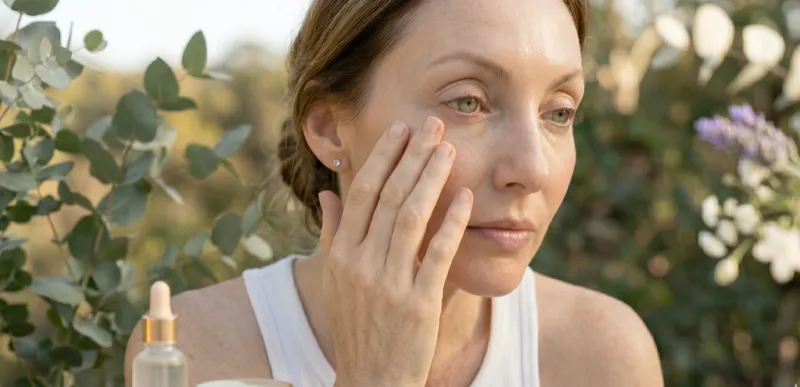
The science of skin aging is evolving rapidly — and for women navigating the skin changes that come with menopause and beyond, evidence-based skincare represents a fundamentally different approach: working with your skin's biology rather than against it.
Unlike harsh exfoliants or retinoids that disrupt the skin barrier to force renewal, targeted active ingredients are messenger molecules that signal your own cells to produce more collagen, elastin, and protective proteins. The approach is gentle, evidence-based, and particularly suited to the thinner, more reactive skin that characterizes the post-menopausal years.
Why Fat Herniation and Fluid Retention Create Persistent Under-Eye Swelling
Under-eye bags are among the most age-revealing periorbital features and one of the most misunderstood — many women assume their bags are caused by fluid retention (puffiness) when they are actually caused by structural fat herniation, or vice versa. The distinction matters because the two types of under-eye bags have completely different treatment approaches: fluid-based bags respond well to topical treatment and lifestyle modification, while fat-based bags have limited topical treatment options. Accurate self-diagnosis of your bag type is the essential first step. Fat herniation bags (structural bags): these are caused by the weakening of the orbital septum — a thin fibrous membrane that holds the retro-orbital fat pads in position behind the orbital rim. With age, the septum stretches and thins, allowing the fat pads to bulge forward through the weakened membrane, creating a convex swelling beneath the lower eyelid. Fat herniation bags are permanent (present at all times of day, regardless of sleep, diet, or hydration), firm to the touch (because they contain solid fat, not fluid), more prominent when looking upward (the upward gaze pushes the fat forward through the weakened septum), and progressive (they increase in size as the septum continues to weaken). Genetics play a significant role — if your parents developed prominent under-eye bags, you are likely to as well, often at a similar age.[1]
Fluid retention bags (puffiness): these are caused by the accumulation of interstitial fluid in the loose periorbital connective tissue. Unlike fat herniation, fluid bags fluctuate — they are worse in the morning (after horizontal sleeping allows gravitational fluid redistribution), after high-sodium meals (increased osmotic fluid retention), during allergy flares (histamine-mediated vascular leakage), and during hormonal fluctuations (estrogen affects fluid distribution). Fluid bags are soft and compressible to the touch (because they contain fluid, not solid tissue), improve throughout the day as gravity assists lymphatic drainage, and respond to cold compression and caffeine application. Many people have a combination of both types — a baseline structural fat herniation bag that is amplified by variable fluid retention, creating bags that are always present but fluctuate in size. The mixed presentation is particularly common in women over 45.
Clinical research confirms that remedies for fluid retention bags: (1) Morning cold compress (3-5 minutes) — constricts the periorbital vasculature and stimulates lymphatic drainage, reducing the fluid component within minutes. (2) Caffeine eye cream — sustains the vasoconstrictive effect for 4-6 hours, keeping the fluid bags reduced through the morning. (3) Sleep position modification — sleeping with the head slightly elevated (15-degree incline) reduces overnight periorbital fluid accumulation by decreasing venous pressure in the periorbital vessels. (4) Sodium restriction after 4pm — reducing evening sodium intake directly reduces the overnight osmotic fluid retention that amplifies morning bags. (5) Allergy management — if allergic rhinitis is contributing to periorbital fluid retention, appropriate antihistamine and nasal corticosteroid treatment reduces the histamine-mediated vascular leakage. (6) Lymphatic massage — gentle tapping along the orbital bone from inner to outer corner, then downward along the nose, physically assists lymphatic drainage. (7) Consistent hydration — adequate daily water intake prevents the compensatory fluid retention that occurs when the body is chronically dehydrated. (8) Peptide eye cream for long-term structural support — peptides gradually strengthen the periorbital connective tissue, improving its resistance to fluid-induced distension and enhancing the tissue's baseline firmness.
Remedies for fat herniation bags: topical treatments have limited effectiveness against structural fat herniation because the cause is a weakened fascial membrane and displaced fat, neither of which respond to topical active ingredients. However, several approaches can REDUCE THE APPEARANCE of fat herniation bags: (1) Caffeine eye cream — while it cannot retract the herniated fat, caffeine can reduce the vascular engorgement that makes the bags appear more prominent by increasing the color contrast between the bag and surrounding skin. (2) Peptide eye cream — cannot address the fat herniation itself, but can improve the quality and thickness of the thin skin overlying the bag, making the bag appear smoother and less textured. (3) Retinol at very low concentration — can thicken the periorbital dermis slightly over months, providing marginally better coverage of the underlying bulge. (4) Cosmetic concealer techniques — strategic light and shadow application can visually minimize the bag. For significant fat herniation bags that are cosmetically distressing, lower blepharoplasty (eyelid surgery) performed by an oculoplastic surgeon remains the most effective treatment — the procedure removes or repositions the herniated fat and tightens the orbital septum. It is a well-established procedure with high satisfaction rates. However, many women with moderate bags find that the combination of caffeine, peptides, and lifestyle modifications reduces the bags' prominence sufficiently to avoid surgery. The decision depends on the severity of the herniation and the individual's cosmetic goals.
Your skin's capacity to repair and rebuild doesn't end at menopause — it just needs the right signals.
— Dr. Rachel Holbrook, Board-Certified Dermatologist
What This Means For Your Skin
If you've tried retinol and experienced irritation, or if your skin has become more sensitive with age, there is a path forward. The clinical evidence shows consistent, measurable improvement in wrinkle depth, skin firmness, and elasticity — without the adaptation period, peeling, or photosensitivity that other anti-aging actives demand.
Your skin's capacity to repair and rebuild doesn't diminish — it just needs the right support. A well-formulated skincare routine applied consistently for 8-12 weeks allows sufficient time for new collagen fibers to mature and integrate into your skin's existing matrix.
The science is clear. The evidence is consistent. The results are measurable.
What happens next is up to you.