
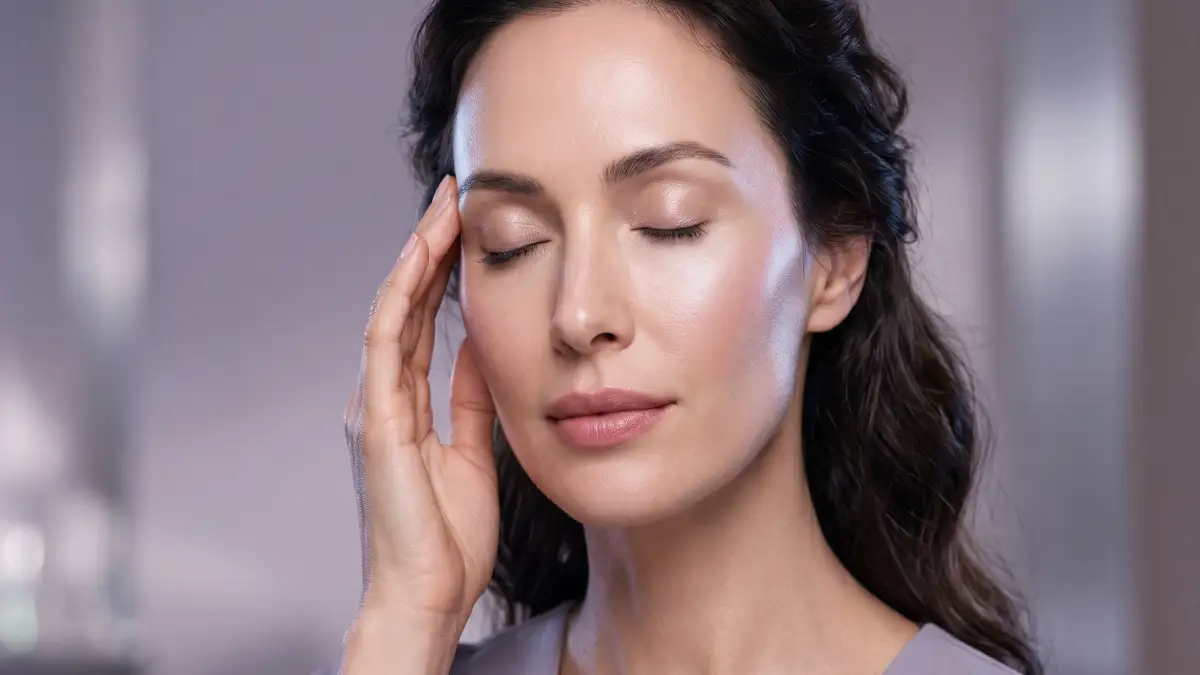
The science of skin aging is evolving rapidly — and for women navigating the skin changes that come with menopause and beyond, evidence-based skincare represents a fundamentally different approach: working with your skin's biology rather than against it.
Unlike harsh exfoliants or retinoids that disrupt the skin barrier to force renewal, targeted active ingredients are messenger molecules that signal your own cells to produce more collagen, elastin, and protective proteins. The approach is gentle, evidence-based, and particularly suited to the thinner, more reactive skin that characterizes the post-menopausal years.
Periorbital Wrinkle Reduction With Neuropeptide Therapy
The periorbital area — particularly crow's feet at the lateral canthi — was the primary measurement site in the landmark Blanes-Mira study that established argireline's clinical efficacy. This region was chosen specifically because crow's feet are almost exclusively caused by orbicularis oculi muscle contraction during smiling, squinting, and blinking, making them an ideal target for a muscle-relaxing neuropeptide. The study demonstrated 30% reduction in wrinkle depth after 30 days of 10% argireline application in this specific anatomical zone.[1]
The periorbital area presents both advantages and challenges for topical argireline application. The skin around the eyes is the thinnest on the face — approximately 0.5mm compared to 2mm on the cheeks — which theoretically enhances peptide penetration to the underlying orbicularis oculi muscle. However, this thin skin is also more sensitive to irritation, which is why most argireline eye formulations use 5% rather than 10% concentration. Wang's 2013 in vivo evaluation specifically examined periorbital rejuvenation with argireline and confirmed both efficacy and tolerability in this delicate area.
Clinical research confirms that for women over 40, crow's feet represent a particular concern because they are among the first expression lines to become visible at rest — not just during smiling. This transition from dynamic to static wrinkles occurs when repeated muscle contraction gradually breaks down the collagen and elastin fibers in the periorbital dermis. Argireline addresses the mechanical cause by reducing contraction intensity, but optimal results require concurrent support for the structural components — which is why combining argireline with peptides that stimulate collagen synthesis (such as palmitoyl tripeptide-1) produces synergistic periorbital improvement.
Application technique around the eyes requires careful attention to avoid product migration into the eyes. Argireline serum should be applied using the ring finger — which naturally exerts the least pressure — in a C-shape pattern starting from the inner corner beneath the eye, sweeping along the orbital bone to the outer corner, and continuing along the crow's feet area toward the temple. This application pattern follows the orbicularis oculi muscle fibers and maximizes contact with the neuromuscular junctions most responsible for crow's feet formation.
Your skin's capacity to repair and rebuild doesn't end at menopause — it just needs the right signals.
— Dr. Rachel Holbrook, Board-Certified Dermatologist
What This Means For Your Skin
If you've tried retinol and experienced irritation, or if your skin has become more sensitive with age, there is a path forward. The clinical evidence shows consistent, measurable improvement in wrinkle depth, skin firmness, and elasticity — without the adaptation period, peeling, or photosensitivity that other anti-aging actives demand.
Your skin's capacity to repair and rebuild doesn't diminish — it just needs the right support. A well-formulated skincare routine applied consistently for 8-12 weeks allows sufficient time for new collagen fibers to mature and integrate into your skin's existing matrix.
The science is clear. The evidence is consistent. The results are measurable.
What happens next is up to you.