
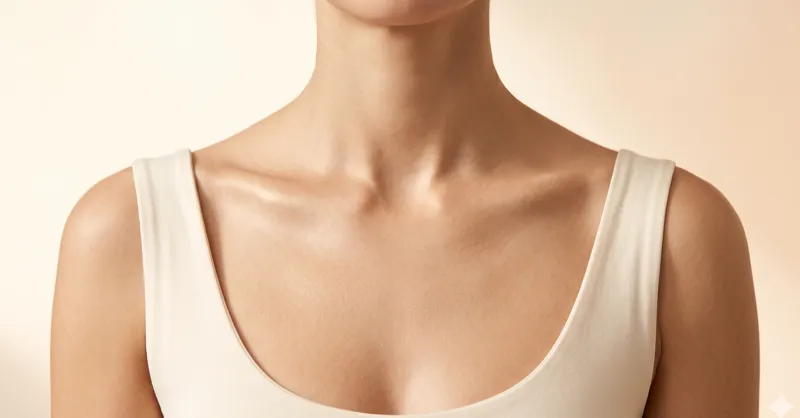
The science of skin aging is evolving rapidly — and for women navigating the skin changes that come with menopause and beyond, evidence-based skincare represents a fundamentally different approach: working with your skin's biology rather than against it.
Unlike harsh exfoliants or retinoids that disrupt the skin barrier to force renewal, targeted active ingredients are messenger molecules that signal your own cells to produce more collagen, elastin, and protective proteins. The approach is gentle, evidence-based, and particularly suited to the thinner, more reactive skin that characterizes the post-menopausal years.
Using the Body's Natural Hydrator to Plump and Smooth the Décolleté
Hyaluronic acid (HA) is the most effective hydrating ingredient available for chest wrinkle reduction, providing both immediate cosmetic improvement (through tissue hydration and plumping) and supportive conditions for long-term structural repair (by maintaining the hydrated environment that fibroblasts need for optimal collagen production). HA is a naturally occurring glycosaminoglycan — a sugar-protein molecule found abundantly in the dermal extracellular matrix, where each HA molecule binds up to 1,000 times its weight in water. This extraordinary water-binding capacity is what gives youthful skin its plump, hydrated, resilient quality. With aging, endogenous HA production declines — by age 50, the skin contains approximately half the HA present at age 20 — producing the dehydrated, volume-depleted appearance that makes wrinkles more visible and skin texture less smooth. On the chest, this HA decline is compounded by the décolleté's fewer sebaceous glands (less surface lipid retention of moisture) and higher TEWL rates (faster evaporation of water from the dermis).[1]
How topical HA reduces chest wrinkles: the mechanism depends on the molecular weight of the HA. Multi-molecular-weight HA formulations provide benefits at multiple skin depths: (1) High-molecular-weight HA (1,000-1,800 kDa) — too large to penetrate the stratum corneum, these molecules sit on the skin surface and form a hydrating film. They draw water from the atmosphere and from the underlying stratum corneum, creating a surface hydration effect that immediately smooths fine wrinkles and provides a dewy, plumped appearance. The effect is cosmetically immediate but temporary — lasting 8-12 hours until the surface film dissipates. (2) Medium-molecular-weight HA (100-500 kDa) — partially penetrates the upper stratum corneum, providing hydration to the epidermal layers. Improves skin texture and flexibility at the cellular level. (3) Low-molecular-weight HA (10-100 kDa) — penetrates to the upper dermis, providing deep hydration where the collagen and elastic fiber networks reside. This is the fraction most relevant to wrinkle reduction on the chest, because the dehydrated dermis beneath chest wrinkles plumps from within when rehydrated, reducing wrinkle depth by 10-20% through pure hydration effects.
Clinical research confirms that critical application technique for HA on chest skin: hyaluronic acid must be applied to damp skin. This point is not a minor optimization — it is a fundamental requirement for correct HA function. HA molecules bind water from whatever source is closest. When applied to damp skin, they bind the surface water and draw it into the stratum corneum, providing the intended hydrating effect. When applied to dry skin in a low-humidity environment, HA molecules can draw water upward from the dermis — paradoxically dehydrating the deeper tissue while hydrating the surface. On the thin chest dermis, this reverse hydration effect can actually worsen crepiness by depleting the limited dermal water that supports the collagen network. Protocol: mist the chest with water or toner immediately before HA application. Apply 5-6 drops of HA serum to the damp skin and spread across the entire décolleté. Immediately seal with ceramide cream — this critical sealing step traps the HA-bound moisture against the skin and prevents evaporative loss through the décolleté's impaired barrier.
HA within the complete décolleté protocol: hyaluronic acid serves as the hydration bridge between active ingredient therapy (which rebuilds structure slowly) and visible improvement (which the user expects to see promptly). The immediate plumping effect of HA — visible after the first application — provides the motivational early win that sustains adherence through the 12-16 weeks required for peptide and retinoid therapy to produce structural results. Protocol placement: Morning — vitamin C serum (collagen cofactor) → HA serum on damp skin (hydration) → peptide cream (collagen stimulation) → ceramide cream (seal) → SPF 50. Evening — HA serum on damp skin → peptide cream or retinol sandwich → ceramide cream. The HA serum goes directly onto clean, damp skin as the first hydrating step, with active ingredients layered over it and ceramide cream as the final seal. Expected results with consistent HA use on the chest: immediate hydration and fine wrinkle smoothing (first application), sustained texture improvement (2-4 weeks), enhanced efficacy of concurrent active ingredients through optimized dermal hydration environment (ongoing). HA alone will not rebuild the collagen structure that prevents wrinkles — but it provides the hydrated environment in which peptides and retinoids work most effectively, while delivering the visible improvement that keeps treatment motivation high during the slow structural rebuilding phase.
Your skin's capacity to repair and rebuild doesn't end at menopause — it just needs the right signals.
— Dr. Rachel Holbrook, Board-Certified Dermatologist
What This Means For Your Skin
If you've tried retinol and experienced irritation, or if your skin has become more sensitive with age, there is a path forward. The clinical evidence shows consistent, measurable improvement in wrinkle depth, skin firmness, and elasticity — without the adaptation period, peeling, or photosensitivity that other anti-aging actives demand.
Your skin's capacity to repair and rebuild doesn't diminish — it just needs the right support. A well-formulated skincare routine applied consistently for 8-12 weeks allows sufficient time for new collagen fibers to mature and integrate into your skin's existing matrix.
The science is clear. The evidence is consistent. The results are measurable.
What happens next is up to you.