
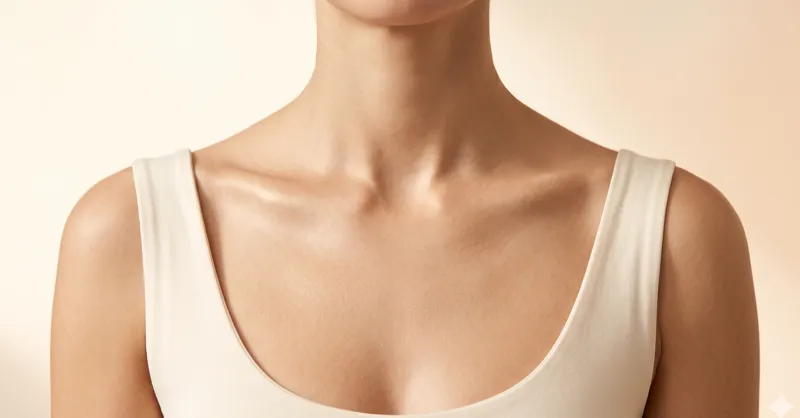
The science of skin aging is evolving rapidly — and for women navigating the skin changes that come with menopause and beyond, evidence-based skincare represents a fundamentally different approach: working with your skin's biology rather than against it.
Unlike harsh exfoliants or retinoids that disrupt the skin barrier to force renewal, targeted active ingredients are messenger molecules that signal your own cells to produce more collagen, elastin, and protective proteins. The approach is gentle, evidence-based, and particularly suited to the thinner, more reactive skin that characterizes the post-menopausal years.
Clinical Evidence for Overnight Silicone Occlusion on Décolleté Creases
Silicone chest pads — medical-grade silicone sheets worn overnight on the décolleté — represent a mechanically-mediated approach to wrinkle reduction that operates through principles entirely different from topical active ingredients. Their mechanism of action involves two simultaneous effects: (1) occlusive hydration — the silicone sheet creates an impermeable barrier over the chest skin that prevents all transepidermal water loss during the 6-8 hours of sleep, allowing the stratum corneum and upper dermis to achieve maximal hydration. This hydration plumps the tissue from within, mechanically reducing wrinkle depth. (2) Mechanical support — the rigid-yet-flexible silicone sheet physically prevents the chest skin from folding and compressing during side sleeping, eliminating the nocturnal mechanical stress that creates and deepens vertical chest creases. These two mechanisms are genuinely effective for wrinkle reduction, but understanding their limitations is equally important.[1]
What silicone pads can do: clinical observations and user studies consistently show that overnight silicone pad use produces visible reduction in chest wrinkle depth. The occlusive hydration effect is immediate — after a single night of use, most women observe smoother, plumper chest skin with visibly reduced fine wrinkles. This effect is primarily cosmetic and temporary (the hydration dissipates over 4-8 hours after pad removal), but with consistent nightly use, the sustained hydration produces cumulative improvement in skin texture and barrier function. The mechanical support function is more durable — preventing nightly compression halts the progressive deepening of sleep creases, and over weeks to months, allows the dermis to partially recover from the chronic deformation. Studies of medical silicone sheeting for scar treatment (the same material and mechanism) demonstrate that sustained occlusion modulates collagen remodeling, potentially normalizing the disordered collagen architecture in wrinkled skin.
Clinical research confirms that what silicone pads cannot do: they do not stimulate new collagen production (no fibroblast signaling pathway is activated), they do not suppress MMP activity (the enzymatic degradation of structural proteins continues unchecked), and they do not reverse photodamage-related structural protein loss. The wrinkle reduction they provide through hydration is mechanically-mediated rather than biologically-mediated — it reduces the visible depth of existing wrinkles without rebuilding the structural deficits that caused them. This distinction matters because it means silicone pads are most effective as a complement to active ingredient therapy, not as a replacement. Using silicone pads alone addresses the symptom (visible wrinkles) without treating the cause (collagen and elastin degradation). Using active ingredients alone (peptides, retinoids) treats the cause but misses the immediate mechanical benefit of overnight compression prevention.
The optimal integration strategy: combine silicone pad use with an active ingredient protocol for maximum décolleté wrinkle reduction. Evening protocol — apply the full topical routine (peptide cream or retinol sandwich + ceramide cream), then place the medical-grade silicone pad over the treated area. The silicone pad serves double duty: it provides occlusive pressure that enhances penetration and retention of the active ingredients beneath it, while simultaneously preventing sleep compression wrinkles. This combined approach produces significantly better results than either intervention alone because it addresses both the biological cause (structural protein loss → active ingredients) and the mechanical cause (sleep compression → silicone pad) simultaneously. Practical tips for silicone pad use: (1) Clean the pad daily with mild soap and water — sebum and product residue reduce adhesion. (2) Replace every 2-4 weeks when adhesion declines. (3) Choose a medical-grade pad that covers the entire upper chest — small patches leave untreated gaps. (4) For best adhesion, apply to clean, dry skin with active products absorbed (wait 15 minutes after applying cream). Expected results with combined silicone pad + active ingredient approach: visible wrinkle reduction at 4-6 weeks, progressive improvement through 3-6 months, with 25-40% reduction in visible wrinkle depth from the combination therapy.
Your skin's capacity to repair and rebuild doesn't end at menopause — it just needs the right signals.
— Dr. Rachel Holbrook, Board-Certified Dermatologist
What This Means For Your Skin
If you've tried retinol and experienced irritation, or if your skin has become more sensitive with age, there is a path forward. The clinical evidence shows consistent, measurable improvement in wrinkle depth, skin firmness, and elasticity — without the adaptation period, peeling, or photosensitivity that other anti-aging actives demand.
Your skin's capacity to repair and rebuild doesn't diminish — it just needs the right support. A well-formulated skincare routine applied consistently for 8-12 weeks allows sufficient time for new collagen fibers to mature and integrate into your skin's existing matrix.
The science is clear. The evidence is consistent. The results are measurable.
What happens next is up to you.