
The science of skin aging is evolving rapidly — and for women navigating the skin changes that come with menopause and beyond, evidence-based skincare represents a fundamentally different approach: working with your skin's biology rather than against it.
Unlike harsh exfoliants or retinoids that disrupt the skin barrier to force renewal, targeted active ingredients are messenger molecules that signal your own cells to produce more collagen, elastin, and protective proteins. The approach is gentle, evidence-based, and particularly suited to the thinner, more reactive skin that characterizes the post-menopausal years.
The Most Evidence-Supported Dietary Pattern for Slower Skin Aging
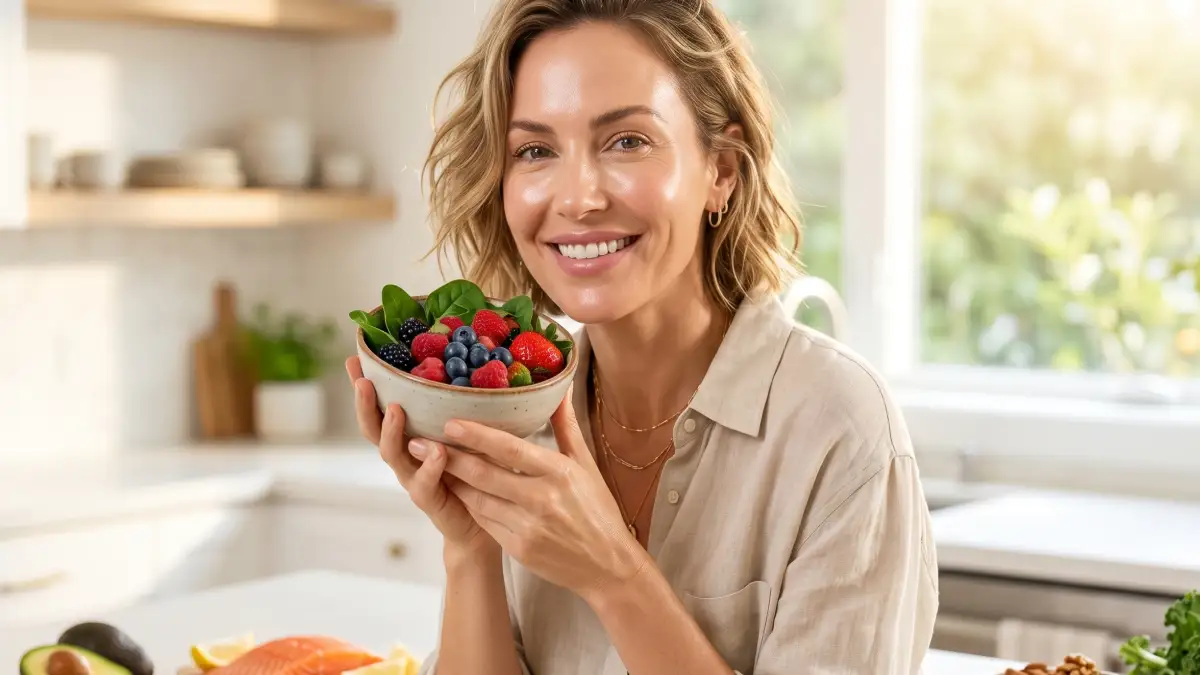
The Mediterranean diet is the single dietary pattern with the strongest and most consistent evidence for slowing skin aging — not because any single component is uniquely powerful, but because the pattern combines every nutritional factor known to influence skin aging into a cohesive, sustainable, and well-studied eating pattern. It delivers high antioxidant intake (from vegetables, fruits, and olive oil), anti-inflammatory omega-3 fatty acids (from fish and nuts), low glycemic load (from whole grains, legumes, and minimal refined sugar), prebiotic fiber (from vegetables and legumes), and polyphenol diversity (from olive oil, red wine, herbs, and spices). No other dietary pattern simultaneously addresses oxidative stress, inflammation, glycation, and nutrient supply for collagen synthesis.[1]
The epidemiological evidence is striking. A study published in the Journal of the American Academy of Dermatology analyzing dietary patterns and skin aging across multiple populations found that adherence to a Mediterranean-type diet was associated with significantly less photoaging and reduced wrinkle severity, independent of sun exposure and smoking. A separate study of Greek, Australian, and Swedish populations found that higher intake of vegetables, olive oil, and legumes — the three pillars of Mediterranean eating — was associated with less sun-related skin damage, while higher intake of butter, margarine, milk, and sugar was associated with more damage. The consistency across diverse populations (Southern European, Northern European, and Australian) strengthens the causal inference.
Clinical research confirms that extra-virgin olive oil (EVOO) deserves special attention as the signature component of the Mediterranean diet with unique skin benefits. EVOO contains oleocanthal (an anti-inflammatory compound with ibuprofen-equivalent activity), hydroxytyrosol (one of the most potent natural antioxidants known, with an ORAC value exceeding vitamin C and vitamin E), and squalene (a lipid that the skin naturally produces for barrier function, and which declines with age). A French study of 2,919 women found that higher olive oil consumption was associated with lower chronological skin aging severity scores, even after adjusting for all dietary and lifestyle confounders. The mechanism is multi-pathway: EVOO reduces systemic inflammation, provides topical-grade antioxidant protection from within, and supplies a building block (squalene) for the skin's lipid barrier.
Implementing the Mediterranean diet for skin benefits requires the full pattern, not isolated components. Daily structure: breakfast built around whole grains, nuts, and fresh fruit; lunch centered on vegetables, olive oil, and legumes or fish; dinner featuring grilled fish or poultry with abundant vegetables dressed in EVOO. Daily requirements: 3+ tablespoons of extra-virgin olive oil (cooking and dressing), 5+ servings of colorful vegetables, 2+ servings of fresh fruit (especially berries and citrus), a handful of nuts (walnuts, almonds), and herbs/spices liberally. Weekly: fatty fish 3+ times, legumes 3+ times, eggs 3-4 times. Minimize: red meat (1-2 times weekly maximum), refined grains, added sugar, and processed foods. Optional: moderate red wine (1 glass with dinner — the resveratrol provides anti-aging polyphenols, but the alcohol is inflammatory, making this a net-neutral addition). The Mediterranean diet is the one dietary recommendation that dermatologists, nutritionists, and longevity researchers consistently agree upon — it is the closest thing to a clinically validated anti-aging diet that exists.
Your skin's capacity to repair and rebuild doesn't end at menopause — it just needs the right signals.
— Dr. Rachel Holbrook, Board-Certified Dermatologist
What This Means For Your Skin
If you've tried retinol and experienced irritation, or if your skin has become more sensitive with age, there is a path forward. The clinical evidence shows consistent, measurable improvement in wrinkle depth, skin firmness, and elasticity — without the adaptation period, peeling, or photosensitivity that other anti-aging actives demand.
Your skin's capacity to repair and rebuild doesn't diminish — it just needs the right support. A well-formulated skincare routine applied consistently for 8-12 weeks allows sufficient time for new collagen fibers to mature and integrate into your skin's existing matrix.
The science is clear. The evidence is consistent. The results are measurable.
What happens next is up to you.