
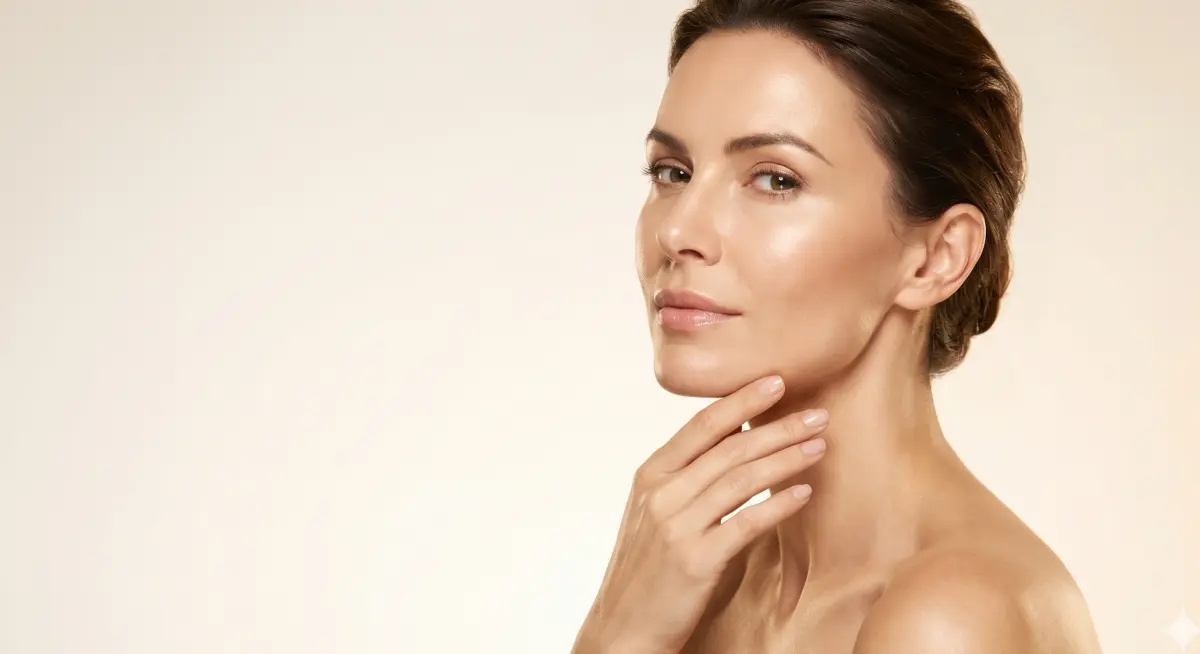
The science of skin aging is evolving rapidly — and for women navigating the skin changes that come with menopause and beyond, evidence-based skincare represents a fundamentally different approach: working with your skin's biology rather than against it.
Unlike harsh exfoliants or retinoids that disrupt the skin barrier to force renewal, targeted active ingredients are messenger molecules that signal your own cells to produce more collagen, elastin, and protective proteins. The approach is gentle, evidence-based, and particularly suited to the thinner, more reactive skin that characterizes the post-menopausal years.
Evidence-Based Home Treatments for Sagging Jawline Over 40
Jowl formation is one of the most visible signs of facial aging, driven by a convergence of collagen degradation, elastin loss, fat pad descent, and gravitational pull on skin that has lost its structural scaffolding. The process begins in the mid-dermis, where type I and type III collagen fibers — responsible for 80% of skin's tensile strength — decline at a rate of 1-1.5% per year after age 30, accelerating to 2-3% per year during perimenopause. As the collagen network thins, the retaining ligaments that anchor facial skin to underlying bone (particularly the mandibular ligament along the jawline) weaken, allowing the overlying skin and subcutaneous fat to descend below the jawline.[1]
The anatomy of jowl formation involves three distinct tissue layers. The superficial musculoaponeurotic system (SMAS) — the fibromuscular layer that connects facial muscles to the skin — loses tension as collagen within it degrades, creating laxity in the lower face. The buccal fat pad, which sits in the mid-cheek during youth, descends inferiorly as the supporting ligaments weaken, redistributing volume from the cheeks to the jowl area. Simultaneously, the platysma muscle in the neck loses tone, contributing to a blurring of the jawline-neck angle that accentuates the appearance of jowling. This is not a single-tissue problem — it is a multilayer structural failure that progresses predictably with age.
Clinical research confirms that clinical assessment of jowl severity uses standardized scales that measure the degree of tissue descent below the mandibular border. Mild jowling (Grade 1) involves slight softening of the jawline with minimal tissue overhang, typically appearing in the early-to-mid 40s. Moderate jowling (Grade 2) shows visible tissue descent with a clear break in the jawline contour, typically developing in the late 40s to 50s. Severe jowling (Grade 3) involves significant tissue redundancy with marionette lines and loss of the cervicomental angle. Understanding the grade is critical because the interventions differ: Grade 1 responds well to topical and at-home treatments, Grade 2 benefits from combining topical treatments with professional procedures, and Grade 3 typically requires surgical intervention for significant improvement.
For women over 40 experiencing early-to-moderate jowling, a comprehensive at-home strategy can measurably slow progression and improve the appearance of the jawline. The evidence supports a multi-modal approach: retinoid therapy to stimulate collagen neogenesis in the dermis, peptide serums to support fibroblast activity, facial exercises to improve muscle tone in the platysma and lower face, and radiofrequency or microcurrent devices to tighten existing collagen fibers. None of these interventions can fully reverse established jowling, but the combination can delay progression by years and maintain jawline definition that would otherwise be lost.
Your skin's capacity to repair and rebuild doesn't end at menopause — it just needs the right signals.
— Dr. Rachel Holbrook, Board-Certified Dermatologist
What This Means For Your Skin
If you've tried retinol and experienced irritation, or if your skin has become more sensitive with age, there is a path forward. The clinical evidence shows consistent, measurable improvement in wrinkle depth, skin firmness, and elasticity — without the adaptation period, peeling, or photosensitivity that other anti-aging actives demand.
Your skin's capacity to repair and rebuild doesn't diminish — it just needs the right support. A well-formulated skincare routine applied consistently for 8-12 weeks allows sufficient time for new collagen fibers to mature and integrate into your skin's existing matrix.
The science is clear. The evidence is consistent. The results are measurable.
What happens next is up to you.