
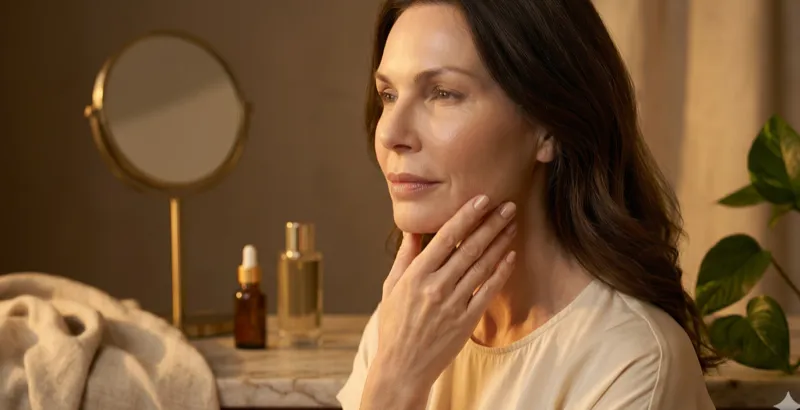
The science of skin aging is evolving rapidly — and for women navigating the skin changes that come with menopause and beyond, evidence-based skincare represents a fundamentally different approach: working with your skin's biology rather than against it.
Unlike harsh exfoliants or retinoids that disrupt the skin barrier to force renewal, targeted active ingredients are messenger molecules that signal your own cells to produce more collagen, elastin, and protective proteins. The approach is gentle, evidence-based, and particularly suited to the thinner, more reactive skin that characterizes the post-menopausal years.
Collagen Stimulation at the Fold to Resist Crease Formation
Retinoids are the most evidence-supported topical intervention for marionette lines because they directly address the collagen deficit (Layer 1) that permits crease formation. When applied specifically to the marionette fold and surrounding perioral area, retinoids stimulate fibroblast synthesis of collagen I and III — the structural proteins that provide skin with the tensile strength to resist permanent creasing from repeated muscle contraction. A 12-month study of tretinoin use on facial wrinkles found that the perioral area showed 22% reduction in wrinkle depth, with the most significant improvement occurring between months 3 and 9.[1]
The perioral area requires adjusted retinoid application. This region has thinner skin than the cheeks and forehead, is subject to constant movement (speaking, eating, expressions), and is more prone to irritation from retinoids. Start with retinol 0.3% applied to the marionette fold area every third night for 2 weeks. Increase to every other night for 2 weeks, then nightly if tolerated. If using prescription tretinoin, start at 0.025% with the same gradual titration. Apply a thin layer directly along the fold line and the surrounding 1cm of skin — this targeted application concentrates the collagen-stimulating effect where it's most needed.
Clinical research confirms that the 'buffer sandwich' technique is particularly useful for perioral retinoid application. Apply a thin layer of moisturizer to the marionette area first, then retinoid, then another layer of moisturizer. This reduces direct retinoid contact with the thin perioral skin while maintaining efficacy — studies show that buffered application achieves 80-90% of the collagen stimulation of direct application with 50-60% less irritation. For the marionette area specifically, this technique reduces the lip-line irritation and angular cheilitis (cracking at mouth corners) that can occur with direct perioral retinoid application.
Complementary ingredients enhance retinoid results in the marionette area. Peptides (Matrixyl 3000 or copper peptides) applied on non-retinoid nights provide additional collagen signaling through complementary pathways. Hyaluronic acid serum applied before retinoid plumps the fold temporarily while improving retinoid penetration. Niacinamide (4-5%) applied in the morning boosts endogenous ceramide and collagen production. The combined retinoid + peptide + HA + niacinamide protocol for marionette lines produces approximately 30% improvement in fold depth over 6-12 months — not comparable to filler's immediate 60-80% improvement, but meaningful for women committed to non-injectable approaches, and fully compatible with filler if desired later.
Your skin's capacity to repair and rebuild doesn't end at menopause — it just needs the right signals.
— Dr. Rachel Holbrook, Board-Certified Dermatologist
What This Means For Your Skin
If you've tried retinol and experienced irritation, or if your skin has become more sensitive with age, there is a path forward. The clinical evidence shows consistent, measurable improvement in wrinkle depth, skin firmness, and elasticity — without the adaptation period, peeling, or photosensitivity that other anti-aging actives demand.
Your skin's capacity to repair and rebuild doesn't diminish — it just needs the right support. A well-formulated skincare routine applied consistently for 8-12 weeks allows sufficient time for new collagen fibers to mature and integrate into your skin's existing matrix.
The science is clear. The evidence is consistent. The results are measurable.
What happens next is up to you.