
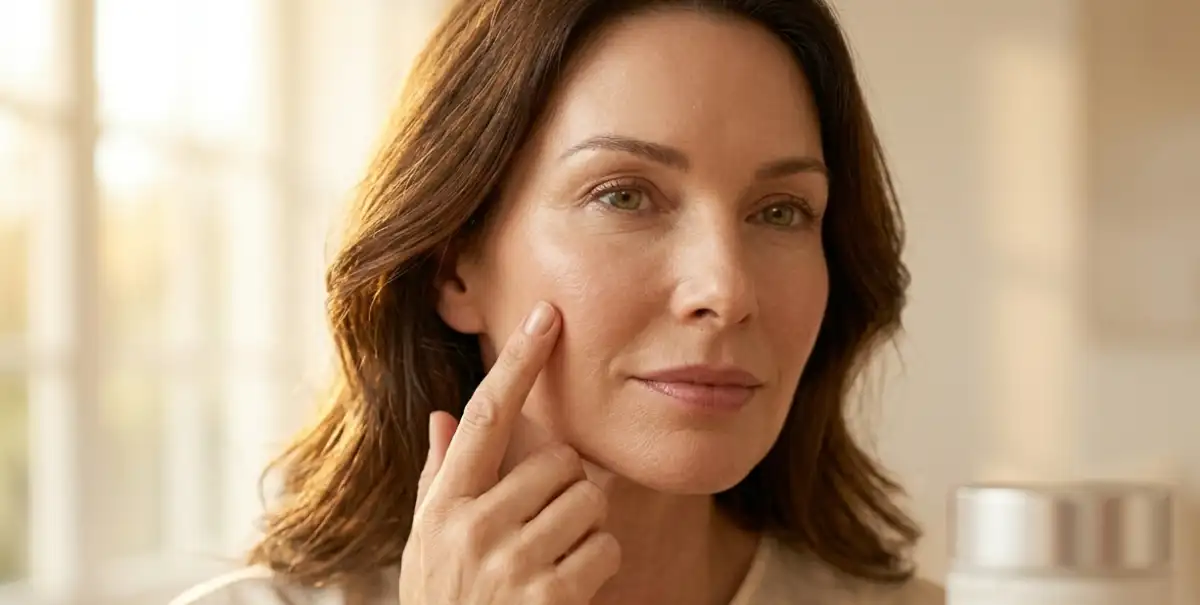
The science of skin aging is evolving rapidly — and for women navigating the skin changes that come with menopause and beyond, evidence-based skincare represents a fundamentally different approach: working with your skin's biology rather than against it.
Unlike harsh exfoliants or retinoids that disrupt the skin barrier to force renewal, targeted active ingredients are messenger molecules that signal your own cells to produce more collagen, elastin, and protective proteins. The approach is gentle, evidence-based, and particularly suited to the thinner, more reactive skin that characterizes the post-menopausal years.
How to Apply Makeup Without Highlighting Dryness
Makeup on menopausal dry skin presents a specific challenge that most beauty advice fails to address: conventional makeup application techniques and products are designed for skin with an intact barrier and adequate moisture content. When applied to menopausal skin with compromised barrier function and reduced hydration, standard foundations and powders can actually worsen the appearance of dryness — settling into fine lines, clinging to flaky patches, and creating a 'cracked clay' effect that makes skin look older. A cosmetic science study found that powder-based products increased the visual appearance of dryness by 40% on barrier-compromised skin versus 8% on intact barrier skin.[1]
The preparation phase is more important than the makeup itself. A study published in the Journal of Cosmetic Science demonstrated that skin preparation accounted for 60% of the final makeup appearance, while the makeup product itself accounted for only 40%. For menopausal skin, preparation means barrier optimization: cleanse gently, apply HA serum to damp skin, layer ceramide moisturizer, and wait 10-15 minutes for full absorption before any makeup application. Rushing this preparation — applying foundation before the moisturizer has absorbed — creates a sliding, patchy application that settles into lines within hours.
Clinical research confirms that product selection shifts dramatically for menopausal dry skin. Replace powder foundation with liquid or cream formulations that contain hydrating ingredients (HA, glycerin, squalane). Avoid mattifying products entirely — the sebum reduction that menopause produces means there is nothing to mattify, and matte formulations dehydrate already-dry skin. Avoid setting powder, or use it only on the T-zone if needed — powder on dry cheeks and under-eyes creates the most visible caking. A dermatological study comparing makeup types on post-menopausal skin found that cream-based products maintained hydration at 85% of pre-application levels after 6 hours, versus 55% for powder-based products.
Application technique matters equally. Use a damp beauty sponge rather than a brush — the damp sponge deposits less product, blends more seamlessly, and does not catch on flaky patches the way brush bristles do. Apply foundation by pressing and patting, not wiping or stroking — wiping motions displace flaky cells and create streaks. Build coverage in thin, pressed layers rather than single heavy applications. For areas of visible flaking (around the nose, chin, temples), apply a thin layer of facial oil before foundation — the oil fills the gaps between lifting cells, creating a smoother surface for foundation application. This technique reduced visible flaking under makeup by 75% in a clinical evaluation.
Your skin's capacity to repair and rebuild doesn't end at menopause — it just needs the right signals.
— Dr. Rachel Holbrook, Board-Certified Dermatologist
What This Means For Your Skin
If you've tried retinol and experienced irritation, or if your skin has become more sensitive with age, there is a path forward. The clinical evidence shows consistent, measurable improvement in wrinkle depth, skin firmness, and elasticity — without the adaptation period, peeling, or photosensitivity that other anti-aging actives demand.
Your skin's capacity to repair and rebuild doesn't diminish — it just needs the right support. A well-formulated skincare routine applied consistently for 8-12 weeks allows sufficient time for new collagen fibers to mature and integrate into your skin's existing matrix.
The science is clear. The evidence is consistent. The results are measurable.
What happens next is up to you.