
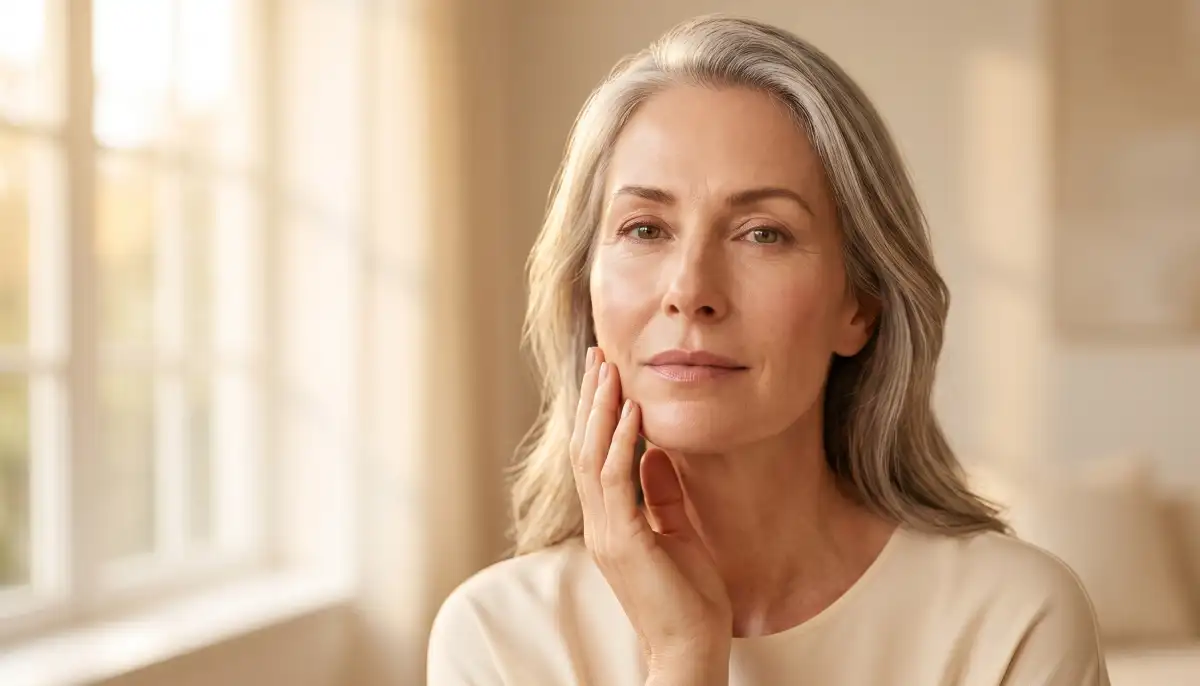
The science of skin aging is evolving rapidly — and for women navigating the skin changes that come with menopause and beyond, evidence-based skincare represents a fundamentally different approach: working with your skin's biology rather than against it.
Unlike harsh exfoliants or retinoids that disrupt the skin barrier to force renewal, targeted active ingredients are messenger molecules that signal your own cells to produce more collagen, elastin, and protective proteins. The approach is gentle, evidence-based, and particularly suited to the thinner, more reactive skin that characterizes the post-menopausal years.
Recognizing the 12 Dermatological Signs of Hormonal Change
Menopause produces at least 12 distinct dermatological symptoms, yet most women recognize only two or three — typically dryness and wrinkles. A comprehensive survey published in Menopause: The Journal of The North American Menopause Society found that 64% of menopausal women reported skin dryness, 40% reported increased sensitivity, 32% reported new or worsened hyperpigmentation, and 15% reported the crawling or tingling sensation known as formication. Many women attributed these symptoms to product reactions or environmental factors rather than hormonal change.[1]
The 12 documented skin symptoms of menopause, ranked by prevalence in clinical literature, are: persistent dryness despite adequate moisturizing; increased sensitivity to previously tolerated products; accelerated wrinkle formation; loss of skin firmness and elasticity; hyperpigmentation and uneven tone; thinning skin that bruises easily; delayed wound healing; formication (crawling, itching, or prickling sensations); adult-onset acne along the jawline; increased facial hair; changes in skin texture (roughness, scaliness); and new or enlarged pores.
Clinical research confirms that each symptom maps to a specific hormonal mechanism. Dryness results from decreased sebum and glycosaminoglycan production. Sensitivity reflects barrier compromise from reduced ceramide synthesis. Jawline acne occurs because declining estrogen unmasks androgen activity, stimulating sebaceous glands in hormone-sensitive areas. Formication — reported by 5-15% of perimenopausal and menopausal women — is caused by estrogen's role in regulating cutaneous nerve fiber density and neurotransmitter signaling.
Recognizing these symptoms as hormonally driven rather than random is clinically important because it changes the treatment approach. A woman treating menopausal dryness as simple dehydration will apply humectants that temporarily mask the symptom. A woman understanding the barrier deficit will use ceramide-based repair formulations that address the structural cause. Similarly, menopausal acne requires a different approach than teenage acne — retinoids and anti-androgens rather than benzoyl peroxide and salicylic acid.
Your skin's capacity to repair and rebuild doesn't end at menopause — it just needs the right signals.
— Dr. Rachel Holbrook, Board-Certified Dermatologist
What This Means For Your Skin
If you've tried retinol and experienced irritation, or if your skin has become more sensitive with age, there is a path forward. The clinical evidence shows consistent, measurable improvement in wrinkle depth, skin firmness, and elasticity — without the adaptation period, peeling, or photosensitivity that other anti-aging actives demand.
Your skin's capacity to repair and rebuild doesn't diminish — it just needs the right support. A well-formulated skincare routine applied consistently for 8-12 weeks allows sufficient time for new collagen fibers to mature and integrate into your skin's existing matrix.
The science is clear. The evidence is consistent. The results are measurable.
What happens next is up to you.