
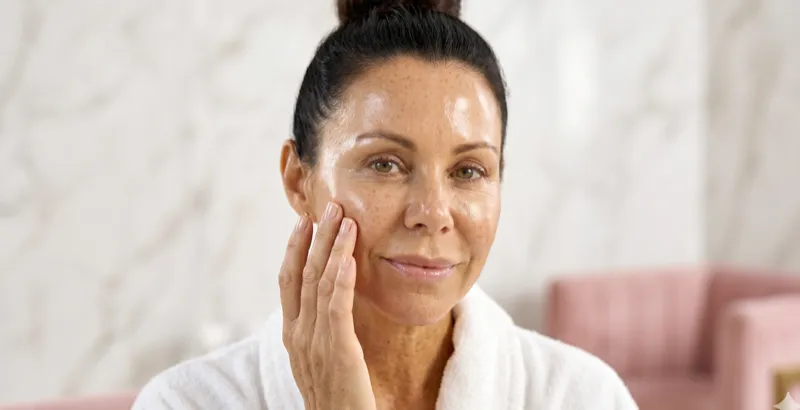
The science of skin aging is evolving rapidly — and for women navigating the skin changes that come with menopause and beyond, evidence-based skincare represents a fundamentally different approach: working with your skin's biology rather than against it.
Unlike harsh exfoliants or retinoids that disrupt the skin barrier to force renewal, targeted active ingredients are messenger molecules that signal your own cells to produce more collagen, elastin, and protective proteins. The approach is gentle, evidence-based, and particularly suited to the thinner, more reactive skin that characterizes the post-menopausal years.
What Women Over 40 Need to Know About Microneedling Safety
Microneedling safety in mature skin requires attention to specific risk factors that are either absent or less significant in younger skin. The thinner epidermis (averaging 0.06-0.08mm versus 0.10-0.12mm in younger adults) means that a given needle depth penetrates proportionally deeper relative to the total skin thickness, increasing the potential for excessive tissue injury. Reduced barrier recovery capacity — the mature skin barrier takes 72-96 hours to fully restore after disruption, compared to 24-48 hours in younger skin — means that the infection window following microneedling is extended. Compromised microcirculation reduces the delivery of immune cells and growth factors to the micro-wound sites, potentially slowing healing and increasing susceptibility to post-procedural infection. A 2018 safety review in Dermatologic Surgery analyzed adverse event reports from microneedling across age groups and found that women over 50 had a 2.3-fold higher rate of prolonged erythema (>72 hours) and a 1.8-fold higher rate of post-inflammatory hyperpigmentation compared to women under 35 at equivalent needle depths, reinforcing the need for conservative depth selection in mature skin.[1]
Contraindications for at-home microneedling that are particularly relevant to women over 40 include: active rosacea or perioral dermatitis (microneedling can trigger severe flares in these conditions, which are more prevalent after 40), current retinoid therapy without a 48-hour pause (retinoid-sensitized skin has a significantly lower threshold for microneedling-induced inflammation), bleeding disorders or anticoagulant use (more common in the over-40 demographic, these conditions increase the risk of hematoma formation from needle-induced capillary damage), active herpes simplex (cold sores) or history of frequent outbreaks (microneedling can trigger viral reactivation along the treated area), diabetes or immunocompromised states (impaired wound healing increases infection risk), and any active skin infection, eczema, or psoriasis on the treatment area. Women on blood thinners (aspirin, warfarin, novel anticoagulants) should consult their physician before microneedling, as even 0.25mm needling can cause petechiae and prolonged oozing in anticoagulated skin.
Clinical research confirms that infection prevention is the most critical safety consideration for at-home microneedling, as the procedure creates thousands of direct pathways through the skin's primary defense barrier. The micro-channels remain open for 2-4 hours post-treatment, during which period bacterial, viral, or fungal pathogens can enter the dermis directly, bypassing the stratum corneum barrier that normally prevents their invasion. Essential infection prevention protocols include: thorough facial cleansing with a gentle antimicrobial cleanser before needling (not micellar water or oil cleanser, which leave residue), using only sterile single-use needle cartridges (never reuse needles, regardless of cleaning method), cleaning the treatment area with 70% isopropyl alcohol and allowing it to fully evaporate before beginning the procedure, using only sterile or freshly opened serums during and immediately after treatment, and avoiding touching the treated face with unwashed hands for 12 hours post-procedure. A 2017 case report in the Journal of the American Academy of Dermatology documented a severe mycobacterial infection following at-home microneedling with a reused dermaroller that had not been adequately sterilized — the patient required 6 months of antibiotic therapy.
Post-treatment care for mature skin follows a protective protocol designed to support the wound-healing response while preventing complications. For the first 24 hours: apply only hyaluronic acid serum and ceramide moisturizer — no actives, no makeup, no chemical sunscreen. For hours 24-72: gradually reintroduce gentle skincare products, beginning with mineral sunscreen (mandatory — the compromised barrier increases UV sensitivity by 40-60%), niacinamide, and non-acidic vitamin C derivatives. After 72 hours: resume full skincare routine including retinol and AHAs. Watch for warning signs requiring medical attention: spreading redness beyond the treated area (may indicate infection), pus or yellow discharge (bacterial infection), clusters of small blisters (possible herpes reactivation), dark pigmentation developing within days of treatment (post-inflammatory hyperpigmentation requiring immediate sun avoidance and possible medical treatment), or any systemic symptoms (fever, malaise) suggesting deep tissue infection. When performed with proper technique, appropriate needle depth, and careful hygiene, at-home microneedling has an excellent safety profile — the 2018 safety review found a serious adverse event rate of less than 0.1% for consumer-depth (≤0.5mm) devices.
Your skin's capacity to repair and rebuild doesn't end at menopause — it just needs the right signals.
— Dr. Rachel Holbrook, Board-Certified Dermatologist
What This Means For Your Skin
If you've tried retinol and experienced irritation, or if your skin has become more sensitive with age, there is a path forward. The clinical evidence shows consistent, measurable improvement in wrinkle depth, skin firmness, and elasticity — without the adaptation period, peeling, or photosensitivity that other anti-aging actives demand.
Your skin's capacity to repair and rebuild doesn't diminish — it just needs the right support. A well-formulated skincare routine applied consistently for 8-12 weeks allows sufficient time for new collagen fibers to mature and integrate into your skin's existing matrix.
The science is clear. The evidence is consistent. The results are measurable.
What happens next is up to you.