
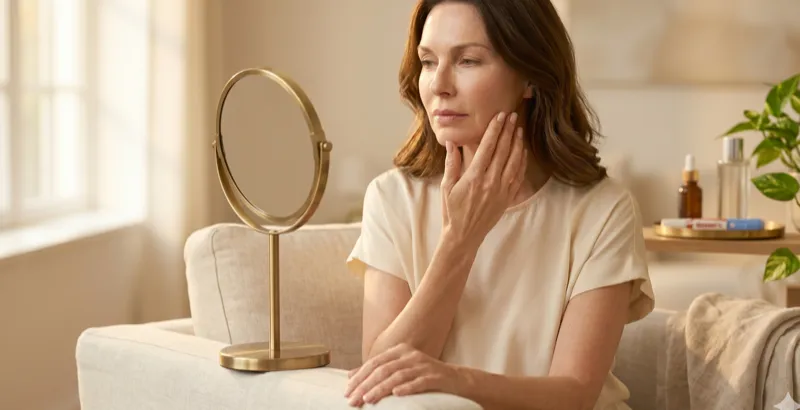
The science of skin aging is evolving rapidly — and for women navigating the skin changes that come with menopause and beyond, evidence-based skincare represents a fundamentally different approach: working with your skin's biology rather than against it.
Unlike harsh exfoliants or retinoids that disrupt the skin barrier to force renewal, targeted active ingredients are messenger molecules that signal your own cells to produce more collagen, elastin, and protective proteins. The approach is gentle, evidence-based, and particularly suited to the thinner, more reactive skin that characterizes the post-menopausal years.
The Gold Standard for Collagen Stimulation During GLP-1 Therapy
Retinoids — the class of vitamin A derivatives that includes prescription tretinoin and over-the-counter retinol — are the most evidence-supported topical intervention for the collagen loss component of Ozempic face. No other topical ingredient has comparable depth of evidence for stimulating fibroblast collagen synthesis in human skin. A landmark study in the Journal of Investigative Dermatology demonstrated that tretinoin 0.05% increased procollagen I synthesis by 80% and procollagen III synthesis by 50% in photodamaged skin after 12 months of use. For GLP-1 patients, this collagen-stimulating effect directly counteracts the accelerated facial aging that rapid volume loss produces.[1]
The retinoid selection for Ozempic face treatment depends on skin tolerance and access. Prescription tretinoin (0.025-0.05%) is the most potent and best-studied option — it produces measurable collagen improvement faster than OTC retinol. For patients without prescription access or with sensitive skin: retinol at 0.5-1.0% provides the same biological effect at lower potency (retinol must be converted to retinoic acid in the skin, with approximately 10-20% conversion efficiency). Retinaldehyde (retinal) at 0.05-0.1% is an intermediate option — one conversion step closer to retinoic acid than retinol, providing faster results with better tolerability than tretinoin.
Clinical research confirms that the initiation protocol for GLP-1 patients should be aggressive but smart. Week 1-2: retinol 0.3% every third night, building tolerance. Week 3-4: retinol 0.5% every other night. Week 5+: retinol 0.5-1.0% nightly, or transition to tretinoin 0.025% if tolerated. The 'sandwich method' (moisturizer → retinoid → moisturizer) reduces irritation while maintaining efficacy. During GLP-1 therapy, the skin may be more reactive than usual due to nutritional changes and dehydration — adjust frequency if irritation occurs, but do not abandon the retinoid entirely. Consistent use at a tolerated frequency produces better results than aggressive use that causes flaking, redness, and treatment interruption.
Results timeline for Ozempic face specifically: At 4 weeks — skin texture improvement (smoother, more refined surface) from increased cell turnover. At 8 weeks — early firmness improvement detectable by touch, measurable by cutometer. At 12 weeks — visible improvement in fine lines and skin quality. At 6 months — peak collagen stimulation producing measurable increases in dermal thickness and skin firmness. At 12 months — maximum cumulative benefit with continued use. Importantly: stopping retinoid use reverses the collagen-stimulating benefit within 3-6 months. For GLP-1 patients, retinoid therapy should continue indefinitely (or until a different anti-aging strategy is adopted) — the collagen support is needed not just during weight loss but permanently afterward to maintain the improved skin quality.
Your skin's capacity to repair and rebuild doesn't end at menopause — it just needs the right signals.
— Dr. Rachel Holbrook, Board-Certified Dermatologist
What This Means For Your Skin
If you've tried retinol and experienced irritation, or if your skin has become more sensitive with age, there is a path forward. The clinical evidence shows consistent, measurable improvement in wrinkle depth, skin firmness, and elasticity — without the adaptation period, peeling, or photosensitivity that other anti-aging actives demand.
Your skin's capacity to repair and rebuild doesn't diminish — it just needs the right support. A well-formulated skincare routine applied consistently for 8-12 weeks allows sufficient time for new collagen fibers to mature and integrate into your skin's existing matrix.
The science is clear. The evidence is consistent. The results are measurable.
What happens next is up to you.