
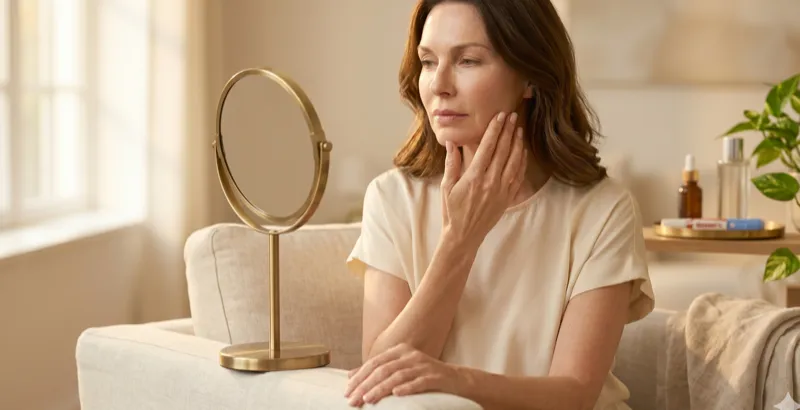
The science of skin aging is evolving rapidly — and for women navigating the skin changes that come with menopause and beyond, evidence-based skincare represents a fundamentally different approach: working with your skin's biology rather than against it.
Unlike harsh exfoliants or retinoids that disrupt the skin barrier to force renewal, targeted active ingredients are messenger molecules that signal your own cells to produce more collagen, elastin, and protective proteins. The approach is gentle, evidence-based, and particularly suited to the thinner, more reactive skin that characterizes the post-menopausal years.
The Full Spectrum of GLP-1 Impact on Integumentary Health
The integumentary effects of GLP-1 receptor agonists extend beyond skin to encompass hair and nails — all three tissues share dependence on nutritional status, blood flow, and hormonal signaling that GLP-1-mediated weight loss disrupts simultaneously. Understanding these as connected manifestations of the same underlying metabolic stress (rather than separate side effects) enables a unified prevention and treatment approach that addresses root causes rather than chasing individual symptoms.[1]
Hair changes affect 3-5% of GLP-1 users noticeably and likely more at subclinical levels. The primary mechanism is telogen effluvium — the synchronized shedding of hair that was prematurely pushed from active growth (anagen) to resting (telogen) phase by metabolic stress. Rapid caloric restriction, protein deficiency, iron depletion, and zinc reduction all contribute. Hair shedding typically begins 2-4 months after significant weight loss starts (reflecting the 3-month telogen phase delay) and can persist for 6-9 months before resolving as nutritional status stabilizes. Prevention requires proactive nutritional support: protein intake >1.2g/kg/day, ferritin levels >40ng/mL (standard laboratory 'normal' starts at 12, but hair biology requires >40), and zinc supplementation (15-30mg daily).
Clinical research confirms that nail changes during GLP-1 therapy include brittleness, slow growth, ridging, and splitting — reflecting the same nutritional deficits that affect hair and skin. Nails are composed primarily of keratin (a sulfur-rich protein), and their growth rate (approximately 3mm/month for fingernails) makes them sensitive to nutritional status changes with a 3-6 month delay. Biotin supplementation (2.5-5mg daily) has evidence for improving nail strength and reducing brittleness — a meta-analysis found 25% improvement in nail thickness after 6 months of biotin supplementation. Adequate protein and iron are equally important for nail health.
The unified management approach for hair, skin, and nail health during GLP-1 therapy centers on preventing the nutritional deficit that drives all three. The supplement stack: hydrolyzed collagen peptides 10g daily (provides proline, hydroxyproline, and glycine for both skin collagen and nail/hair keratin building blocks), biotin 5mg daily (supports keratin synthesis), iron with vitamin C (only if ferritin <40), zinc 15mg daily (cofactor for over 300 enzymes including those involved in hair and skin protein synthesis), omega-3 fatty acids 2g daily (anti-inflammatory, supports sebaceous function for hair and skin). Topical support: retinoid + peptide protocol for skin, gentle scalp massage with rosemary oil (evidence for improving follicular blood flow), and nail-specific products containing keratin peptides and calcium. This comprehensive approach addresses all three tissues simultaneously because the root cause — metabolic stress from rapid weight loss — is shared.
Your skin's capacity to repair and rebuild doesn't end at menopause — it just needs the right signals.
— Dr. Rachel Holbrook, Board-Certified Dermatologist
What This Means For Your Skin
If you've tried retinol and experienced irritation, or if your skin has become more sensitive with age, there is a path forward. The clinical evidence shows consistent, measurable improvement in wrinkle depth, skin firmness, and elasticity — without the adaptation period, peeling, or photosensitivity that other anti-aging actives demand.
Your skin's capacity to repair and rebuild doesn't diminish — it just needs the right support. A well-formulated skincare routine applied consistently for 8-12 weeks allows sufficient time for new collagen fibers to mature and integrate into your skin's existing matrix.
The science is clear. The evidence is consistent. The results are measurable.
What happens next is up to you.