
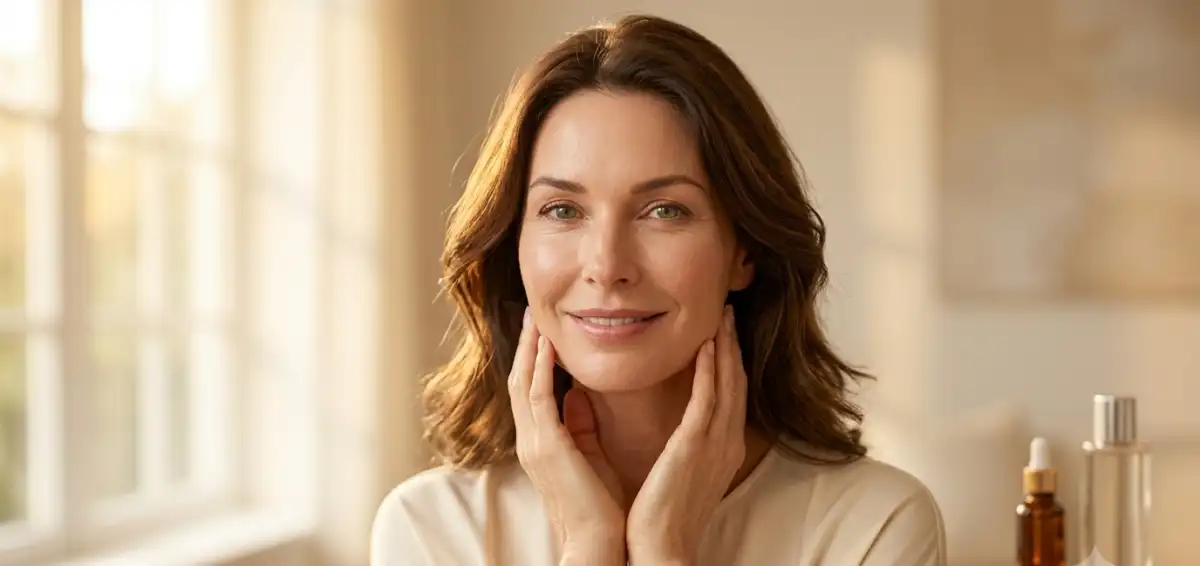
The science of skin aging is evolving rapidly — and for women navigating the skin changes that come with menopause and beyond, evidence-based skincare represents a fundamentally different approach: working with your skin's biology rather than against it.
Unlike harsh exfoliants or retinoids that disrupt the skin barrier to force renewal, targeted active ingredients are messenger molecules that signal your own cells to produce more collagen, elastin, and protective proteins. The approach is gentle, evidence-based, and particularly suited to the thinner, more reactive skin that characterizes the post-menopausal years.
The 8 Dermatological Shifts That Begin in Your Late 30s
Perimenopause produces eight distinct dermatological changes, each driven by the erratic estrogen fluctuations that characterize this transitional phase. The first and most commonly reported is intermittent dryness — skin that feels adequately hydrated one week and uncomfortably tight the next, corresponding to estrogen peaks and troughs. A study in Skin Research and Technology measured transepidermal water loss (TEWL) across the perimenopausal cycle and found 15-30% variation between high-estrogen and low-estrogen phases, confirming the biological basis for this cycling symptom.[1]
The second through fourth changes are interconnected: increased sensitivity (barrier compromise from inconsistent ceramide production), new-onset acne (androgen unmasking during low-estrogen phases), and texture roughness (slowing epidermal turnover from 28 to 35-40 days). These three changes share a common mechanism — they all worsen during the low-estrogen troughs of perimenopausal cycles and improve during high-estrogen peaks. Women often describe a 'good skin week, bad skin week' pattern that perfectly mirrors hormonal cycling.
Clinical research confirms that the fifth through seventh changes are progressive rather than cyclical: early fine line deepening (beginning collagen decline), subtle pigmentation changes (melanocyte destabilization), and pore enlargement (decreased collagen support around follicular structures). These changes accumulate over the perimenopausal years, typically becoming noticeable 2-3 years into the transition. A longitudinal study following 200 women through perimenopause found that objective skin elasticity measurements decreased by 0.3-0.5% per year during early perimenopause — slower than the 2.1% per year of post-menopause, but already measurable.
The eighth change is the most overlooked: wound healing begins to slow. A controlled study in the Journal of Investigative Dermatology demonstrated that perimenopausal women showed wound re-epithelialization rates intermediate between pre-menopausal and post-menopausal controls — 15-20% slower than baseline. This has practical implications for skin recovery from procedures, aggressive exfoliation, and even minor everyday damage. The clinical takeaway is that perimenopausal skin requires gentler treatment and more recovery time than the same woman's skin needed five years earlier.
Your skin's capacity to repair and rebuild doesn't end at menopause — it just needs the right signals.
— Dr. Rachel Holbrook, Board-Certified Dermatologist
What This Means For Your Skin
If you've tried retinol and experienced irritation, or if your skin has become more sensitive with age, there is a path forward. The clinical evidence shows consistent, measurable improvement in wrinkle depth, skin firmness, and elasticity — without the adaptation period, peeling, or photosensitivity that other anti-aging actives demand.
Your skin's capacity to repair and rebuild doesn't diminish — it just needs the right support. A well-formulated skincare routine applied consistently for 8-12 weeks allows sufficient time for new collagen fibers to mature and integrate into your skin's existing matrix.
The science is clear. The evidence is consistent. The results are measurable.
What happens next is up to you.