
The science of skin aging is evolving rapidly — and for women navigating the skin changes that come with menopause and beyond, evidence-based skincare represents a fundamentally different approach: working with your skin's biology rather than against it.
Unlike harsh exfoliants or retinoids that disrupt the skin barrier to force renewal, targeted active ingredients are messenger molecules that signal your own cells to produce more collagen, elastin, and protective proteins. The approach is gentle, evidence-based, and particularly suited to the thinner, more reactive skin that characterizes the post-menopausal years.
Two Different Mechanisms, Two Different Solutions
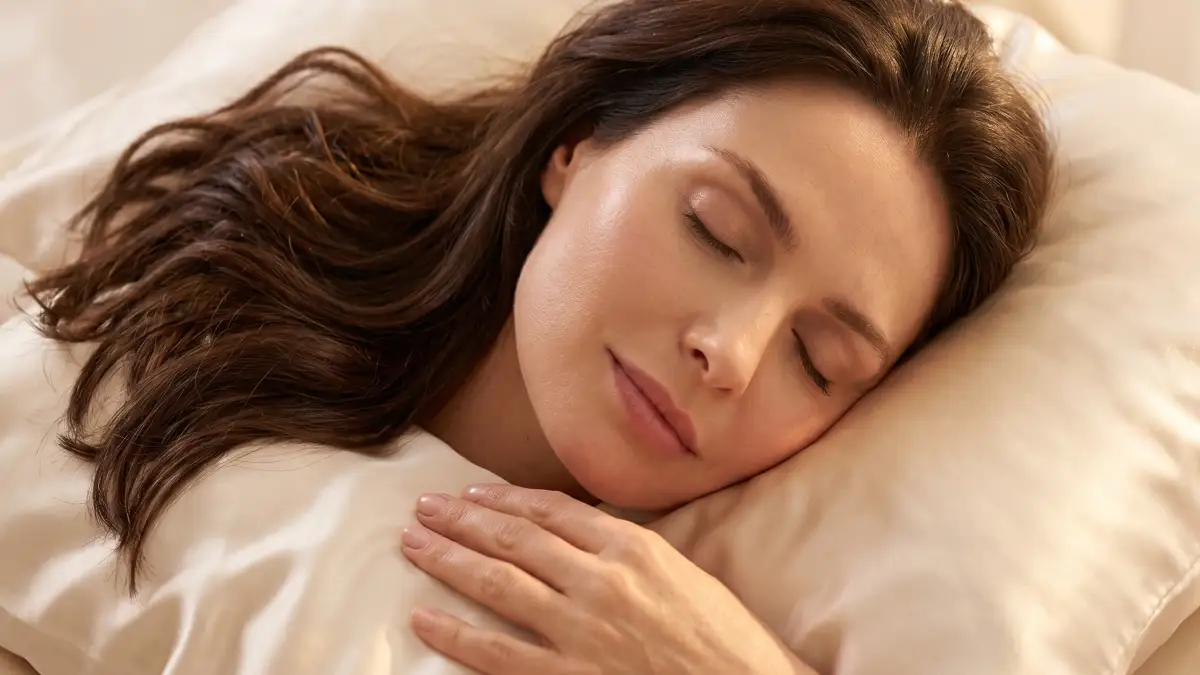
The distinction between sleep wrinkles and expression wrinkles is fundamental to effective anti-aging treatment, yet most skincare routines fail to differentiate between them. Expression wrinkles — crow's feet, frown lines, forehead furrows — form perpendicular to the underlying muscle fibers and deepen with repeated facial movements over decades. Sleep wrinkles, by contrast, form at compression points where skin folds against a pillow surface and follow entirely different directional patterns unrelated to muscle anatomy.[1]
A landmark mapping study identified key diagnostic differences: expression wrinkles on the forehead run horizontally (from frontalis muscle contraction), while sleep wrinkles on the forehead run diagonally. On the cheeks, expression lines radiate from the mouth and eyes following orbicularis patterns, while sleep wrinkles appear as vertical lines on the lateral cheek where pillow contact is greatest. These directional differences allow dermatologists to determine which wrinkles are sleep-related and which are expression-related during clinical examination.
Clinical research confirms that treatment implications are significant because the two wrinkle types require fundamentally different interventions. Expression wrinkles respond well to neuromodulators like botulinum toxin, which reduce the muscle contractions that create them. Sleep wrinkles, however, do not involve muscle contraction at all — they are purely mechanical. Botox has no effect on sleep wrinkles. Instead, sleep wrinkles require mechanical prevention through sleep position modification, specialized pillows, and collagen-supporting skincare.
Many women over 40 notice new wrinkles appearing despite consistent use of anti-aging products and even neuromodulator treatments. In many cases, these treatment-resistant lines are sleep wrinkles being misidentified as expression wrinkles. Recognizing the mechanical origin of these creases is the first step toward effective prevention, combining sleep surface optimization with nighttime collagen-stimulating formulations that strengthen skin resilience against nightly compression.
Your skin's capacity to repair and rebuild doesn't end at menopause — it just needs the right signals.
— Dr. Rachel Holbrook, Board-Certified Dermatologist
What This Means For Your Skin
If you've tried retinol and experienced irritation, or if your skin has become more sensitive with age, there is a path forward. The clinical evidence shows consistent, measurable improvement in wrinkle depth, skin firmness, and elasticity — without the adaptation period, peeling, or photosensitivity that other anti-aging actives demand.
Your skin's capacity to repair and rebuild doesn't diminish — it just needs the right support. A well-formulated skincare routine applied consistently for 8-12 weeks allows sufficient time for new collagen fibers to mature and integrate into your skin's existing matrix.
The science is clear. The evidence is consistent. The results are measurable.
What happens next is up to you.