
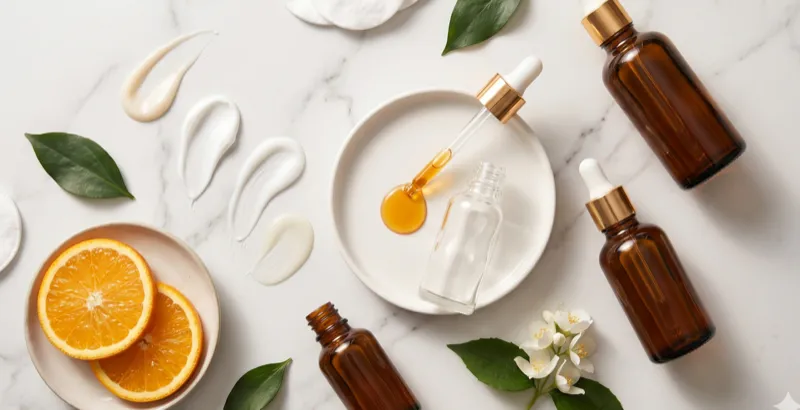
The science of skin aging is evolving rapidly — and for women navigating the skin changes that come with menopause and beyond, evidence-based skincare represents a fundamentally different approach: working with your skin's biology rather than against it.
Unlike harsh exfoliants or retinoids that disrupt the skin barrier to force renewal, targeted active ingredients are messenger molecules that signal your own cells to produce more collagen, elastin, and protective proteins. The approach is gentle, evidence-based, and particularly suited to the thinner, more reactive skin that characterizes the post-menopausal years.
Why This Antioxidant Pair Provides 8x Greater UV Protection
The combination of ferulic acid with vitamins C and E represents one of the most significant discoveries in topical antioxidant science — a synergy so powerful that it fundamentally changed how dermatologists approach UV protection and anti-aging. The landmark 2005 study by Pinnell and colleagues at Duke University demonstrated that adding 0.5-1.0% ferulic acid to a formulation of 15% L-ascorbic acid and 1% alpha-tocopherol (vitamin E) doubled the photoprotective capacity of the vitamin C+E combination, providing approximately 8-fold greater protection against UV-induced erythema and oxidative damage compared to vitamin C alone. This was not a marginal improvement — it was a multiplicative synergy that established the C+E+Ferulic combination as the gold standard for topical antioxidant therapy.[1]
How the synergy works: each antioxidant operates in a different compartment of the skin and neutralizes different types of reactive species, creating a comprehensive free radical neutralization network. Vitamin C (L-ascorbic acid) is water-soluble and operates in the aqueous compartments — the cytoplasm of keratinocytes and fibroblasts, and the aqueous phase of the extracellular matrix. It neutralizes superoxide anion, hydroxyl radical, and singlet oxygen — the primary ROS generated by UVB radiation. Vitamin E (alpha-tocopherol) is lipid-soluble and operates in the cell membranes and intercellular lipid matrix — the compartments where vitamin C cannot reach. It neutralizes lipid peroxyl radicals, preventing the chain reaction of lipid peroxidation that damages cell membranes and barrier lipids. Ferulic acid — a plant-derived phenolic acid — stabilizes the vitamin C and E molecules in the formulation (increasing shelf life by 40-60%) while providing its own antioxidant activity against nitrogen-based free radicals (particularly peroxynitrite) that neither vitamin C nor E effectively neutralizes.
Clinical research confirms that the practical impact for anti-aging: UV-generated free radicals are the primary extrinsic driver of collagen and elastin degradation. Every day of unprotected UV exposure generates enough ROS to fragment an estimated 25-30% of collagen in the exposed dermis and activate MMPs that continue degrading structural proteins for up to 7 days after the exposure. The C+E+Ferulic combination, applied every morning before sunscreen, neutralizes approximately 80% of UV-generated free radicals — dramatically reducing the daily structural damage that accumulates into visible wrinkles, laxity, and texture deterioration. This antioxidant protection is complementary to sunscreen, not redundant: sunscreen blocks UV photons from entering the skin, while antioxidants neutralize the free radicals generated by the UV photons that sunscreen does not block (no sunscreen blocks 100% of UV). Together, sunscreen + C+E+Ferulic provides the most comprehensive UV defense available.
How to use the C+E+Ferulic combination: (1) Apply every morning as the first active step after cleansing. (2) Use 4-5 drops for the entire face; extend to the neck and exposed chest. (3) Wait 1-2 minutes for absorption before applying the next product layer. (4) Follow with peptide cream (providing collagen stimulation to rebuild what UV has damaged), then SPF 50 sunscreen. (5) Store in a cool, dark place — the ferulic acid stabilizes the formula but does not make it immortal. Replace every 2-3 months after opening. (6) Monitor color — a fresh C+E+Ferulic serum is clear to pale yellow. Darkening to amber or brown indicates oxidation and reduced efficacy. Product selection: look for products explicitly formulated with the Duke Antioxidant Patent proportions (15% L-ascorbic acid, 1% alpha-tocopherol, 0.5% ferulic acid at pH below 3.5). Products that list all three ingredients but at unknown concentrations may not provide the synergistic ratio. The original SkinCeuticals C E Ferulic set the standard; numerous brands now offer equivalent formulations at various price points.
Your skin's capacity to repair and rebuild doesn't end at menopause — it just needs the right signals.
— Dr. Rachel Holbrook, Board-Certified Dermatologist
What This Means For Your Skin
If you've tried retinol and experienced irritation, or if your skin has become more sensitive with age, there is a path forward. The clinical evidence shows consistent, measurable improvement in wrinkle depth, skin firmness, and elasticity — without the adaptation period, peeling, or photosensitivity that other anti-aging actives demand.
Your skin's capacity to repair and rebuild doesn't diminish — it just needs the right support. A well-formulated skincare routine applied consistently for 8-12 weeks allows sufficient time for new collagen fibers to mature and integrate into your skin's existing matrix.
The science is clear. The evidence is consistent. The results are measurable.
What happens next is up to you.