
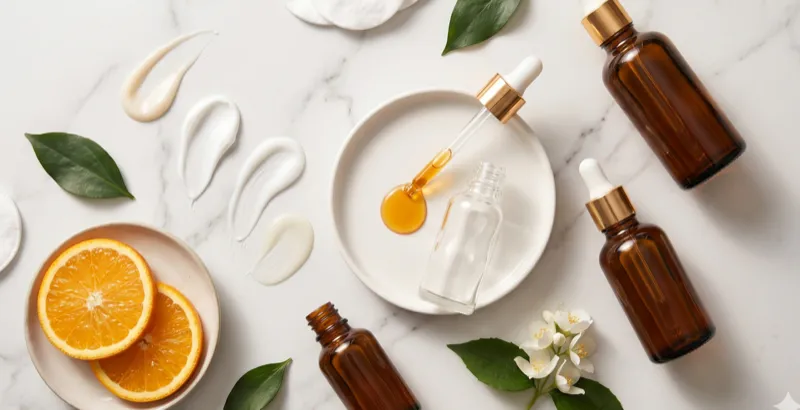
The science of skin aging is evolving rapidly — and for women navigating the skin changes that come with menopause and beyond, evidence-based skincare represents a fundamentally different approach: working with your skin's biology rather than against it.
Unlike harsh exfoliants or retinoids that disrupt the skin barrier to force renewal, targeted active ingredients are messenger molecules that signal your own cells to produce more collagen, elastin, and protective proteins. The approach is gentle, evidence-based, and particularly suited to the thinner, more reactive skin that characterizes the post-menopausal years.
The Collagen Cofactor That Makes Every Other Active More Effective
Vitamin C (L-ascorbic acid) works for wrinkles — but not in the way most consumers expect. The common assumption is that vitamin C directly reduces wrinkles through some immediate cosmetic mechanism. The reality is more nuanced and more powerful: vitamin C is a required biochemical cofactor for the enzymes that assemble collagen molecules, meaning it does not directly reduce wrinkles but ensures that the collagen produced by other stimulants (retinol, peptides) is structurally sound and functionally durable. Without adequate vitamin C, the collagen stimulated by retinol therapy is defective — the hydroxylation of proline and lysine residues (essential for collagen triple helix stability and cross-linking) cannot occur without ascorbic acid as the electron donor for prolyl hydroxylase and lysyl hydroxylase enzymes. Vitamin C is the quality control step in the collagen production line.[1]
The dual mechanism of vitamin C for wrinkles: Mechanism 1 — Collagen assembly support. Every collagen molecule produced in the dermis requires vitamin C for proper structural assembly. In vitamin C-deficient conditions, procollagen molecules are produced but cannot form the stable triple helix structure that gives collagen its mechanical strength. These defective collagen molecules are rapidly degraded, providing no structural benefit. Topical vitamin C at 15-20% ensures saturating concentrations of ascorbic acid at the site of collagen assembly, guaranteeing that every collagen molecule stimulated by retinol or peptide therapy is assembled correctly. Mechanism 2 — Antioxidant protection. UV radiation generates reactive oxygen species (ROS) that directly cleave collagen and elastin fibers through oxidative bond cleavage. A single day of moderate UV exposure can fragment an estimated 25-30% of collagen in the exposed dermis. Topical vitamin C, applied before UV exposure, neutralizes these ROS before they can reach structural proteins — reducing UV-induced collagen degradation by an estimated 40-60%.
Clinical research confirms that the clinical evidence: Pinnell et al. (2001) established that topical L-ascorbic acid at 15-20% achieves maximal skin concentration and UV protection, with no additional benefit above 20%. Traikovich (1999) demonstrated that 10% topical vitamin C applied daily for 12 weeks produced statistically significant improvement in fine wrinkles, tactile roughness, skin tone, and sallowness compared to vehicle control. Humbert et al. (2003) showed that 5% vitamin C cream applied daily for 6 months produced significant increases in dermal collagen density (measured by ultrasound) in photoaged skin. The evidence consistently shows that vitamin C works for wrinkles — but it works through gradual structural improvement over months, not through immediate cosmetic effects.
How to maximize vitamin C efficacy for wrinkles: (1) Form — L-ascorbic acid is the most potent and best-studied form. Derivatives (ascorbyl palmitate, magnesium ascorbyl phosphate, ascorbyl glucoside) are more stable but less potent, requiring higher concentrations for equivalent efficacy. (2) Concentration — 15-20% L-ascorbic acid for facial use; 10-15% for neck and chest (thinner skin absorbs more efficiently). (3) pH — must be formulated below pH 3.5 for optimal penetration and stability. (4) Timing — morning application provides maximum benefit because the antioxidant protection operates during the UV-exposed hours. (5) Stability — L-ascorbic acid oxidizes rapidly when exposed to light, air, and heat. Choose products in opaque, airless pump packaging and replace every 2-3 months. A product that has turned yellow-brown has lost significant potency. (6) Combination — apply vitamin C serum in the morning, followed by peptide cream (TGF-beta collagen stimulation), followed by SPF 50 (preventing the UV damage that vitamin C cannot fully neutralize). Use retinol in the evening (RAR/RXR collagen stimulation). This protocol ensures that collagen is being stimulated from multiple pathways during the day and evening, with vitamin C ensuring proper assembly of all newly produced collagen molecules.
Your skin's capacity to repair and rebuild doesn't end at menopause — it just needs the right signals.
— Dr. Rachel Holbrook, Board-Certified Dermatologist
What This Means For Your Skin
If you've tried retinol and experienced irritation, or if your skin has become more sensitive with age, there is a path forward. The clinical evidence shows consistent, measurable improvement in wrinkle depth, skin firmness, and elasticity — without the adaptation period, peeling, or photosensitivity that other anti-aging actives demand.
Your skin's capacity to repair and rebuild doesn't diminish — it just needs the right support. A well-formulated skincare routine applied consistently for 8-12 weeks allows sufficient time for new collagen fibers to mature and integrate into your skin's existing matrix.
The science is clear. The evidence is consistent. The results are measurable.
What happens next is up to you.