
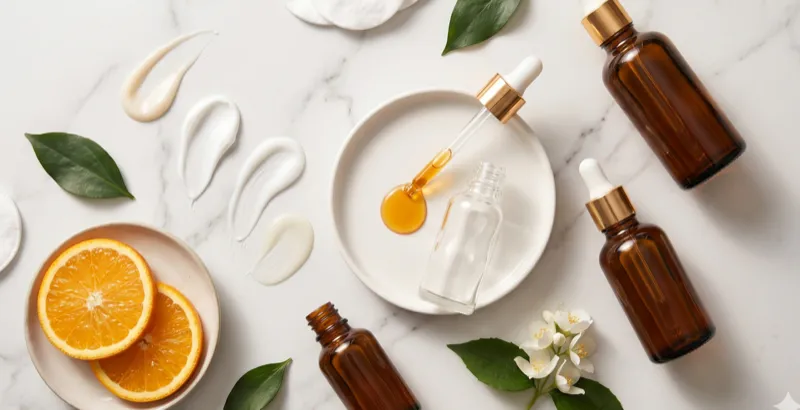
The science of skin aging is evolving rapidly — and for women navigating the skin changes that come with menopause and beyond, evidence-based skincare represents a fundamentally different approach: working with your skin's biology rather than against it.
Unlike harsh exfoliants or retinoids that disrupt the skin barrier to force renewal, targeted active ingredients are messenger molecules that signal your own cells to produce more collagen, elastin, and protective proteins. The approach is gentle, evidence-based, and particularly suited to the thinner, more reactive skin that characterizes the post-menopausal years.
The Multi-Pathway Vitamin That Supports Every Aspect of Skin Aging
Niacinamide (nicotinamide, vitamin B3) occupies a unique position in anti-aging skincare: it is not the most potent collagen stimulator (retinol and peptides surpass it), not the most effective antioxidant (vitamin C is stronger), and not the most powerful pigment corrector (hydroquinone and retinoids are more potent). Yet niacinamide is arguably the most versatile anti-aging ingredient available because it addresses multiple aging mechanisms simultaneously through multiple pathways, all without irritation, photosensitivity, or barrier compromise. This multi-pathway, zero-irritation profile makes niacinamide the ideal companion ingredient — it enhances the efficacy of every other active in the routine while providing its own substantial anti-aging benefits.[1]
The five evidence-based anti-aging benefits of niacinamide: (1) Barrier repair — niacinamide upregulates serine palmitoyltransferase, the rate-limiting enzyme in ceramide synthesis. Increased endogenous ceramide production strengthens the stratum corneum barrier, reducing transepidermal water loss by 20-30% within 4 weeks of consistent use. This barrier support is particularly valuable for aging skin (where endogenous ceramide production declines) and for skin using retinol (which can temporarily compromise the barrier). (2) Anti-inflammatory — niacinamide suppresses NF-kB signaling, the master inflammatory pathway that drives MMP upregulation, reactive oxygen species generation, and inflammatory cytokine production. By dampening chronic low-grade inflammation (inflammaging), niacinamide reduces the enzymatic collagen degradation that is a primary driver of visible aging.
Clinical research confirms that (3) Pigment correction — niacinamide blocks the transfer of melanosomes from melanocytes to surrounding keratinocytes. Unlike tyrosinase inhibitors (vitamin C, arbutin) that reduce melanin production, niacinamide blocks melanin distribution — preventing the pigment from being deposited in the visible skin surface. Studies demonstrate 35-68% reduction in hyperpigmented spots after 8-12 weeks of 5% niacinamide use. (4) Collagen support — niacinamide enhances fibroblast energy metabolism through its role as a precursor to NAD+ and NADPH, the essential coenzymes for cellular energy production. Better-energized fibroblasts produce more collagen and respond more robustly to growth factor signals from peptides. (5) Sebum regulation — niacinamide modestly reduces sebum production (25-35% reduction at 2% concentration over 4 weeks), which benefits oily and combination skin types by reducing pore appearance and improving skin texture.
How to use niacinamide for maximum anti-aging benefit: (1) Concentration — 3-5% for anti-aging purposes. Higher concentrations (10%) have not demonstrated proportionally greater benefits and may cause mild flushing in some individuals. (2) Formulation — niacinamide is stable across a wide pH range (4-7), compatible with virtually all other actives, and effective in both serum and cream vehicles. Look for it in your moisturizer — many well-formulated ceramide creams include niacinamide at functional concentrations, allowing you to get barrier repair and niacinamide benefits in a single product. (3) Timing — morning and/or evening, with no restrictions on combination with other actives. Niacinamide is compatible with retinol, vitamin C, AHAs, peptides, and all other common anti-aging ingredients. (4) Expectations — niacinamide produces subtle, cumulative improvements across multiple parameters rather than dramatic changes in any single parameter. The woman who uses niacinamide for 6 months will notice improved texture, more even tone, better hydration retention, and less irritation from retinol — a collection of modest improvements that together produce a meaningfully better overall skin quality.
Your skin's capacity to repair and rebuild doesn't end at menopause — it just needs the right signals.
— Dr. Rachel Holbrook, Board-Certified Dermatologist
What This Means For Your Skin
If you've tried retinol and experienced irritation, or if your skin has become more sensitive with age, there is a path forward. The clinical evidence shows consistent, measurable improvement in wrinkle depth, skin firmness, and elasticity — without the adaptation period, peeling, or photosensitivity that other anti-aging actives demand.
Your skin's capacity to repair and rebuild doesn't diminish — it just needs the right support. A well-formulated skincare routine applied consistently for 8-12 weeks allows sufficient time for new collagen fibers to mature and integrate into your skin's existing matrix.
The science is clear. The evidence is consistent. The results are measurable.
What happens next is up to you.