
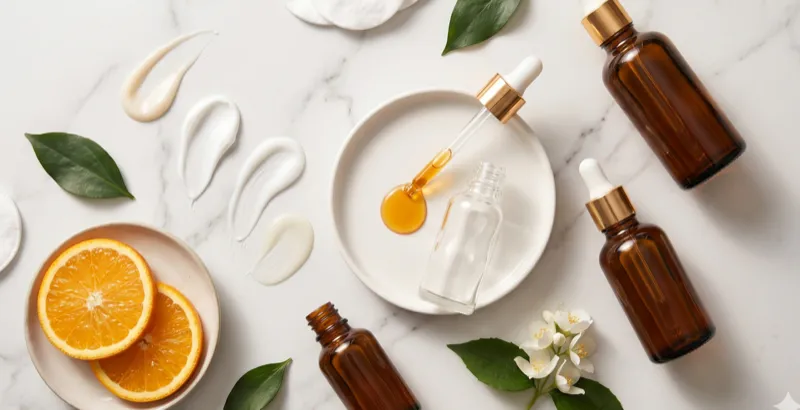
The science of skin aging is evolving rapidly — and for women navigating the skin changes that come with menopause and beyond, evidence-based skincare represents a fundamentally different approach: working with your skin's biology rather than against it.
Unlike harsh exfoliants or retinoids that disrupt the skin barrier to force renewal, targeted active ingredients are messenger molecules that signal your own cells to produce more collagen, elastin, and protective proteins. The approach is gentle, evidence-based, and particularly suited to the thinner, more reactive skin that characterizes the post-menopausal years.
Two Different Solutions for Two Different Causes of Skin Dryness
Hyaluronic acid and ceramides address skin dryness through fundamentally different mechanisms — and understanding this difference is the key to resolving persistent dryness that neither ingredient alone can fix. The common approach of choosing one or the other misses the fact that dry aging skin suffers from two simultaneous deficits: reduced dermal water content (which hyaluronic acid addresses) AND impaired barrier function (which ceramides address). Using hyaluronic acid without ceramides is like filling a leaky bucket — water goes in but drains out through the compromised barrier. Using ceramides without hyaluronic acid repairs the bucket but leaves it empty. The combination addresses both the water deficit and the water retention deficit simultaneously.[1]
Hyaluronic acid — the water attractor: HA is a glycosaminoglycan naturally present in the dermis, where each molecule binds up to 1,000 times its weight in water. Endogenous HA production declines with age — by 50, dermal HA content is approximately 50% of the level at age 20. This decline reduces dermal turgor (the plump, hydrated volume that supports smooth skin surface), making wrinkles more visible and skin texture less resilient. Topical HA works by drawing water into the skin layers: low-molecular-weight HA (10-100 kDa) penetrates to the upper dermis, providing structural hydration; high-molecular-weight HA (1,000-1,800 kDa) remains on the surface, creating a moisture-attracting film. The effect is measurable: HA application increases skin hydration by 20-40% within hours. However, this hydration is temporary — without a barrier seal, the water attracted by HA evaporates through transepidermal water loss within 4-8 hours.
Clinical research confirms that ceramides — the water seal: ceramides are the predominant lipid class in the stratum corneum, comprising approximately 50% of the intercellular lipid matrix that forms the skin's permeability barrier. This barrier prevents water from evaporating from the dermis through the skin surface. With aging, ceramide production declines — particularly after menopause, when estrogen-dependent lipid synthesis drops significantly. The result is chronically elevated transepidermal water loss (TEWL) that drains moisture from the dermis faster than the body can replenish it. Topical ceramide cream — containing ceramides NP, AP, and EOP with cholesterol and fatty acids in physiological ratios — reconstructs the barrier lipid matrix, reducing TEWL by 20-30% within 2-4 weeks. This is a longer-lasting, structural solution to dryness rather than a temporary hydration boost.
The combined protocol for dry aging skin: Step 1 — apply hyaluronic acid serum to damp skin (the moisture on the surface provides the water that HA binds and draws inward). Use a multi-molecular-weight HA for hydration at multiple skin depths. Step 2 — apply active ingredients (vitamin C serum in the morning, peptide cream morning and evening, retinol sandwich on retinol evenings). Step 3 — seal with ceramide cream as the final step. The ceramide layer locks in the HA-bound water, the active ingredients, and the skin's own moisture — preventing the evaporative loss that makes dryness chronic. This three-step architecture — hydrate (HA) → treat (actives) → seal (ceramides) — resolves the persistent dryness that neither HA nor ceramides can fix independently. The women who complain that hyaluronic acid 'doesn't work' for their dryness are almost always missing the ceramide seal. The women who find ceramide cream 'not hydrating enough' are missing the HA pre-treatment. Both ingredients are individually effective but collectively transformative.
Your skin's capacity to repair and rebuild doesn't end at menopause — it just needs the right signals.
— Dr. Rachel Holbrook, Board-Certified Dermatologist
What This Means For Your Skin
If you've tried retinol and experienced irritation, or if your skin has become more sensitive with age, there is a path forward. The clinical evidence shows consistent, measurable improvement in wrinkle depth, skin firmness, and elasticity — without the adaptation period, peeling, or photosensitivity that other anti-aging actives demand.
Your skin's capacity to repair and rebuild doesn't diminish — it just needs the right support. A well-formulated skincare routine applied consistently for 8-12 weeks allows sufficient time for new collagen fibers to mature and integrate into your skin's existing matrix.
The science is clear. The evidence is consistent. The results are measurable.
What happens next is up to you.