
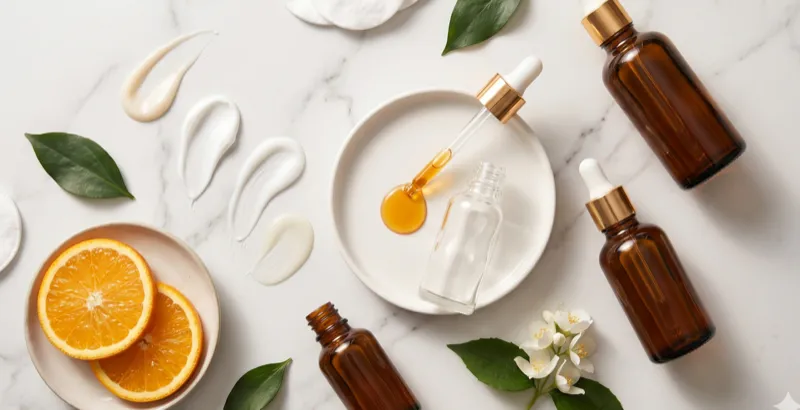
The science of skin aging is evolving rapidly — and for women navigating the skin changes that come with menopause and beyond, evidence-based skincare represents a fundamentally different approach: working with your skin's biology rather than against it.
Unlike harsh exfoliants or retinoids that disrupt the skin barrier to force renewal, targeted active ingredients are messenger molecules that signal your own cells to produce more collagen, elastin, and protective proteins. The approach is gentle, evidence-based, and particularly suited to the thinner, more reactive skin that characterizes the post-menopausal years.
The Barrier Lipid That Aging Skin Cannot Function Without
Ceramides are the single most important class of lipids in the skin, comprising approximately 50% of the intercellular lipid matrix in the stratum corneum — the outermost layer that forms the skin's primary barrier against the external environment. This barrier has two critical functions: preventing water from escaping outward (transepidermal water loss, or TEWL) and preventing irritants, allergens, and pathogens from entering inward. When ceramide levels are adequate, the barrier is intact: the skin retains moisture, resists irritation, and maintains the hydrated internal environment that dermal fibroblasts need for optimal collagen production. When ceramide levels decline — as they do progressively with age and dramatically after menopause — the barrier becomes leaky, chronic dehydration develops, inflammation increases, and the structural proteins that maintain skin firmness degrade at accelerated rates.[1]
The ceramide barrier structure: ceramides do not function as individual molecules floating freely in the skin. They self-assemble with cholesterol and fatty acids into organized lamellar bilayer sheets — stacked layers of lipid that fill the spaces between corneocytes (dead skin cells) in the stratum corneum, creating a continuous, water-resistant seal. This architecture is sometimes compared to a brick wall, where the corneocytes are bricks and the ceramide-cholesterol-fatty acid lamellae are the mortar. The barrier's effectiveness depends on the presence of all three lipid classes in the correct ratio (approximately 3:1:1 ceramides:cholesterol:fatty acids). Topical products that supply ceramides alone, without cholesterol and fatty acids, provide incomplete barrier repair because the lamellae cannot self-assemble correctly without all three components.
Clinical research confirms that why ceramide decline with age matters for anti-aging: the barrier deficit caused by ceramide decline creates a cascade of aging-accelerating effects: (1) Chronic dehydration — increased TEWL depletes dermal water content, reducing tissue turgor and making wrinkles more visible. The dehydrated dermis cannot support optimal fibroblast function, reducing the efficacy of collagen-stimulating treatments. (2) Inflammatory cascade — the compromised barrier allows environmental irritants to penetrate, triggering chronic low-grade inflammation. This inflammation activates NF-kB signaling, which upregulates MMP expression — accelerating the enzymatic degradation of collagen and elastin. (3) Increased sensitivity — the leaky barrier makes the skin reactive to products and environmental factors that were previously tolerated. This sensitivity often leads women to simplify their routine, removing active ingredients (retinol, vitamin C) that their skin needs most. (4) Reduced active ingredient efficacy — topical actives applied to barrier-compromised skin may penetrate erratically (causing irritation in some areas) or evaporate from the surface before absorption (reducing efficacy).
How to use ceramides for maximum anti-aging support: (1) Choose a properly formulated ceramide product — look for products containing ceramide NP, ceramide AP, and ceramide EOP (the three major species in human stratum corneum) along with cholesterol and fatty acids. The CeraVe, La Roche-Posay Toleriane, and Dr. Jart Ceramidin lines all contain physiological ceramide ratios. (2) Apply as the final step in your skincare routine — the ceramide cream serves as the occlusive seal that locks in all previously applied actives (vitamin C, HA, peptides, retinol) and prevents their evaporation from the skin surface. (3) Use morning and evening — the barrier requires continuous support, not intermittent repair. (4) Apply to damp skin when possible — ceramides self-assemble into lamellar structures more efficiently in the presence of water. (5) Use as the bread in the retinol sandwich — ceramide cream before and after retinol provides barrier protection during retinoid delivery, reducing irritation while maintaining efficacy. The practical message: ceramide cream is not a luxury moisturizer — it is a functional barrier repair treatment that determines the efficacy of every other product in your routine. Without adequate ceramides, no amount of retinol, peptides, or vitamin C can achieve their full potential.
Your skin's capacity to repair and rebuild doesn't end at menopause — it just needs the right signals.
— Dr. Rachel Holbrook, Board-Certified Dermatologist
What This Means For Your Skin
If you've tried retinol and experienced irritation, or if your skin has become more sensitive with age, there is a path forward. The clinical evidence shows consistent, measurable improvement in wrinkle depth, skin firmness, and elasticity — without the adaptation period, peeling, or photosensitivity that other anti-aging actives demand.
Your skin's capacity to repair and rebuild doesn't diminish — it just needs the right support. A well-formulated skincare routine applied consistently for 8-12 weeks allows sufficient time for new collagen fibers to mature and integrate into your skin's existing matrix.
The science is clear. The evidence is consistent. The results are measurable.
What happens next is up to you.