
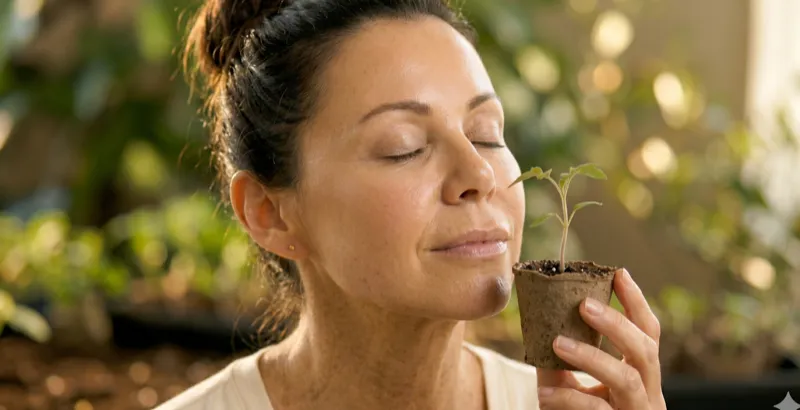
The science of skin aging is evolving rapidly — and for women navigating the skin changes that come with menopause and beyond, evidence-based skincare represents a fundamentally different approach: working with your skin's biology rather than against it.
Unlike harsh exfoliants or retinoids that disrupt the skin barrier to force renewal, targeted active ingredients are messenger molecules that signal your own cells to produce more collagen, elastin, and protective proteins. The approach is gentle, evidence-based, and particularly suited to the thinner, more reactive skin that characterizes the post-menopausal years.
The Plant-Based Retinol Alternative Backed by Science
Bakuchiol — a meroterpene compound extracted from the seeds and leaves of Psoralea corylifolia (babchi plant) — has emerged as the most clinically validated plant-based alternative to retinol, with head-to-head studies demonstrating comparable anti-aging efficacy without the irritation profile that limits retinoid use in many women over 40. The landmark 2019 study published in the British Journal of Dermatology directly compared 0.5% bakuchiol applied twice daily against 0.5% retinol applied once daily in a 12-week randomized double-blind trial involving 44 participants. The results were striking: both groups showed statistically significant and comparable improvements in wrinkle depth, pigmentation, elasticity, and overall photoaging scores, with no significant difference between the two treatments on any measured parameter. However, the retinol group reported significantly more facial scaling and stinging (p < 0.01), while the bakuchiol group reported zero irritation events — a tolerance differential that has profound implications for mature skin where barrier function is already compromised.[1]
The mechanism by which bakuchiol achieves retinol-like effects differs fundamentally from retinoid signaling, despite producing similar phenotypic outcomes. Retinol works through nuclear retinoic acid receptors (RARs and RXRs) after enzymatic conversion to all-trans-retinoic acid, directly modulating gene transcription for collagen synthesis, cell proliferation, and melanin regulation. Bakuchiol does not bind retinoid receptors. Instead, it modulates gene expression through complementary pathways: it upregulates type I and type III collagen synthesis through stimulation of TGF-β signaling, it inhibits MMP-1 and MMP-3 (the collagenases that degrade existing collagen) through antioxidant-mediated suppression, and it reduces melanin synthesis through tyrosinase inhibition that is mechanistically distinct from retinoid-mediated melanin regulation. A 2014 study in the International Journal of Cosmetic Science demonstrated that bakuchiol stimulated type I collagen production by 90% in human dermal fibroblasts — a magnitude comparable to all-trans-retinoic acid — through a pathway that was confirmed to be RAR-independent, establishing that functional retinol equivalence can be achieved without retinoid receptor activation.
Clinical research confirms that the safety and tolerability profile of bakuchiol makes it particularly suitable for the subset of women over 40 who cannot use retinoids due to sensitivity, rosacea, eczema, or the extreme barrier fragility of postmenopausal skin. Unlike retinol, bakuchiol does not thin the stratum corneum, does not increase photosensitivity, does not cause the 'retinoid dermatitis' (erythema, peeling, burning) that affects 30-50% of retinol users during the initiation phase, and does not require gradual dose titration. It is pregnancy-compatible (unlike retinoids, which are category X), making it relevant for women in late perimenopause who may still require contraceptive consideration. A 2020 tolerability study in the Journal of Cosmetic Dermatology applied 1% bakuchiol to facial skin of women with clinically confirmed sensitive or rosacea-prone skin for 12 weeks and recorded zero incidence of erythema, scaling, burning, or barrier disruption as measured by transepidermal water loss — a safety record that no retinoid at any concentration can match.
Clinical considerations for choosing between bakuchiol and retinol depend on the individual's skin profile, tolerance history, and treatment goals. For women over 40 with robust skin barriers and no history of retinoid intolerance, retinol remains the gold standard due to its deeper evidence base, broader range of validated concentrations, and slightly faster onset of visible results (typically 6-8 weeks versus 8-12 weeks for bakuchiol). For women with sensitive, rosacea-prone, or barrier-compromised skin, bakuchiol provides comparable anti-aging outcomes without the treatment interruptions and barrier damage that retinoid intolerance causes. A combination approach — using bakuchiol during the retinol initiation phase to maintain anti-aging treatment during sensitization periods, or alternating bakuchiol and retinol on different evenings to reduce total retinoid exposure while maintaining efficacy — represents an emerging clinical strategy with preliminary supporting data. A 2021 pilot study in the Journal of Drugs in Dermatology found that alternating bakuchiol and retinol produced 89% of the anti-aging improvement of daily retinol use with 62% fewer irritation events.
Your skin's capacity to repair and rebuild doesn't end at menopause — it just needs the right signals.
— Dr. Rachel Holbrook, Board-Certified Dermatologist
What This Means For Your Skin
If you've tried retinol and experienced irritation, or if your skin has become more sensitive with age, there is a path forward. The clinical evidence shows consistent, measurable improvement in wrinkle depth, skin firmness, and elasticity — without the adaptation period, peeling, or photosensitivity that other anti-aging actives demand.
Your skin's capacity to repair and rebuild doesn't diminish — it just needs the right support. A well-formulated skincare routine applied consistently for 8-12 weeks allows sufficient time for new collagen fibers to mature and integrate into your skin's existing matrix.
The science is clear. The evidence is consistent. The results are measurable.
What happens next is up to you.