
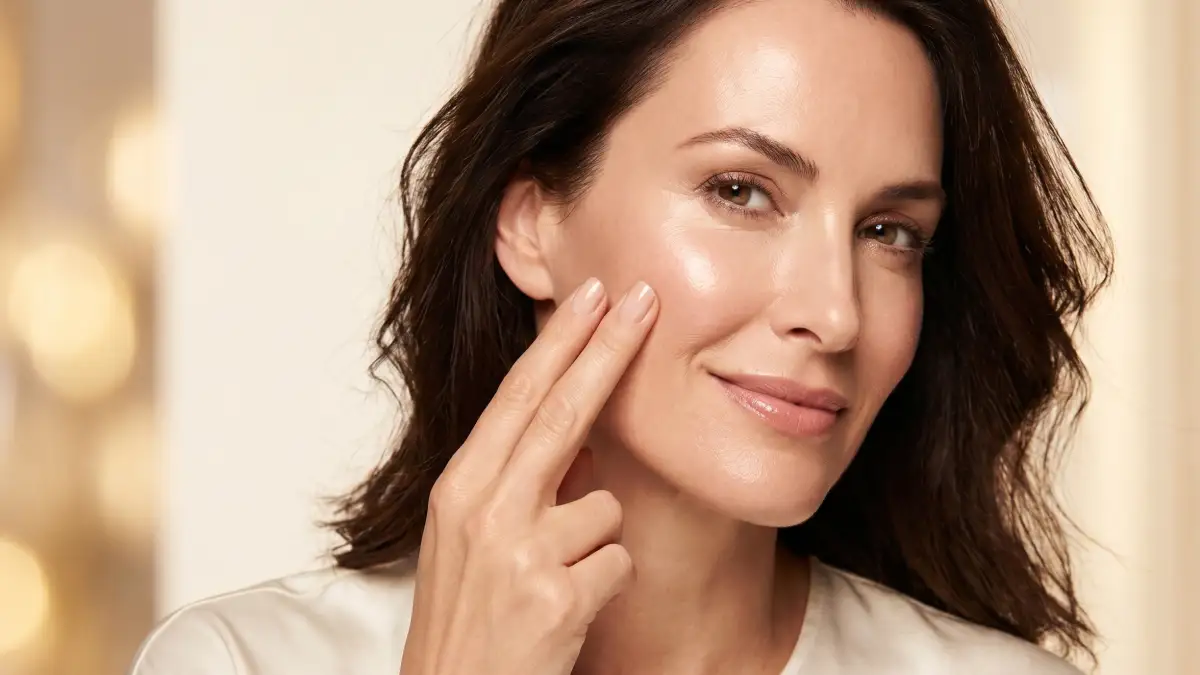
The science of skin aging is evolving rapidly — and for women navigating the skin changes that come with menopause and beyond, evidence-based skincare represents a fundamentally different approach: working with your skin's biology rather than against it.
Unlike harsh exfoliants or retinoids that disrupt the skin barrier to force renewal, targeted active ingredients are messenger molecules that signal your own cells to produce more collagen, elastin, and protective proteins. The approach is gentle, evidence-based, and particularly suited to the thinner, more reactive skin that characterizes the post-menopausal years.
The Science Behind Proactive Collagen Preservation
Collagen banking refers to the proactive strategy of maximizing dermal collagen synthesis and minimizing degradation before the accelerated decline that begins in the fourth decade of life. Unlike reactive anti-aging approaches that attempt to rebuild lost collagen, banking focuses on creating a biological surplus — a measurably higher baseline of collagen density that delays the visible onset of aging by years.[1]
The concept draws from longitudinal research demonstrating that collagen loss is not linear but follows an exponential curve, with women losing approximately 1-1.5% of dermal collagen per year after age 30, accelerating to 2-3% annually during the perimenopausal transition. This means the collagen you preserve in your 30s and 40s has disproportionate value compared to collagen regenerated later.
Clinical research confirms that histological studies confirm that skin with higher baseline collagen density maintains structural integrity significantly longer under identical aging pressures. The dermal matrix functions as a load-bearing network — when collagen fibril density drops below a critical threshold, the remaining fibers experience increased mechanical stress, accelerating further degradation in a self-reinforcing cycle.
Effective collagen banking requires a multi-pathway approach targeting both synthesis stimulation and degradation prevention. Retinoids activate procollagen gene expression, ascorbic acid stabilizes the collagen triple helix during post-translational modification, and matrix metalloproteinase inhibitors reduce enzymatic breakdown. Clinical protocols combining these mechanisms have demonstrated up to 80% recovery of procollagen synthesis in chronologically aged skin.
Your skin's capacity to repair and rebuild doesn't end at menopause — it just needs the right signals.
— Dr. Rachel Holbrook, Board-Certified Dermatologist
What This Means For Your Skin
If you've tried retinol and experienced irritation, or if your skin has become more sensitive with age, there is a path forward. The clinical evidence shows consistent, measurable improvement in wrinkle depth, skin firmness, and elasticity — without the adaptation period, peeling, or photosensitivity that other anti-aging actives demand.
Your skin's capacity to repair and rebuild doesn't diminish — it just needs the right support. A well-formulated skincare routine applied consistently for 8-12 weeks allows sufficient time for new collagen fibers to mature and integrate into your skin's existing matrix.
The science is clear. The evidence is consistent. The results are measurable.
What happens next is up to you.