
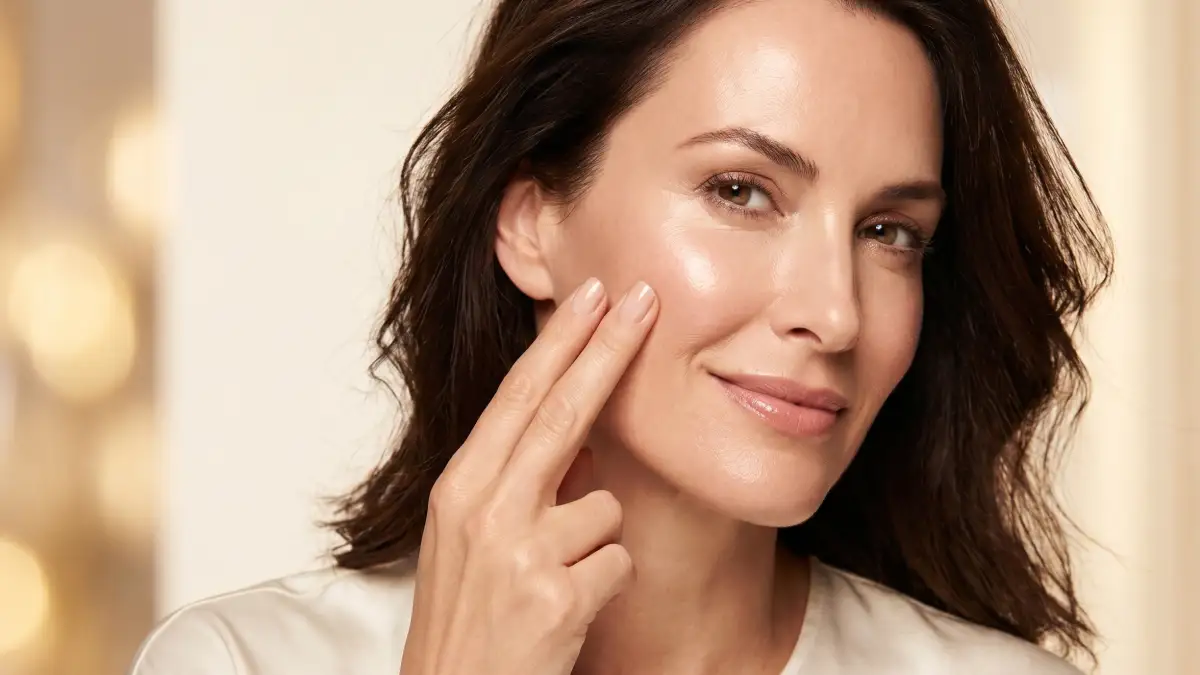
The science of skin aging is evolving rapidly — and for women navigating the skin changes that come with menopause and beyond, evidence-based skincare represents a fundamentally different approach: working with your skin's biology rather than against it.
Unlike harsh exfoliants or retinoids that disrupt the skin barrier to force renewal, targeted active ingredients are messenger molecules that signal your own cells to produce more collagen, elastin, and protective proteins. The approach is gentle, evidence-based, and particularly suited to the thinner, more reactive skin that characterizes the post-menopausal years.
Why Your 40s Are the Most Critical Decade for Collagen
The decade between 40 and 50 represents a uniquely critical window for collagen banking because it precedes the dramatic hormonal shift of menopause while collagen-producing fibroblasts still retain significant synthetic capacity. Research by Brincat and colleagues demonstrated that women lose up to 30% of their total skin collagen within the first five years after menopause — making the pre-menopausal years the last opportunity to build reserves at maximum efficiency.[1]
At 40, dermal fibroblasts have already experienced measurable functional decline but remain highly responsive to topical stimulation. Studies show that retinoid-treated skin in this age group can achieve procollagen synthesis rates approaching those of skin 15-20 years younger, a responsiveness that diminishes progressively with each subsequent decade.
Clinical research confirms that the critical insight for women over 40 is that collagen banking at this stage yields the highest return on investment of any age group. Fibroblasts retain enough mitochondrial function to respond robustly to growth factor signaling, while the approaching menopausal decline creates genuine urgency. Women who begin aggressive collagen stimulation protocols at 40 enter menopause with measurably higher dermal collagen density than age-matched controls.
Clinical protocols for the 40-plus demographic should emphasize both synthesis acceleration and degradation prevention. Prescription-strength retinoids remain the gold standard for procollagen gene activation, while antioxidant combinations protect existing collagen from matrix metalloproteinase-mediated fragmentation. Fisher's research demonstrated that collagen fragments themselves promote oxidative stress, creating a vicious cycle that proactive banking interrupts.
Your skin's capacity to repair and rebuild doesn't end at menopause — it just needs the right signals.
— Dr. Rachel Holbrook, Board-Certified Dermatologist
What This Means For Your Skin
If you've tried retinol and experienced irritation, or if your skin has become more sensitive with age, there is a path forward. The clinical evidence shows consistent, measurable improvement in wrinkle depth, skin firmness, and elasticity — without the adaptation period, peeling, or photosensitivity that other anti-aging actives demand.
Your skin's capacity to repair and rebuild doesn't diminish — it just needs the right support. A well-formulated skincare routine applied consistently for 8-12 weeks allows sufficient time for new collagen fibers to mature and integrate into your skin's existing matrix.
The science is clear. The evidence is consistent. The results are measurable.
What happens next is up to you.