
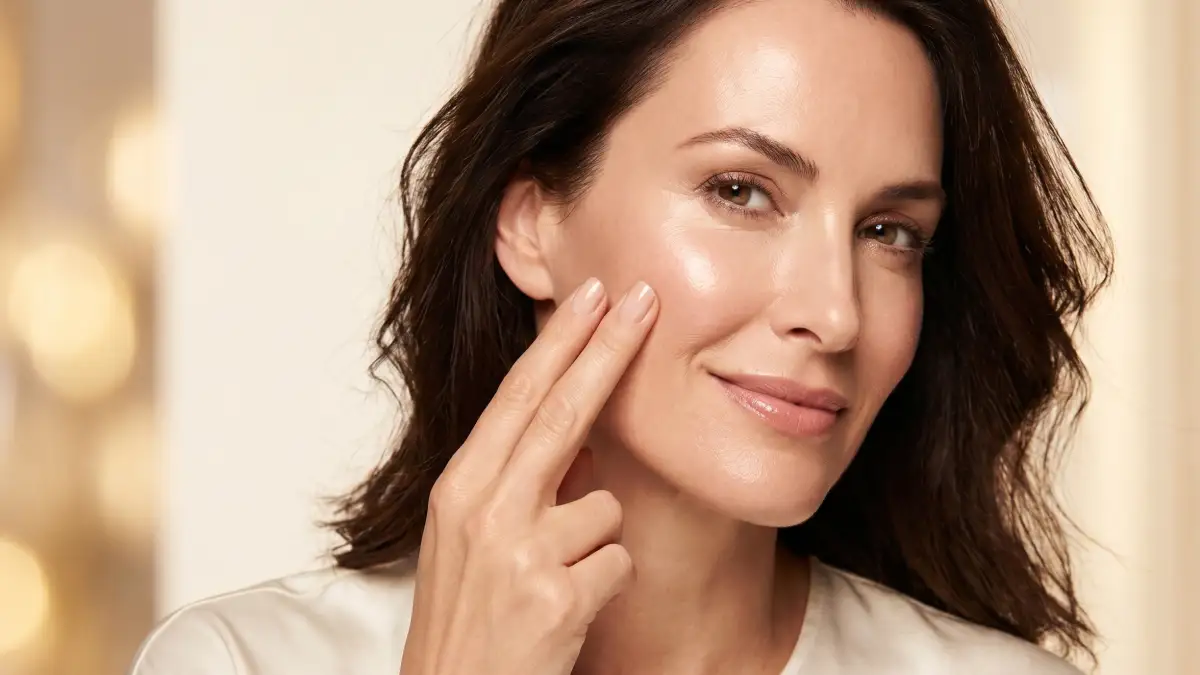
The science of skin aging is evolving rapidly — and for women navigating the skin changes that come with menopause and beyond, evidence-based skincare represents a fundamentally different approach: working with your skin's biology rather than against it.
Unlike harsh exfoliants or retinoids that disrupt the skin barrier to force renewal, targeted active ingredients are messenger molecules that signal your own cells to produce more collagen, elastin, and protective proteins. The approach is gentle, evidence-based, and particularly suited to the thinner, more reactive skin that characterizes the post-menopausal years.
Building Maximum Reserves Before Hormonal Decline
Pre-menopausal collagen banking is the most strategically valuable phase of any long-term anti-aging protocol. Estrogen plays a direct role in maintaining collagen homeostasis by upregulating procollagen gene expression and suppressing collagenase activity. As estrogen levels begin their perimenopausal decline — often starting 4-8 years before the final menstrual period — the window for efficient collagen deposition narrows progressively.[1]
Brincat's landmark research established that skin collagen content correlates more strongly with years since menopause than with chronological age, confirming that hormonal status is the primary driver of dermal collagen loss in women. Women who maintain robust collagen synthesis throughout their 40s effectively create a buffer — entering menopause from a position of biological surplus rather than deficit.
Clinical research confirms that the pre-menopausal strategy should incorporate both topical and systemic approaches. Topical retinoids stimulate fibroblast procollagen production through retinoic acid receptor activation, while vitamin C provides the essential cofactor for prolyl hydroxylase, the enzyme responsible for collagen cross-linking and structural stability. Shuster's research demonstrated that skin collagen density varies significantly between individuals of the same age, suggesting that interventional factors can meaningfully alter the trajectory.
Timing matters because fibroblast responsiveness to stimulatory signals decreases with cellular senescence. Pre-menopausal fibroblasts express higher levels of TGF-beta receptors — the primary signaling pathway for collagen synthesis — than post-menopausal cells. Quan's research showed that UV exposure further reduces TGF-beta receptor expression, making photoprotection an essential component of any pre-menopausal banking strategy.
Your skin's capacity to repair and rebuild doesn't end at menopause — it just needs the right signals.
— Dr. Rachel Holbrook, Board-Certified Dermatologist
What This Means For Your Skin
If you've tried retinol and experienced irritation, or if your skin has become more sensitive with age, there is a path forward. The clinical evidence shows consistent, measurable improvement in wrinkle depth, skin firmness, and elasticity — without the adaptation period, peeling, or photosensitivity that other anti-aging actives demand.
Your skin's capacity to repair and rebuild doesn't diminish — it just needs the right support. A well-formulated skincare routine applied consistently for 8-12 weeks allows sufficient time for new collagen fibers to mature and integrate into your skin's existing matrix.
The science is clear. The evidence is consistent. The results are measurable.
What happens next is up to you.