
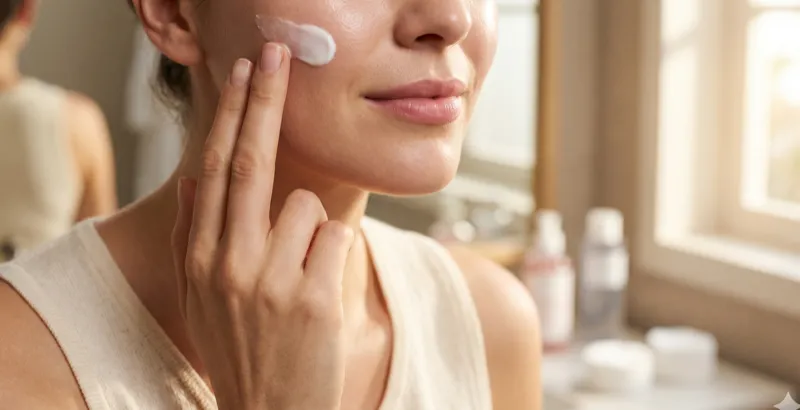
The science of skin aging is evolving rapidly — and for women navigating the skin changes that come with menopause and beyond, evidence-based skincare represents a fundamentally different approach: working with your skin's biology rather than against it.
Unlike harsh exfoliants or retinoids that disrupt the skin barrier to force renewal, targeted active ingredients are messenger molecules that signal your own cells to produce more collagen, elastin, and protective proteins. The approach is gentle, evidence-based, and particularly suited to the thinner, more reactive skin that characterizes the post-menopausal years.
Maximizing the Nocturnal Growth Hormone Window for Structural Rebuilding
The evening skincare routine is the most therapeutically important part of a collagen-building protocol because it aligns active ingredient delivery with the body's natural repair cycle. During sleep, several biological conditions converge to create the optimal environment for collagen synthesis: (1) Growth hormone release — the pituitary gland releases its largest growth hormone pulse 60-90 minutes after sleep onset. Growth hormone directly stimulates fibroblast proliferation and collagen production. (2) Cortisol nadir — cortisol (which suppresses collagen synthesis and promotes MMP activity) reaches its lowest point during sleep, removing the hormonal brake on structural repair. (3) Increased dermal blood flow — peripheral vasodilation during sleep increases nutrient and oxygen delivery to dermal fibroblasts. (4) Zero UV exposure — no UV-generated free radicals or MMP activation during the 6-8 hours of sleep, allowing uninterrupted collagen accumulation. Applying collagen-stimulating actives in the evening synchronizes their peak activity with this biological repair window.[1]
The retinol evening routine (3-4 nights per week): Step 1 — Gentle cleanser. Remove sunscreen, makeup, and daytime product residue. Non-foaming, cream-based cleansers are ideal for mature skin — they cleanse without stripping barrier lipids. Step 2 — Hyaluronic acid serum on damp skin. Mist face with water, then apply 5-6 drops of multi-molecular-weight HA. The hydration layer ensures that fibroblasts operate in an optimally hydrated environment during the nocturnal repair window. HA also creates a moisture reservoir that buffers against the mild barrier perturbation that retinol can cause. Step 3 — Wait until skin feels dry to touch (5-10 minutes). Retinol applied to damp skin penetrates too rapidly, increasing irritation without increasing efficacy. Step 4 — Ceramide cream, thin layer (sandwich layer 1). Creates a lipid buffer that slows retinol delivery rate. Step 5 — Retinol (pea-size amount, spread evenly across face). The retinol activates the RAR/RXR pathway during the hours of peak fibroblast responsiveness, maximizing per-application collagen stimulation. Step 6 — Ceramide cream, generous layer (sandwich layer 2). Seals the retinol, provides occlusion for overnight hydration retention, and delivers ceramide barrier support.
Clinical research confirms that the peptide evening routine (3-4 nights per week, alternating with retinol): Step 1 — Gentle cleanser. Step 2 — Hyaluronic acid serum on damp skin. Step 3 — Peptide cream (Matrixyl 3000). The evening peptide application provides the second daily dose of TGF-beta stimulation (complementing the morning dose), maintaining near-continuous growth factor signaling to fibroblasts throughout the 24-hour cycle. On non-retinol nights, the peptide cream is the primary active — still effective because the TGF-beta pathway operates independently and does not require the retinoid pathway to be simultaneously active. Step 4 — Ceramide cream seal.
Advanced evening strategies for maximum collagen repair: (1) Weekly overnight intensive (1 night per week) — after the full evening routine, apply a thick layer of squalane oil or healing ointment (CeraVe Healing Ointment, Aquaphor) over the ceramide cream. This creates a total occlusion environment that: prevents all transepidermal water loss, maximizes dermal hydration during the repair window, extends active ingredient contact time, and creates the hydrated, protected environment that optimizes fibroblast collagen output. (2) Sleeping position — back sleeping prevents mechanical compression that can counteract collagen rebuilding on the chest and create sleep wrinkles on the face. A silk pillowcase reduces friction-induced barrier disruption on the facial skin. (3) Pre-sleep protein — consuming 15-20g of protein (casein from cottage cheese or a protein shake) 30-60 minutes before sleep provides amino acid substrates (glycine, proline, lysine) for collagen synthesis during the nocturnal growth hormone window. (4) Consistent sleep schedule — growth hormone release follows circadian rhythm. Irregular sleep times disrupt the GH pulse pattern, reducing the repair window's collagen-building capacity. The evening routine is not just about applying products — it is about creating the total nocturnal environment (ingredients + hydration + occlusion + nutrition + sleep quality) that maximizes the biological repair window for structural rebuilding.
Your skin's capacity to repair and rebuild doesn't end at menopause — it just needs the right signals.
— Dr. Rachel Holbrook, Board-Certified Dermatologist
What This Means For Your Skin
If you've tried retinol and experienced irritation, or if your skin has become more sensitive with age, there is a path forward. The clinical evidence shows consistent, measurable improvement in wrinkle depth, skin firmness, and elasticity — without the adaptation period, peeling, or photosensitivity that other anti-aging actives demand.
Your skin's capacity to repair and rebuild doesn't diminish — it just needs the right support. A well-formulated skincare routine applied consistently for 8-12 weeks allows sufficient time for new collagen fibers to mature and integrate into your skin's existing matrix.
The science is clear. The evidence is consistent. The results are measurable.
What happens next is up to you.