
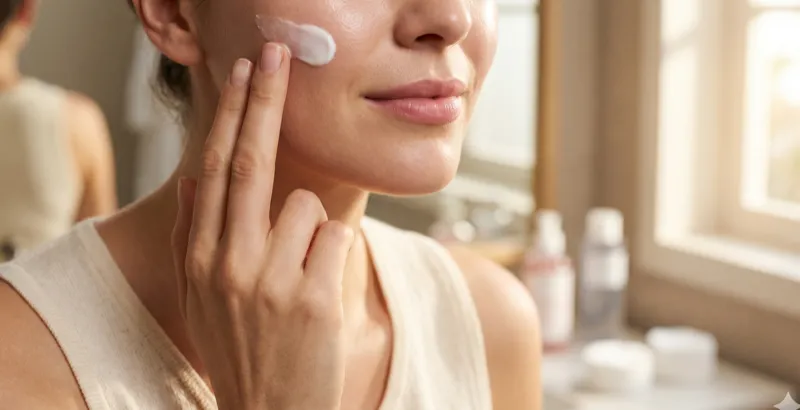
The science of skin aging is evolving rapidly — and for women navigating the skin changes that come with menopause and beyond, evidence-based skincare represents a fundamentally different approach: working with your skin's biology rather than against it.
Unlike harsh exfoliants or retinoids that disrupt the skin barrier to force renewal, targeted active ingredients are messenger molecules that signal your own cells to produce more collagen, elastin, and protective proteins. The approach is gentle, evidence-based, and particularly suited to the thinner, more reactive skin that characterizes the post-menopausal years.
Buffered Delivery That Maintains Collagen Stimulation While Minimizing Irritation
The retinol sandwich method is the most important application technique for sustained collagen building because it solves the fundamental tension in retinoid therapy: the concentration that maximizes collagen stimulation is often the same concentration that causes irritation, and irritation forces treatment interruption that halts collagen accumulation. The sandwich method resolves this tension by changing the delivery rate without changing the total dose. The ceramide layers before and after retinol slow the absorption rate, converting a sharp spike of retinol at the stratum corneum into a gentler, sustained release. The total amount of retinol reaching the dermal fibroblasts is the same — the same retinoid receptor activation occurs, the same collagen gene upregulation happens, and the same MMP suppression is achieved. What changes is the irritation: the buffered delivery reduces peak concentration at the barrier, cutting irritation by an estimated 40-60% while maintaining full therapeutic efficacy.[1]
Step-by-step technique for maximum collagen benefit: Step 1 — Cleanse and wait. Use a gentle cleanser, then wait 10-20 minutes until skin is completely dry. Residual moisture on the skin surface accelerates retinol absorption through the compromised areas of the barrier, creating uneven delivery that produces localized irritation without increasing overall efficacy. Dry application is safer and equally effective. Step 2 — Ceramide cream, thin layer (the bottom bread). Apply a thin, even layer of ceramide-rich moisturizer to the entire treatment area (face, neck, and optionally chest). This layer serves three functions: (a) creates a lipid barrier that modulates retinol penetration rate, (b) provides ceramides that actively repair the barrier during the hours of retinol exposure, and (c) delivers cholesterol and fatty acids that support the lamellar structure weakened by retinoid activity. Wait 5 minutes for the ceramide layer to establish.
Clinical research confirms that step 3 — Retinol application (the filling). Apply a pea-size amount of retinol (0.25-0.5%) to the fingertips and spread in a thin, even layer over the ceramide layer. The retinol encounters the ceramide barrier and is absorbed gradually — some retinol partitions into the ceramide emulsion and releases slowly over hours, some penetrates directly but at a reduced rate. The net effect is sustained-release retinol delivery that maintains retinoid receptor activation throughout the night without the sharp initial spike that causes burning, redness, and peeling. Wait 5 minutes for partial absorption. Step 4 — Ceramide cream, generous layer (the top bread). Apply a second, slightly thicker layer of ceramide cream over the retinol. This layer (a) dilutes any retinol still sitting on the surface, reducing residual peak concentration, (b) provides additional occlusion that enhances overnight hydration retention, and (c) delivers a second dose of barrier-supportive lipids to counteract any barrier perturbation during the night.
Why the sandwich method is specifically important for collagen building: Collagen building is a long-term process that requires months to years of consistent retinol application. The most common reason women fail to build collagen with retinol is not that retinol doesn't work — it is that they cannot maintain consistent application. Irritation leads to breaks, breaks lead to readaptation, readaptation leads to frustration, and frustration leads to abandonment. The sandwich method breaks this cycle by making retinol consistently tolerable, enabling the uninterrupted months of application that collagen rebuilding requires. Consider the math: a woman who uses retinol 3 nights per week for 12 months (approximately 156 applications) using the sandwich method will build substantially more collagen than a woman who applies retinol directly for 3 months (39 applications), takes a month off due to irritation, restarts, takes another break, and manages perhaps 80 total applications in the same year. Consistency, enabled by the sandwich method, is the primary determinant of collagen building outcomes. The sandwich method is not a compromise — it is an optimization that prioritizes the variable that matters most: sustained, comfortable, long-term adherence.
Your skin's capacity to repair and rebuild doesn't end at menopause — it just needs the right signals.
— Dr. Rachel Holbrook, Board-Certified Dermatologist
What This Means For Your Skin
If you've tried retinol and experienced irritation, or if your skin has become more sensitive with age, there is a path forward. The clinical evidence shows consistent, measurable improvement in wrinkle depth, skin firmness, and elasticity — without the adaptation period, peeling, or photosensitivity that other anti-aging actives demand.
Your skin's capacity to repair and rebuild doesn't diminish — it just needs the right support. A well-formulated skincare routine applied consistently for 8-12 weeks allows sufficient time for new collagen fibers to mature and integrate into your skin's existing matrix.
The science is clear. The evidence is consistent. The results are measurable.
What happens next is up to you.